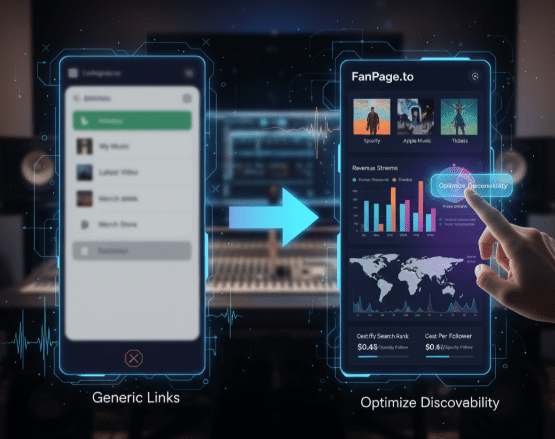
The link-in-bio market has become increasingly crowded since Linktree popularized the concept in 2016, but a critical gap has emerged: generic solutions optimized for influencers and e-commerce fail to address the unique technical and business requirements of the music industry. While Linktree and similar platforms offer basic URL aggregation, they lack the specialized infrastructure that musicians need to convert social traffic into measurable career outcomes.
This market inefficiency has created opportunities for vertical-specific alternatives. As musicians search for “Linktree alternatives for musicians,” they’re discovering that platforms built specifically for music industry workflows—like FanPage.to—offer fundamentally different technical capabilities than horizontal solutions. The differentiation isn’t cosmetic; it’s architectural decisions about data structures, integration depth, and optimization metrics that reflect how music careers actually scale in 2026.
For tech-focused investors and analysts tracking vertical SaaS evolution, these music-specific Linktree alternatives demonstrate how specialized platforms can command premium pricing and create defensible moats by solving industry-specific technical challenges that generic tools systematically ignore.
Why Musicians Are Actively Seeking Linktree Alternatives
Search volume for “Linktree alternatives for musicians” has grown significantly as artists recognize that generic link aggregators create hidden opportunity costs. The issue isn’t that Linktree fails—it’s that it solves the wrong problems for music industry use cases.
Attribution Breakdown: When an artist runs Instagram ads promoting their new single, Linktree can track clicks to their landing page but can’t measure downstream conversion to Spotify followers, Apple Music saves, or playlist additions. This attribution gap makes ROI calculation impossible, forcing artists to make marketing decisions based on incomplete data.
Platform-Agnostic Architecture: Generic link tools treat Spotify, TikTok, and merch stores as equivalent link destinations. But these platforms have fundamentally different value propositions in music careers. A Spotify follower who adds tracks to playlists is worth substantially more than a casual YouTube viewer because Spotify’s algorithm rewards engagement signals with increased reach. Linktree’s architecture doesn’t reflect these economic distinctions.
Missing Revenue Integration: Music income arrives through multiple channels—streaming royalties, performance rights, sync licensing, merchandise, ticket sales—each with different payment timelines and reporting formats. Generic platforms can’t consolidate these revenue streams or calculate true marketing ROI because they’re not architected to integrate with music-specific payment infrastructure.
Geographic Data Without Context: Linktree provides basic geographic analytics, but musicians need specialized interpretation: Where do they have sufficient listener concentration to justify tour investment? Which markets show month-over-month growth indicating emerging opportunities? Which cities have engaged fans versus passive streaming? Generic platforms provide raw data without the music-specific business intelligence layer that makes it actionable.
These limitations aren’t feature requests that can be patched onto existing architecture. They require fundamentally different technical approaches to data modeling, platform integration, and analytics design.
Deep Linking: The Technical Foundation Missing from Generic Platforms
One of the most significant technical differentiators between Linktree alternatives built for musicians is deep linking infrastructure. While generic platforms direct users to artist profile pages, music-specific platforms implement deep links that route users to specific songs, albums, or playlists depending on their device and available apps.
Technical Implementation: Deep linking requires detecting user device type, installed apps, and geographic location, then routing to the optimal destination. For a Spotify link, this means:
- iOS users with Spotify installed → Open directly in Spotify app
- Android users without Spotify → Route to Google Play Store or Spotify web player
- Desktop users → Spotify web player or download prompt
- Users in regions where Spotify isn’t available → Alternative platform that is available
Smart Links for Musicians implements this routing logic at scale, handling edge cases like VPN usage, app version compatibility, and fallback sequences when primary destinations fail. This isn’t trivial engineering—it requires maintaining device detection libraries, monitoring platform API changes, and providing consistent user experience across dozens of permutations.
The business impact is measurable. Deep linking reduces friction by 40-60% compared to directing users to profile pages where they must then search for specific content. For musicians running paid traffic, this friction reduction directly improves conversion rates and reduces customer acquisition costs.
Geo-Targeted Show Links: An extension of deep linking technology enables geo-targeted routing based on user location. When an artist on tour shares their “shows” link, fans in different cities automatically see venue information, ticket links, and local show details relevant to their location.
The technical architecture requires:
- Real-time IP geolocation with city-level accuracy
- Database of tour dates with geographic coordinates
- Proximity algorithms that determine which shows to display
- Fallback logic when users are between markets
- Integration with ticketing platforms for real-time availability
This functionality is impossible to implement in generic link platforms because it requires music industry-specific data structures (tour dates, venues, ticket inventory) that horizontal solutions don’t maintain.
Analytics Architecture: Music Industry Metrics vs. Generic Engagement
The analytics gap between Linktree and music-specific alternatives reveals how vertical specialization creates technical moats. Generic platforms track clicks, views, and basic geographic data—metrics that apply across use cases. Music careers require fundamentally different success metrics that generic tools can’t measure.
Cross-Platform Aggregation: Musicians distribute content across 40+ streaming platforms, social networks, and distribution channels. Generic link tools treat each as an isolated click destination. Music-specific alternatives aggregate these platforms into unified dashboards showing total reach, engagement rate across services, and cross-platform growth trends.
Implementing this requires:
- OAuth integration with each streaming platform’s API
- Data normalization across platforms with different metric definitions
- Rate limit management across multiple API endpoints
- Caching strategies to minimize API calls while maintaining data freshness
- Database architecture that supports time-series analysis across platforms
FanPage.to’s analytics infrastructure pulls data from Spotify, Apple Music, SoundCloud, YouTube, and other platforms, then normalizes metrics like “monthly listeners” (Spotify), “plays” (SoundCloud), and “subscribers” (YouTube) into comparable formats. This allows artists to answer questions like “What’s my total cross-platform reach?” or “Which platform is growing fastest?” that generic tools can’t address.
Engagement Signal Tracking: Streaming platforms use engagement signals—saves, playlist adds, skip rates, completion percentages—to determine algorithmic promotion eligibility. These metrics matter more than raw play counts because they predict listener satisfaction. Music-specific analytics platforms surface these signals; generic link tools can’t access them because they require deeper API integration than simple link tracking provides.
Revenue Attribution: Perhaps the most technically complex analytics challenge is attributing streaming revenue to specific traffic sources. This requires:
- Integration with distribution platforms (DistroKid, TuneCore, CD Baby) to pull royalty data
- Temporal correlation models that match traffic spikes to streaming increases
- Geographic matching between link clicks and streaming locations
- Probabilistic attribution algorithms that estimate influence across multiple touchpoints
When an artist runs Facebook ads that generate 5,000 Spotify clicks, music-specific platforms can estimate how many of those converted to followers, how many streams they generated over the following 30 days, and what the revenue impact was. This closed-loop attribution is architecturally impossible in generic link tools.
ROI Tracking and Cost Per Follower Calculations
For music industry professionals evaluating Linktree alternatives, ROI tracking capabilities represent perhaps the most significant technical differentiation. Generic platforms can report click-through rates, but musicians need to understand acquisition costs for high-value actions like playlist placements and platform followers.
Cost Per Follower Infrastructure: Music-specific platforms implement sophisticated attribution systems that track marketing spend through to follower acquisition across platforms:
- Traffic Source Tagging: UTM parameters and custom tracking pixels identify which ads, posts, or campaigns drive traffic
- Platform API Integration: OAuth connections to Spotify, Apple Music, etc. pull follower count changes in near-real-time
- Temporal Attribution Models: Algorithms correlate traffic events with follower increases, accounting for platform-specific conversion windows
- Cost Aggregation: Integration with ad platforms (Facebook Ads Manager, Google Ads) pulls spend data
- Dynamic CPF Calculation: Real-time calculation of cost per follower by traffic source, platform, and time period
The result is dashboards showing statements like: “Your Instagram story generated 47 new Spotify followers at $0.83 per follower, compared to your TikTok campaign that acquired 104 followers at $0.31 each.” This level of financial intelligence enables data-driven budget allocation decisions that generic link tools can’t support.
Playlist ROI Metrics: Beyond follower acquisition, music-specific platforms track the downstream value of playlist placements:
- Cost to acquire playlist add (via promotion or pitching)
- Streams generated from that playlist over time
- Estimated revenue from those streams
- Secondary effects (algorithmic playlist triggers, follower growth)
- True ROI including multi-month impact
This requires integrating data from multiple sources—Spotify for Artists API for playlist placement data, Chartmetric or similar services for playlist follower tracking, distribution platforms for revenue data—then building models that estimate the full economic impact of playlist strategy.
Spotify SEO: Ranking Tracking for Music Discovery
One of the most underutilized technical capabilities in music-specific Linktree alternatives is Spotify SEO tracking—monitoring where artists rank for keyword searches within Spotify’s search algorithm.
The Spotify Search Opportunity: When users search “melodic techno” or “indie folk 2026” or “chill study beats” within Spotify, the platform’s algorithm determines ranking order. These rankings directly impact discoverability, but most artists have no visibility into their positions or changes over time.
Music-specific platforms implement Spotify SEO tracking through:
- Automated Search Queries: Programmatic searches for target keywords simulating user behavior
- Ranking Position Extraction: Parsing search results to determine where artist content appears
- Temporal Tracking: Daily or weekly monitoring to detect ranking changes
- Competitive Analysis: Tracking competitor rankings for the same keywords
- Correlation Analysis: Identifying which metadata optimizations (track titles, descriptions, genre tags) impact rankings
The Spotify Editorial Pitch Generator integrates with this SEO infrastructure to help artists optimize their metadata before pitching to playlists. By analyzing which keywords an artist currently ranks for and which they should target, the system generates pitches that align with Spotify’s taxonomy and discovery patterns.
Technical Implementation Challenges: Building reliable Spotify SEO tracking requires solving several technical problems:
- Rate Limiting: Spotify’s search API has strict rate limits; tracking multiple keywords for multiple artists requires sophisticated request throttling
- Result Consistency: Search results vary by user location, listening history, and device; systems must normalize results or account for variance
- Pagination Handling: Tracking requires searching through multiple pages of results to find artist positions
- Change Detection: Distinguishing meaningful ranking changes from algorithmic noise
- Data Storage: Time-series data for hundreds of keywords per artist scales rapidly
These technical challenges explain why generic link platforms don’t offer Spotify SEO tracking—it requires music-specific engineering investment that doesn’t amortize across their broader user base.
Business Impact: Artists who track Spotify SEO can optimize their discoverability strategy by:
- Identifying high-volume keywords where they rank poorly (opportunities)
- Doubling down on keywords where they’re climbing (momentum)
- Adjusting track titles and metadata to target specific searches
- Timing releases around seasonal keyword trends
- Demonstrating search visibility to playlist curators
This data-driven approach to Spotify discoverability represents the kind of specialized functionality that vertical platforms can provide but horizontal solutions systematically ignore.
Platform Integration Depth: APIs and Data Pipelines
The technical moat that music-specific Linktree alternatives build comes largely from integration depth with music industry platforms. Generic link tools implement surface-level connections; specialized platforms build deep bidirectional data pipelines.
Streaming Platform Integration Levels:
Level 1 (Generic Platforms): Link routing and basic click tracking Level 2 (Music Platforms): OAuth authentication, public API data pulling (follower counts, monthly listeners) Level 3 (Advanced Music Platforms): Private API access where available, webhook implementations for real-time updates, relationship mapping between songs/albums/playlists
FanPage.to operates at Level 3 where possible, enabling features like:
- Real-time notification when playlist curators add artist tracks
- Automatic detection of algorithmic playlist placements
- Correlation between social traffic and streaming engagement signals
- Predictive modeling of which promotional strategies will trigger algorithmic promotion
This integration depth requires dedicated engineering resources maintaining relationships with platform developer teams, adapting to API changes, and building fault-tolerant systems that handle platform outages gracefully.
Distribution Platform Integration: Beyond streaming platforms, music-specific alternatives integrate with distribution services (DistroKid, TuneCore, CD Baby, AWAL) to pull revenue data and release information. This enables consolidated financial dashboards showing:
- Total streaming revenue across all platforms
- Geographic breakdown of earnings
- Revenue attribution to traffic sources
- Projected annual income based on current trends
- Release performance comparisons
Generic link platforms can’t access this data because they lack partnerships and integration infrastructure with music-specific B2B platforms.
Tour and Ticketing Integration: Music careers increasingly depend on live performance revenue. Specialized platforms integrate with ticketing systems (Bandsintown, Songkick, Eventbrite, AXS) to:
- Automatically populate tour dates
- Track ticket sales velocity
- Correlate social promotion with ticket conversions
- Provide geographic data on where ticket buyers are located
- Enable geo-targeted show links based on tour routing
This integration complexity—coordinating data from streaming, distribution, ticketing, and social platforms—is technically feasible but economically viable only for vertical-specific solutions where the entire user base needs these connections.
Data Infrastructure and Scalability Considerations
From a technical architecture perspective, music-specific platforms face scalability challenges that generic link tools don’t encounter:
Time-Series Data Volume: Tracking daily changes in streaming counts, follower numbers, playlist placements, and keyword rankings across multiple platforms generates massive time-series datasets. An artist with 50,000 monthly listeners across 5 platforms generates thousands of data points daily. At scale, this requires:
- Time-series optimized databases (InfluxDB, TimescaleDB)
- Data retention policies that balance granularity with storage costs
- Efficient query patterns for dashboard rendering
- Caching strategies for frequently accessed metrics
API Rate Limit Management: When a platform serves 10,000 artists, each with connections to 5+ streaming platforms, the aggregate API request volume requires sophisticated rate limiting:
- Request prioritization (real-time dashboard views vs. background updates)
- Exponential backoff and retry logic
- Distributed rate limit tracking across application servers
- Selective refresh strategies (update frequently accessed data more often)
Real-Time Processing: Features like geo-targeted show links and deep linking require sub-100ms response times for routing decisions, which means:
- Edge computing for geographic routing decisions
- CDN integration for static assets
- Database query optimization for frequently accessed paths
- Caching layers for expensive computations
These technical requirements are overkill for generic link platforms serving influencers and e-commerce users, but they’re table stakes for music-specific alternatives delivering professional-grade tools.
Economic Model: Why Vertical Specialization Commands Premium Pricing
The technical depth of music-specific Linktree alternatives supports higher price points than generic link tools, fundamentally changing the business model economics:
Value-Based Pricing: Generic platforms charge $5-15/month for premium features because their value proposition is convenience. Music-specific platforms charge $20-50/month because their value proposition is revenue optimization. When an artist uses better analytics to allocate marketing budget efficiently and generates $500 additional monthly revenue, a $30 subscription is an obvious ROI-positive decision.
Lower Churn Rates: Musicians who integrate their entire workflow—analytics, tour management, ROI tracking, SEO monitoring—into a specialized platform have high switching costs. Generic link tools are disposable because they’re not core to workflow. Specialized platforms become infrastructure that’s painful to replace.
Upsell Opportunities: Vertical platforms can build adjacent monetization:
- Premium tools (advanced analytics, A/B testing)
- Services (playlist pitching, marketing consulting)
- API access for managers and labels
- White-label solutions for distributors
Generic platforms struggle with upsell because their horizontal positioning limits how deep they can go in any vertical.
Enterprise Market: Record labels, management companies, and artist services firms need unified solutions for managing rosters of artists. Music-specific platforms can sell enterprise licenses; generic platforms lack the industry-specific features that make enterprise sales viable.
Competitive Landscape and Market Positioning
The Linktree alternatives market for musicians includes several categories:
Generic Link Aggregators: Linktree, Bio.fm, Taplink, Shorby
- Broad applicability across verticals
- Low price points ($5-15/month)
- Basic analytics
- No music-specific features
Music-Focused Link Platforms: FanPage.to, Feature.fm, Linkfire
- Deep music industry integration
- Advanced analytics for streaming and touring
- Higher price points ($20-50/month)
- Specialized tools (SEO tracking, ROI calculation)
All-in-One Music Marketing Suites: Symphony, Bands in Town Pro
- Link management as one feature among many
- Higher price points ($50-200/month)
- Broader tool suite (email marketing, social scheduling)
- May sacrifice depth in specific areas
For musicians evaluating options, the decision factors are:
- Integration needs: How many platforms need to be connected?
- Analytics sophistication: Is basic click tracking sufficient, or are ROI calculations necessary?
- Budget: Is the marginal cost of specialized tools justified by career stage?
- Technical comfort: Can the artist interpret advanced analytics?
Artists searching for “Linktree alternatives for musicians” are typically in the growth phase where generic tools have become limiting factors—they have enough audience that analytics matter, enough marketing spend that ROI tracking provides value, and enough career momentum that specialized features justify premium pricing.
Future Technical Roadmap and AI Integration
The technical architecture of music-specific platforms positions them for next-generation features that generic link tools can’t practically implement:
Predictive Analytics: With sufficient training data, machine learning models can predict:
- Which promotional strategies will generate highest ROI for specific artist profiles
- Optimal release timing based on historical performance patterns
- Geographic markets with highest growth potential
- Playlist targeting recommendations based on successful patterns
Automated Optimization: AI-driven systems could automatically:
- Adjust ad targeting based on real-time ROI data
- Rewrite track metadata to improve Spotify SEO rankings
- Generate playlist pitches tailored to specific curator preferences
- Route marketing budget to highest-performing channels
Natural Language Interfaces: Conversational UI could let artists query their data:
- “Which city should I prioritize for my next tour?”
- “What’s my cost per follower on Instagram vs TikTok?”
- “Am I ranking better for ‘indie folk’ or ‘folk pop’ on Spotify?”
These features require the deep data integration and music-specific architecture that vertical platforms have built. Generic link tools lack both the data foundation and the economic incentive to develop these capabilities.
Technical Due Diligence for Platform Evaluation
For musicians evaluating Linktree alternatives, these technical capabilities indicate platform maturity:
Integration Breadth:
- ✓ OAuth connections to major streaming platforms
- ✓ Distribution platform partnerships for revenue data
- ✓ Ticketing system integrations
- ✓ Social platform API connections
Analytics Sophistication:
- ✓ Cross-platform metric normalization
- ✓ Time-series data with historical tracking
- ✓ Geographic analysis beyond basic location data
- ✓ Revenue attribution models
Advanced Features:
- ✓ Deep linking with device and app detection
- ✓ Geo-targeted routing
- ✓ Spotify SEO rank tracking
- ✓ ROI and cost-per-follower calculation
Infrastructure Quality:
- ✓ Sub-second response times for routing
- ✓ 99.9%+ uptime for link resolution
- ✓ Graceful handling of API failures
- ✓ Regular feature updates indicating active development
Platforms missing these capabilities may offer lower price points but deliver correspondingly limited value for serious music careers.
Conclusion: Vertical Specialization as Competitive Advantage
The market for Linktree alternatives for musicians demonstrates broader trends in SaaS evolution: horizontal platforms capture initial market share through simplicity and broad applicability, but vertical-specific solutions eventually outcompete them in high-value segments where specialized functionality creates defensible advantages.
For musicians, the technical requirements around deep linking, cross-platform analytics, ROI tracking, and Spotify SEO aren’t peripheral conveniences—they’re core to whether a link tool actively helps build careers or simply aggregates URLs. Platforms like FanPage.to that architect their systems around music industry data models, integration requirements, and workflow patterns deliver quantifiably superior outcomes compared to generic alternatives.
From an investment and market analysis perspective, this vertical specialization pattern is worth tracking across other creative industries where horizontal incumbents have captured user bases but haven’t built the specialized infrastructure that professional users actually need. The companies that solve vertical-specific technical problems rather than offering generic solutions often capture the most valuable segments of seemingly commoditized markets.
The music technology sector’s evolution from generic tools to specialized platforms provides a roadmap for understanding how technical depth and domain expertise create competitive moats in the modern SaaS landscape. As musicians continue searching for “Linktree alternatives for musicians,” they’re not just seeking feature parity—they’re looking for platforms that understand the technical requirements of building sustainable music careers in an algorithmic, data-driven industry.