Good Old Days
If anyone reading this remembers the time before the internet that means you are definitely over 30, probably more like over 40. Travelers didn’t have to worry about letting folks at home know where they were as most likely they would have moved on before that message got there by airmail or word of mouth. Photographs were saved for when you got home or perhaps enclosed in a Christmas card if you were a long-term traveler.
Same with adventure seekers. How long did Sir Edmund Hillary’s news take to return home after he stood on the top of Everest with Tenzing Norgay?
If we look at the history of recording climbing expeditions in the Himalayas, we find that the person who was involved in setting up and maintaining the Himalayan Database started way back in the 1960s when one of her first assignments for Reuters News Agency was to report on the 1963 American Everest Expedition. She interviewed returning team members and collected details records and memories from them.
Elizabeth Hawley was that person, and she went on to work with Jimmy Roberts, founder of Mountain Travel trekking agency. She submitted the expedition reports through the Himalayan Club to the Himalayan Journal and the American Alpine Journal. This must have been a long, drawn-out process. The idea of a Himalayan Database came about when in the early 1990s her information was transferred to a computer database. That took until 2004 to complete but the Himalayan Database was born, up and running, and making full use of the internet, and it is still going today.
Internet Comes to the Khumbu
Meantime, while Ms. Hawley was working in Kathmandu, things were progressing in the Everest, or Khumbu, as its known locally, region. With the world now linked to the internet, receiving data from travelers, climbers, and expeditions days later was no longer an option.
According to Ang Tshering Sherpa, former president of the Nepal Mountaineering Association, climbers used to carry satellite phones to report back to base camp and their home countries. According to him, these were expensive and required permits. Not something your average trekker would want to deal with.
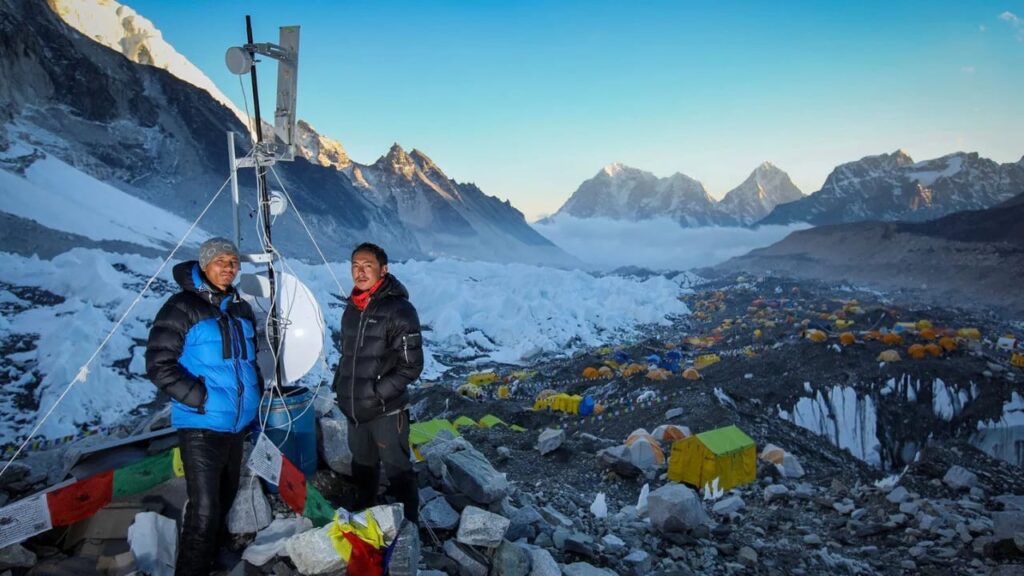
Over time Wi-Fi did indeed come to the Khumbu, and the network is available at many lodges along the trails. It even reached Everest Base Camp. But again, the world was moving on, and demand for faster and better Wi-Fi grew. Travelers are video calling their friends and family from the base camp. Broadcasting live in Instagram, Facebook and Tiktok. Recently the Everest Base Camp Helicopter tour makes anyone go to everest without long 14 days trek. This 4 hours Helicopter tour is becoming a game charger for anyone who wants to see everest but don’t want to trek
At the moment, Ncell provides 2G and 3G services in Namche Bazaar, Thame, Thyangboche, Gorak Shep, Everest View Hotel, Khumjung, Phakding, and Lukla, with things due to change very soon.
Fast 4G Connectivity
There are two main companies providing telecommunications in Nepal – the government-run Nepal Telecom Corporation, Nepal Telecom and the private Ncell.
Ncell began building the highest cell phone town in the world at 5,200m which will provide 4G, according to their officials. With five base transceiver stations or BTS around the Everest Region at elevations of 3,830m to 5,200m they intend to go live very soon. They had hoped to have everything running by the end of 2022 but because of covid it is excpted to to completed by mid 2023
The aim of providing 4G is two-fold: to help the local community and support and boost tourism. Definitely, it will be a big plus for tourists who are used to uploading photographs and information on a daily, if not hourly, basis.
Environmental Studies
The last thing anyone wants is to damage the environment while installing towers. So, a study was planned to ensure this would not happen. Another plus is that improved Internet services could help mitigate disasters and aid with disaster risk management to benefit the environment and people.
Will 4G Reach the Top of Everest?
According to Ncell, the initial report shows that 4G can be received on the summit of the world’s highest mountain at 8,848m. Base camp has already got 4G service. On the other side of Everest, China has already successfully tested 5G at its base camp with a study that began in April 2020.
The five BTS towers, which are seven meters in height, will be built at Thame, Somare Pari Hill, Dingboche, Thukla Hill, and Pyramid Hill. This would result, according to the draft reports, with almost 27,500 users able to access the service per house. That is 5,499 users per tower per hour. Four of the five towers will be powered by solar energy and the project in Thame will be managed by electricity from the Khumbu Electricity Company. For those using solar power, 33 panels will be installed at each site, plus a battery.
WiFI Costs
Currently, in the Everest Region, tourists pay between USD$5 to USD12 per hour to access 3G WiFi at their guest houses. We do not know how 4G will impact these prices. We will keep you updated.
Happy Tourists
This improvement in internet services will definitely make visitors to the region happy. Trekkers, climbers, and pilgrims, as well as locals, will be able to access and pass on information quickly and easily. And, of course, if there is an emergency, the correct services will be accessed more quickly.