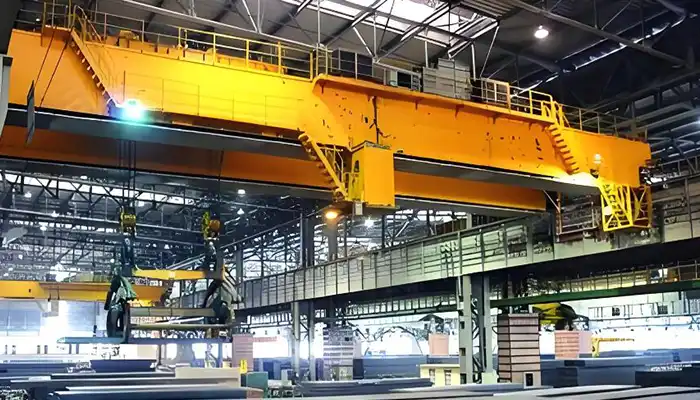
In the grand narrative of global industrialization, material-handling efficiency often determines whether an enterprise succeeds or fails. Electric Overhead Traveling (EOT) cranes—commonly referred to as an Overhead bridge crane— are indispensable power hubs in modern factories, warehouses, and heavy industrial facilities. By intelligently utilizing otherwise unused vertical space within buildings, these systems reduce ground-level congestion and enable precise three-dimensional movement of heavy loads.
Enhancing Industrial Efficiency: The Core Mission of EOT Systems
The fundamental purpose of a bridge crane is to lift, lower, and horizontally move heavy materials safely, efficiently, and in a controlled manner within a defined space. Unlike ground-based equipment such as forklifts, bridge cranes operate over a wide area without being constrained by floor obstacles. This “aerial operation” model optimizes workshop layouts, enabling more compact and streamlined production lines.
The Synergy Between Space Utilization and Logistics Throughput
In modern logistics, space represents a direct cost. Bridge cranes are typically mounted on runway beams at the top of facility support columns, integrating seamlessly with the building structure. This configuration allows the crane to perform complex motion sequences along three axes: longitudinal travel (bridge), transverse travel (trolley), and vertical lifting (hoist).
The physics of this motion follows strict engineering logic. When determining the power required for crane operation, engineers must calculate resistance forces, including friction and inertial loads. The total resistance WWW of bridge travel can be expressed as:
W=μ×(G+P)×dD+k×2fD×(G+P)W = \mu \times (G + P) \times \frac{d}{D} + k \times \frac{2f}{D} \times (G + P)W=μ×(G+P)×Dd+k×D2f×(G+P)
Where:
- GGG = self-weight of the crane
- PPP = rated load
- μ\muμ = friction coefficient
- ddd = journal diameter
- DDD = wheel diameter
- fff = rolling friction coefficient
This level of precision ensures operational stability and energy efficiency across a wide range of industrial applications.
Reducing Labor Intensity and Ensuring Workplace Safety
Beyond physical movement, a primary objective of EOT crane systems is risk reduction. Manually handling multi-ton loads is not only inefficient but also hazardous. By using electric power and digitized controls, these systems transform complex mechanical operations into manageable workflows—significantly reducing physical strain and preventing workplace injuries caused by fatigue or improper manual handling.
Structural Breakdown: Components and Their Industrial Roles
To fully understand the uses of a bridge crane, one must examine how its precision components work together to solve engineering challenges.
| Component Name | Primary Function | Industrial Value |
| Bridge | Main structural beam spanning the workshop | Provides horizontal platform and defines span |
| Electric Hoist | Device for vertical lifting and lowering | Determines lifting capacity and speed |
| Trolley | Mechanism that moves the hoist across the bridge | Enables precise lateral positioning |
| End Trucks | Wheeled assemblies at both ends of the bridge | Ensure synchronized longitudinal travel |
| Runway Rails | Fixed guide rails mounted on the structure | Define operating boundaries and travel path |
| Control System | Operator interface (pendant or remote) | Enables fine control of mechanical motion |
The integration of these components is far more than simple assembly. For example, Chengdu Weiyuan, a professional bridge crane manufacturer, specializes in the design, production, sales, and installation of such systems. Through strategic partnerships with industry peers such as Jinzhou and Nucleon, Weiyuan delivers modular designs that ensure component stability even under extreme operating conditions.
Configuration Differences: Single-Girder vs. Double-Girder Designs
Choosing between a single-girder and a double-girder structure is critical to achieving specific production goals.
Flexibility of Single-Girder Bridge Cranes
Single-girder bridge cranes are typically preferred in small to medium-sized workshops. With a single beam bridge, they are lightweight and easy to install. Their primary use is handling routine loads—generally up to 20 tons—in machining, assembly, and light warehousing environments. For facilities with limited headroom, this design minimizes structural load and reduces construction costs.
Power of Double-Girder Bridge Cranes
By contrast, double-girder bridge cranes are engineered for the demanding conditions of heavy industry. Featuring two parallel beams, they offer greater lifting heights (as the hoist usually sits between the girders), longer spans, and lifting capacities reaching hundreds of tons. In environments such as steel mills, the stability and redundancy of double-girder systems are essential for continuous operation.
The Art of Customization: Building Tailored Solutions with Weiyuan
In the high-end crane market, Weiyuan is more than a supplier—it is a creator of efficiency. Through deep parametric design, Weiyuan customizes every aspect of the system to suit each client’s unique environment.
- Precision Fit: Free design services adjust parameters such as chain length and lifting height based on actual plant clearance and column spacing.
- Professional Environmental Protection: For outdoor use or high-dust workshops, Weiyuan applies custom dust covers, waterproof seals, and anti-corrosion coatings. High protection ratings ensure long-term reliability of electronic components in harsh climates.
- Brand Integration: Beyond functionality, Weiyuan supports customized housing colors and logo integration, aligning heavy equipment with corporate identity.
This level of customization ensures that whether a client requires a manual bridge crane for precision tasks or a heavy-duty bridge crane for industrial production, the solution is optimized across the entire equipment lifecycle—from installation to maintenance.
Broad Application Fields: From Manufacturing to Agriculture
The uses of EOT cranes extend far beyond basic material handling, serving as efficiency multipliers across specialized sectors.
Industrial Manufacturing and Automotive Maintenance
In manufacturing, cranes are used for equipment positioning and component assembly. In the automotive industry, they support engine lifting and chassis maintenance, where fine speed control is critical to protecting precision parts.
Construction and Energy / Mining
On construction sites, these systems lift steel structures and precast concrete components. In the energy sector, they maintain wind turbine blades or dismantle heavy machinery in mining operations.
Outdoor Events and Stage Design
In large stadiums and concert halls, cranes lift heavy lighting rigs and LED screens. These applications demand ultra-low noise levels and redundant braking systems to ensure absolute safety over audiences.
Agriculture and Fisheries
In modern aquaculture, cranes lift massive fishing nets and automated harvesting equipment. Given the highly corrosive environment, Weiyuan’s anti-corrosion solutions are particularly effective. In agriculture, these systems support the maintenance of large machinery and assembly of heavy transmission systems.
Safety and Compliance: The Industrial Red Line
Safety is the non-negotiable foundation of any lifting operation. Weiyuan systems strictly comply with international and regional standards and undergo rigorous stress testing before delivery.
- ISO Certification: Ensures quality management in procurement and assembly, particularly in electrical safety.
- CE Certification: A prerequisite for entry into European and global high-end markets, demonstrating compliance with health, safety, and environmental directives.
- IP Protection Ratings: For warehouse or outdoor cranes, drive motors and control cabinets typically achieve IP54 or higher (IP65/IP66) to resist water and fine dust.
Case Study: From Manual Burden to Intelligent Transformation
In an industrial transformation study, a traditional assembly station manufacturer faced low efficiency and high injury rates due to manual handling. After introducing Weiyuan’s intelligent bridge crane system, the company achieved significant improvements:
- Efficiency: Automated path planning and VFD control increased material flow efficiency by over 30%.
- Precision: PLC-based closed-loop control achieved millimeter-level positioning accuracy.
- Safety: Integrated overload limiters and infrared anti-collision systems reduced workplace accidents by 90%.
Lifecycle Support: Installation and Technical Service
A high-quality crane can deliver value for decades. Weiyuan has established a comprehensive closed-loop support system covering everything from pre-sales consultation to rapid after-sales response.
Comprehensive Installation Guidance
For international clients, Weiyuan provides detailed manuals and multilingual video tutorials. Through online installation guidance, engineers offer real-time remote supervision to ensure accurate electrical wiring and mechanical alignment.
On-Site Support and Warranty
For complex projects, professional technical teams can be dispatched for on-site commissioning and operator training. Weiyuan offers a one-year warranty on all products and leverages a strong global inventory to provide maintenance and replacement parts for designated bridge crane components.