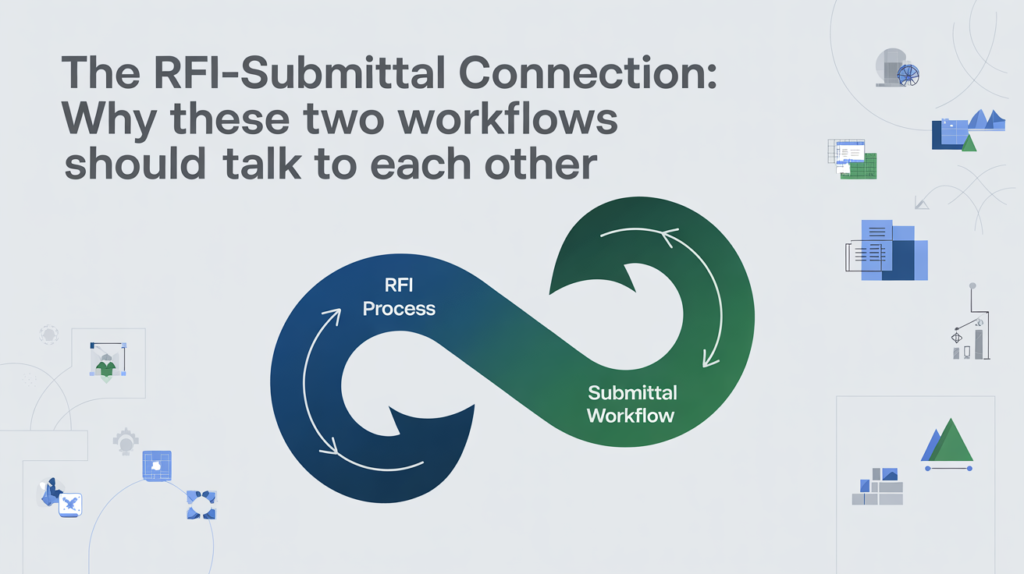
On most commercial construction projects, RFIs and submittals operate in separate lanes. Project engineers manage the submittal log while fielding RFIs as they come in. Design teams review submittals in one system and answer RFIs in another. Everyone treats them as distinct processes with different timelines, different stakeholders, and different purposes.
This separation creates a blind spot that costs projects weeks of schedule time and thousands of dollars. The reality is that RFIs and submittals are deeply interconnected, and treating them as isolated workflows leads to redundant work, missed coordination opportunities, and avoidable delays.
The Hidden Cost of Disconnected Workflows
When RFIs and submittals don’t talk to each other, project teams end up doing the same work twice. A mechanical subcontractor submits an RFI asking about conflicting duct routing details in the drawings. Two weeks later, they submit shop drawings for the same ductwork. The design team reviews the shop drawings without the context of the earlier RFI, leading to another round of questions that could have been resolved during the RFI response.
Research from the Navigant Construction Forum found that RFI responses cost an average of $1,080 per request, with the median response time stretching nearly 10 days. When submittals follow disconnected from RFI resolutions, these costs multiply. The shop drawings get rejected, triggering another RFI to clarify the rejection, which then requires a resubmittal. What should have been a single coordinated review becomes three separate transactions.
This pattern repeats across mechanical, electrical, and plumbing systems. It shows up in structural steel connections, facade details, and fire protection layouts. Each time an RFI clarifies a design issue that will eventually require a submittal, the lack of connection between the two processes creates an opportunity for miscommunication.
Where RFIs and Submittals Naturally Intersect
Understanding where these workflows intersect reveals why they need to communicate better. Several common scenarios show the connection clearly:
Design Clarifications Leading to Submittals An electrical contractor issues an RFI about lighting fixture specifications that conflict between the drawings and the specification section. The design team’s response clarifies which product is required and provides additional performance criteria. When the submittal for those same fixtures arrives weeks later, the engineer reviewing it may not remember the RFI or have easy access to that decision. The review happens in a vacuum, potentially missing nuances established in the earlier RFI discussion.
Material Substitutions A subcontractor discovers that a specified product has a 16-week lead time that will blow the schedule. They issue an RFI requesting approval for an alternate. The design team approves the substitution with specific conditions about performance characteristics. When the product data sheets arrive as a submittal, they need to be reviewed against those conditions, not just the original specification. Without a clear link between the RFI and the submittal, that context can easily be lost.
Site Conditions Affecting Installation Details Field teams encounter unexpected conditions that require clarification through an RFI. The design team’s response might include specific installation requirements or modified details. When shop drawings for those installations come through the submittal process, the reviewer needs to verify they align with the RFI resolution. If that RFI response lives in a separate system or email thread, the connection may never be made.
Code Compliance Questions An RFI asks about fire rating requirements for a particular assembly. The design team’s response references specific testing standards and installation requirements. The submittal for that assembly needs to demonstrate compliance with those same requirements. If the submittal reviewer doesn’t have the RFI context, they might approve something that doesn’t actually meet the clarified requirements.
The Coordination Gap During Critical Path Activities
The disconnection between RFIs and submittals becomes especially problematic during critical path activities. Long-lead equipment purchases often trigger both an RFI to clarify specific requirements and a submittal to approve the actual equipment. When these processes run on separate tracks, delays compound.
Consider a typical sequence for a custom air handling unit on a healthcare project. The mechanical contractor issues an RFI to clarify performance requirements that weren’t fully detailed in the specifications. They need this answer before they can order the equipment because the clarification affects the unit’s size and cost. According to industry data, the submittal review process itself can take 2-6 weeks for complex equipment, and any rejection triggers a resubmittal cycle.
If the RFI response isn’t directly linked to the submittal review, the design team might overlook details they clarified during the RFI process. This leads to conditional approval or rejection, which pushes the schedule back by weeks. For critical path items, those weeks cascade through the entire project timeline.
Modern AI-powered tools like BuildSync can help bridge this gap by automatically extracting and comparing technical characteristics from both submittals and project specifications, making it easier to verify that approved equipment aligns with design intent – including any clarifications made during the RFI process. This kind of automated technical review helps catch discrepancies before they cause schedule delays.
How Information Gets Lost in Translation
The typical construction project workflow creates multiple opportunities for information to get lost between RFIs and submittals. Here’s what commonly happens:
Email Overload RFI responses often arrive via email with attachments, sketches, or marked-up drawings. These emails get filed in project folders or individual inboxes. When submittal time comes around, the project engineer reviewing product data sheets or shop drawings may not remember to search through months of RFI correspondence to find relevant context.
Staff Turnover Project engineers who handled early RFIs might not be the same people reviewing submittals later in the project. Without a system that connects the two workflows, institutional knowledge walks out the door with staff changes.
Multiple Software Systems Many project teams use one system for RFI management and a different system for submittal reviews. The design team might review submittals in their document management software while tracking RFIs through a separate portal. This creates information silos where cross-referencing becomes manual and time-consuming.
Time Gaps RFIs typically happen during early construction phases while submittals follow the procurement schedule. Months might pass between when an RFI gets answered and when the related submittal comes in for review. That time gap makes it easy to forget the connection between them.
Building Better Bridges Between Workflows
Connecting RFIs and submittals doesn’t require overhauling entire project management systems. Several practical approaches can improve coordination:
Link RFIs to Specification Sections When creating an RFI, reference the specific specification section it relates to. When submittals for that same section arrive, the reviewer can quickly search for related RFIs. This simple cross-referencing habit creates a trail that’s easy to follow.
Include RFI Numbers in Submittal Transmittals If a submittal relates to a previous RFI, note the RFI number in the submittal log and transmittal. This explicit connection tells the reviewer there’s additional context they should consider. The mechanical contractor submitting shop drawings can note “See RFI #127 for clarification on duct sizing criteria,” prompting the reviewer to pull that information.
Update Specification Sections After RFI Resolutions When an RFI clarifies or modifies project requirements, update the specification section or drawing to reflect that decision. This ensures that submittal reviewers are working from the most current information rather than the original documents that prompted the RFI in the first place.
Create RFI/Submittal Cross-Reference Logs Maintain a simple log that tracks which RFIs relate to upcoming submittals. During weekly coordination meetings, review this log to identify submittals where the design team should be aware of previous RFI discussions. This proactive approach prevents surprises during the review process.
Hold Pre-Submittal Coordination Meetings For complex or critical submittals, schedule a brief coordination meeting with the design team before submission. Use this time to review any related RFIs and ensure everyone understands how previous clarifications should inform the submittal review. These 30-minute investments can save weeks of resubmittal cycles.
The Technology Solution
Construction technology has evolved to address this coordination challenge. Modern project management platforms increasingly offer features that link RFIs and submittals through shared specification sections, equipment tags, or drawing references. When an RFI gets answered, the system can flag related submittals that will need to be reviewed with that context in mind.
Some platforms automatically attach RFI responses to specification sections, so when a submittal reviewer opens product data for that section, they see a notification about relevant RFIs. This automated prompting ensures context doesn’t get lost simply because people are busy or new to the project.
The most sophisticated systems use automation to extract technical requirements from RFIs and compare them against submittal data, catching discrepancies before they reach the design team. This reduces the back-and-forth that happens when submittals don’t align with clarified requirements.
The Schedule and Budget Impact
The financial impact of disconnected RFI and submittal workflows extends beyond the direct costs of processing individual requests. When submittals get rejected because they don’t account for RFI clarifications, the resubmittal cycle typically adds 2-3 weeks to the schedule. For critical path items, those weeks push substantial completion dates and trigger liquidated damages or schedule compression costs.
Contractors often absorb the cost of re-engineering or re-procuring items that should have been right the first time. Manufacturers might charge restocking fees for equipment that needs to be modified after initial fabrication. Design teams spend additional time reviewing resubmittals that could have been approved initially if the RFI context had been clear.
These costs multiply across the dozens or hundreds of submittals on a typical commercial project. A large hospital project might process 2,000 submittals over an 18-month construction period. If even 10% of those submittals require rework due to disconnected RFI clarifications, that’s 200 resubmittal cycles adding weeks to the schedule and thousands of dollars in administrative and procurement costs.
Making the Connection Stick
Improving coordination between RFIs and submittals requires commitment from all project stakeholders. General contractors need to establish protocols that encourage subcontractors to reference related RFIs in their submittal transmittals. Design teams should create review processes that prompt engineers to search for relevant RFI history before approving submittals. Project engineers need to maintain cross-reference logs and use them proactively.
The most successful projects treat RFIs and submittals as interconnected parts of a single coordination process rather than separate administrative tasks. They build time into the schedule for pre-submittal coordination on critical items. They use technology to automate connections where possible and establish manual protocols where automation isn’t available.
Construction teams that make these connections see tangible benefits: fewer resubmittals, faster approval cycles, reduced coordination issues in the field, and stronger relationships between contractors and design teams. The investment in better coordination pays for itself many times over in avoided delays and rework.
The RFI-submittal connection matters because construction is fundamentally about coordination. Every RFI clarifies intent, and every submittal confirms compliance with that intent. When these two workflows operate independently, opportunities for miscommunication multiply. When they talk to each other, projects run smoother, schedules hold, and budgets stay intact.
Project teams that recognize this connection and build systems to support it gain a competitive advantage. They deliver projects faster with fewer coordination issues. They build stronger reputations for quality and reliability. Most importantly, they avoid the costly delays and rework that plague projects where RFIs and submittals never quite manage to communicate.