Expert Guide by CRESIRE – Leading BIM Service Provider
To move more towards digital workflows that improve accuracy, reduce risks, and increase the speed of decision-making, the architecture, engineering, and construction (AEC) industry is on a trend toward more use of digital tools and processes.
Many AEC professionals and laser scan service providers have come to depend on creating BIM models through point-cloud data to document existing conditions. Information in AEC industries is often limited due to time constraints, limited budgets, and an inability to gather needed data quickly and effectively.
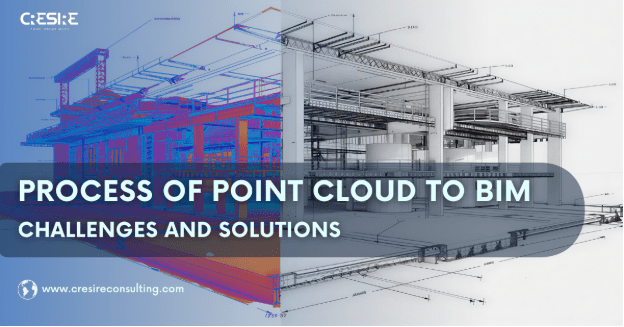
This article outlines the complete process of converting point clouds to BIM, common challenges faced by professionals, and the solutions that experienced BIM partners like CRESIRE provide. It also links to a detailed walkthrough video for deeper understanding.
Understanding the Process of Point Cloud to BIM
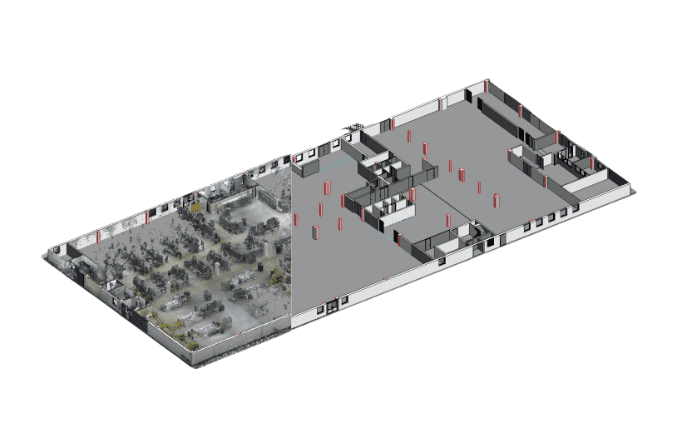
The process of converting point clouds into BIM models consists of using many scanned data points (or “point clouds”) to create a digital 3D model that shows the current state of a building. When scanned using photogrammetry (using photographs) or laser scanning (using laser beams), the data points are more detailed than what traditional site surveys typically record.
According to a study conducted by Dodge Data & Analytics, companies that employ Reality Capture Techniques have been able to reduce site documentation time by an average of almost 60% while simultaneously increasing measurement accuracy.
Key Challenges in Converting Point Cloud to BIM
1. Managing Large Scabarn Files
Point cloud datasets often run into several gigabytes. Handling, processing, and aligning these files demands advanced hardware and software capabilities. Many teams struggle with performance delays, leading to inefficiencies.
2. Ensuring High Level of Accuracy
Translating irregular shapes and real-world conditions into a BIM environment requires precise interpretation. Any errors in modeling can affect downstream activities such as design coordination, quantity takeoff, and renovation planning.
3. Varying Levels of Detail
Different stakeholders expect different levels of detail, from basic geometry to complex building components. Misunderstanding LOD expectations often leads to rework.
4. Interpreting Complex Existing Structures
Older or modified buildings rarely align perfectly with drawings. Capturing such deviations accurately is essential but time-consuming if handled manually.
5. Software Compatibility and Data Transfer
Organizations use various BIM platforms. Ensuring smooth integration between scan formats and modeling software is crucial for workflow continuity.
Solutions: How CRESIRE Streamlines the Process of Point Cloud to BIM
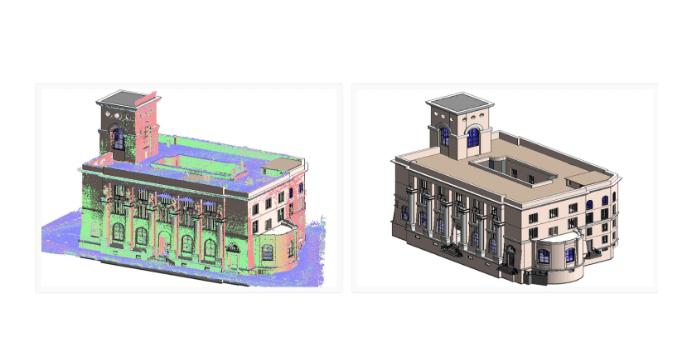
With their wealth of industry knowledge gained through working on numerous international projects, CRESIRE provides an organized, dependable, and quality-based scan to BIM services for AEC practitioners, surveyors, and laser scanning companies. The experienced team makes sure the finished BIM model is accurate and meets or exceeds industry standards.
1. Detailed Data Processing
CRESIRE filters noise, organizes scan data, and creates structured point cloud files, enabling faster processing. Aligning scans accurately helps avoid distortion during modeling.
2. Seamless Integration with BIM Platforms
The team works with leading BIM tools, including Autodesk Revit and Navisworks, ensuring compatibility for further design, coordination, and analysis. This technical integration reduces workflow interruptions and improves project efficiency.
3. Customized and Standards-Based Modeling
Every project requires its own modeling approach. CRESIRE develops models based on client-specific LOD requirements, project standards, and intended use. Whether the goal is renovation planning, clash detection, or facility management, the model is structured accordingly.
4. Quality Assurance Built Into the Workflow
CRESIRE performs continuous audits throughout the modeling process. Geometry checks, point-to-model variance reviews, and visual inspections ensure that the output meets the accuracy benchmarks set at the start of the project.
5. Team Collaboration and Transparent Communication
Stakeholders receive regular progress updates, sample models, and issue resolutions. This collaborative approach minimizes misunderstandings and accelerates approvals.
Step-by-Step Process Followed at CRESIRE
Below is a simplified version of how CRESIRE executes the process of point cloud to BIM:
- Requirement gathering
Understanding scope, LOD, building use, and deliverable format. - Scan data assessment
Evaluating completeness, resolution, point cloud data format, and alignment issues. - Data cleaning and registration
Removing noise, merging multiple scans, and preparing a unified dataset. - Modeling structural, architectural, and MEP elements
Developing accurate geometry while ensuring adherence to BIM standards. - Quality checks and revisions
Comparing model elements against the point cloud to maintain precision. - Final model delivery
Providing the model in preferred formats for design teams, contractors, and facility managers.
Results Delivered Through CRESIRE’s Scan to BIM Approach
Accurate As-Built BIM Model
A detailed and dimensionally accurate 3D BIM model representing existing architectural, structural, and MEP elements exactly as they appear on-site.
Time savings
Automated workflows and experienced teams significantly reduce modeling time. Research by Autodesk indicates that BIM-based existing condition modeling can cut project timelines by up to 40 percent.
Cost efficiency
Eliminating rework and improving documentation accuracy leads to lower project costs.
Improved accuracy
Precise measurement reduces design coordination issues, enhancing renovation and retrofit planning.
Better collaboration
Teams can work with a unified source of truth, minimizing conflicts and improving decision-making.
Why Partnering With CRESIRE Provides an Advantage
CRESIRE brings a methodical, quality-focused approach that simplifies the complex process of point cloud to BIM. Their expertise in handling both simple and intricate structures ensures that clients receive dependable models ready for immediate use. The combination of technical capability, disciplined workflows, and strong communication makes CRESIRE a trusted partner for AEC organizations worldwide.
If you need a scan to CAD or scan to BIM services for renovation, facility management, infrastructure upgrades, or precise documentation, CRESIRE offers tailored solutions that match project goals and budgets.
To get started with your project, request a free quote.
Email us today at – enquiry@cresireconsulting.com