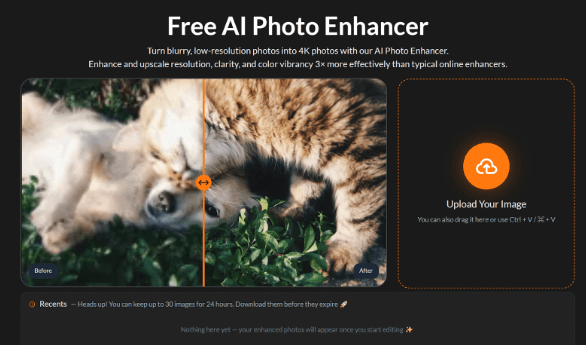
Picture quality problems frustrate us all. A cherished childhood photo has yellowed with age, your smartphone captured a crucial moment but the lighting was terrible, or you accidentally took a blurry shot of something you can never photograph again. Traditional photo editing might help a little, but achieving truly professional results typically requires skills most people don’t have. That’s where artificial intelligence changes everything.
Free AI Photo Enhancer tools can transform disappointing photos into images you’ll be proud to display, share, or print.These tools have learned from millions of high-quality images, enabling them to recognize what details should exist in a sharp, clear photograph even when those details aren’t visible in your original image.
Why Traditional Editing Falls Short
Traditional photo editing relies on mathematical operations that adjust pixels based on predetermined formulas. When you sharpen an image in conventional software, you’re essentially increasing contrast along edges. When you brighten it, you’re multiplying pixel values. These operations are predictable but limited—they can only modify what’s already there, not recreate missing information.
This limitation becomes obvious when dealing with severely degraded images. A traditional editor can make a blurry photo slightly less blurry, but it can’t reconstruct the fine details that blur obscures. It can adjust colors, but it can’t intelligently restore faded hues to their original vibrancy while keeping skin tones natural. This is where AI demonstrates its superiority: it doesn’t just adjust existing pixels, it understands what the image should look like and reconstructs accordingly.
How AI Sees Your Photos Differently
When you use an Unblur Image tool powered by AI, something sophisticated happens behind the scenes. The system examines your photo and identifies various quality issues—blur patterns, noise characteristics, compression artifacts, color imbalances, and missing details. It then classifies the type of degradation present because different problems require different solutions.
The AI compares problematic areas with its learned understanding of how those elements should appear in high-quality images. For example, if your photo shows a blurred face, the AI knows what facial features typically look like at various angles and in different lighting conditions. It uses this knowledge to intelligently sharpen and reconstruct details in a way that looks natural rather than artificial or over-processed.
This contextual understanding extends to all image elements. The AI treats skin differently from fabric, which it treats differently from foliage or architecture. Each texture and material type gets enhancement appropriate to its characteristics, creating results that look cohesive and realistic across the entire image.
Real-World Success Stories
E-commerce sellers find AI enhancement invaluable for product photography. Not everyone can afford professional product shots, but customers expect clear, attractive images when shopping online. AI enhancement transforms smartphone product photos into professional-looking images that showcase items effectively, potentially increasing sales by making products look more appealing and trustworthy.
Social media enthusiasts use enhancement to make their content stand out. When everyone’s feed is full of photos, the ones with superior clarity, color, and sharpness naturally attract more attention and engagement. Quick AI enhancement before posting can mean the difference between a post that gets scrolled past and one that stops people mid-scroll.
Genealogists and family historians digitizing old family photos find AI restoration capabilities almost magical. Photographs that have sat in albums or boxes for decades often look disappointingly poor when first scanned. AI enhancement breathes new life into these irreplaceable memories, revealing details and colors that may not have been clearly visible even when the photos were new.
Professional creatives incorporate AI enhancement into their workflows not as a replacement for skill but as a time-saving tool. A photographer might enhance hundreds of event photos quickly before moving to detailed manual editing on select favorites. A graphic designer might enhance stock photos to better fit project requirements without spending hours on manual adjustments.
Understanding Limitations
While AI enhancement is remarkably powerful, it’s not magic. The technology works best when reconstructing details that logically should exist based on surrounding context. If an image is so degraded that virtually no detail remains, or if large portions are completely missing, AI can improve what’s there but can’t invent content from nothing.
The source image quality matters significantly. An image that’s merely slightly soft will enhance beautifully. An image that’s extremely blurry might improve substantially but could still show some residual softness. An image where blur has completely destroyed all fine detail may not achieve perfect sharpness no matter how advanced the AI, though it will still look dramatically better than the original.
Conclusion
AI photo enhancement represents one of the most practical applications of artificial intelligence technology for everyday users. It solves real problems that people encounter regularly, delivering tangible value without requiring technical expertise. The tools are accessible, often free, and continue improving as AI technology advances.
Whether you’re preserving family history, improving your creative projects, enhancing business visuals, or simply making your personal photos look their best, AI enhancement provides capabilities that were impossible or impractically difficult just a few years ago. The technology handles the complex technical work while you focus on selecting which photos to enhance and how you’ll use the improved results.
Start experimenting with AI photo enhancement today. Take that box of old photos you’ve been meaning to digitize properly. Pull up some of your favorite digital photos that never quite looked as good as you remembered the moment being. Run them through an AI enhancer and see the difference for yourself. You’ll quickly understand why this technology has become an essential tool for anyone who works with or cares about photographs. Quality images are no longer the exclusive domain of professionals with expensive equipment—AI enhancement brings that quality within everyone’s reach.