In the rapidly evolving landscape of digital content, Artificial Intelligence has become an indispensable assistant. It drafts emails, outlines blog posts, and summarizes complex topics in seconds. However, as useful as these tools are, they often leave behind a distinct digital fingerprint—a sterile, overly polished tone that readers (and search engines) are starting to recognize.
The challenge today isn’t just generating content; it’s connecting with the reader. If you rely solely on the raw output of a Large Language Model (LLM), you risk sounding like a robot. To truly engage an audience, you must learn the art of “humanizing” your text. Whether you are checking your work against a sophisticated AI Detector or simply trying to build trust with your audience, the goal is to ensure your unique voice shines through the algorithm.
The “Uncanny Valley” of Text
We often talk about the “uncanny valley” in robotics—where a robot looks almost human but is just slightly “off,” causing a feeling of unease. The same concept applies to writing. AI writing is grammatically perfect. In fact, it is too perfect. It lacks the messy, colorful, and unpredictable nature of human thought.
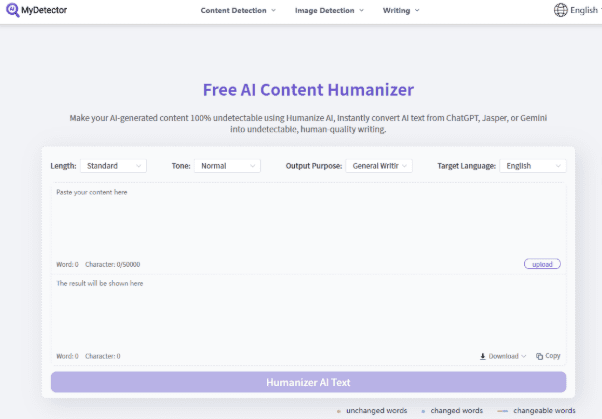
When you read an AI-generated paragraph, you might notice it flows well, but it feels hollow. It often uses repetitive transition words like “Furthermore,” “In conclusion,” or “Moreover.” It rarely takes a hard stance or shares a controversial opinion. To fix this, you don’t always need a specific software tool; sometimes, you need a shift in mindset. While an AI Content Humanizer tool can help rephrase sentences, the ultimate humanizer is your own perspective.
1. Embrace Imperfection and Idioms
One of the easiest ways to spot AI writing is the absence of colloquialisms. AI models are trained to be universally understood and polite, which means they strip away local flavor, slang, and idioms.
To de-roboticize your writing, sprinkle in the language of everyday life. Don’t be afraid to break a grammar rule for stylistic effect. Start a sentence with “And” or “But.” Use sentence fragments. If you are writing for a casual audience, write the way you speak.
For example, an AI might write:
“It is crucial to understand that productivity requires significant discipline.”
A human might write:
“Look, let’s be real—staying productive is a grind, and it takes serious discipline.”
The second sentence has a voice. It assumes a relationship between the writer and the reader. It feels like a conversation, not a lecture.
2. The Power of Personal Anecdotes
The one thing AI cannot do is live your life. It has no childhood memories, no embarrassing mistakes, and no triumphs. It relies on a dataset of other people’s words.
To instantly clear any check from a platform like mydetector.ai, inject personal experience into the text. If you are writing about marketing, don’t just list strategies. Tell the story of the time you wasted $500 on an ad campaign that failed miserably.
These “micro-stories” serve two purposes:
- Validation: They prove you actually know what you are talking about.
- differentiation: No AI model can hallucinate your specific memory with genuine emotional weight.
When a reader encounters a story starting with, “I remember when I was…” or “Last Tuesday, I ran into…”, their brain switches from “scanning mode” to “listening mode.”
3. Varying Sentence Structure (The “Burstiness” Factor)
In the world of linguistic analysis, there is a concept called “burstiness.” This refers to the variation in sentence structure and length. AI tends to be very consistent. It produces sentences of average length, one after another, creating a monotonous rhythm.
Humans are bursty. We write a long, complex sentence that winds through several ideas, using commas and semi-colons to hold it all together. Then we stop. Short sentence. Boom.
If you want to avoid the “AI gaze,” look at your paragraph visually. Does it look like a block of uniform bricks? If so, break it up. Combine two short sentences into a complex one. Chop a long sentence into three jagged fragments. This rhythmic variation is the heartbeat of human writing.
4. Opinion and Emotional Intelligence
AI is designed to be neutral. It often hedges its bets with phrases like “It is important to note that…” or “There are various factors to consider.” It rarely gets angry, excited, or sarcastic.
To make your writing yours, you need to have an opinion. If you are reviewing a product, don’t just list the specs. Tell the reader how it made you feel. Was it frustrating? Was it delightful? Did it remind you of your grandmother’s cooking?
Emotional intelligence involves anticipating the reader’s questions and frustrations. An AI will explain how to change a tire. A human will acknowledge that changing a tire in the rain is miserable and scary, and then explain how to do it. That acknowledgement of the reader’s emotional state creates a bond that algorithms cannot replicate.
Conclusion
The goal isn’t to stop using AI. Tools like ChatGPT or Claude are incredible for brainstorming and structuring. The goal is to stop publishing raw AI content. Think of the AI as a junior intern. It gathers the research and writes a rough first draft. But you—the human—are the editor-in-chief.
You must review the work, add the flavor, check the facts, and ensure the rhythm feels right. You can use resources like mydetector.ai to see where your draft stands, but ultimately, your own intuition is the best guide. If you read a sentence and your eyes glaze over, rewrite it. If it sounds like something a corporate brochure would say, delete it.
Writing is, at its core, a transfer of emotion and knowledge from one brain to another. AI can handle the knowledge part, but the emotion? That is entirely up to you.