Zcash (ZEC) is one of the few cryptocurrencies built for financial privacy, but buying it has become harder. Many large exchanges no longer list it, and the ones that do ask for a passport and a selfie before you can trade. For a coin whose main feature is privacy, that is an awkward first step.
The practical alternative is to swap a coin you already hold, such as Bitcoin, Litecoin or USDT, for ZEC through an instant swap service that does not require an account, and then shield the coins in your own wallet. This guide walks through that process, step by step.
Transparent and shielded Zcash, in 30 seconds
Zcash has two kinds of addresses:
- Transparent addresses start with t1 or t3. They work like Bitcoin addresses: balances and transactions are visible on the blockchain.
- Shielded addresses (unified addresses starting with u1, or older Sapling addresses starting with zs) use zero-knowledge proofs to hide the sender, the receiver and the amount.
Most swap services pay ZEC to a transparent address. That is fine: once the coins arrive, your wallet can move them into the shielded pool, and from there they are private.
What you need
1) A Zcash wallet that can shield. Zodl (formerly Zashi), Zingo and Zkool can all receive at a transparent address and shield the balance.
2) Your transparent receiving address (t1… or t3…), copied from that wallet.
3) The coin you are swapping from, in a wallet you control, such as BTC, LTC or USDT.
Step by step: swapping BTC to ZEC without an account
The example below uses GhostSwap, an instant swap service that covers 1,600+ coins without an account or KYC. The steps are similar on other services of this kind.
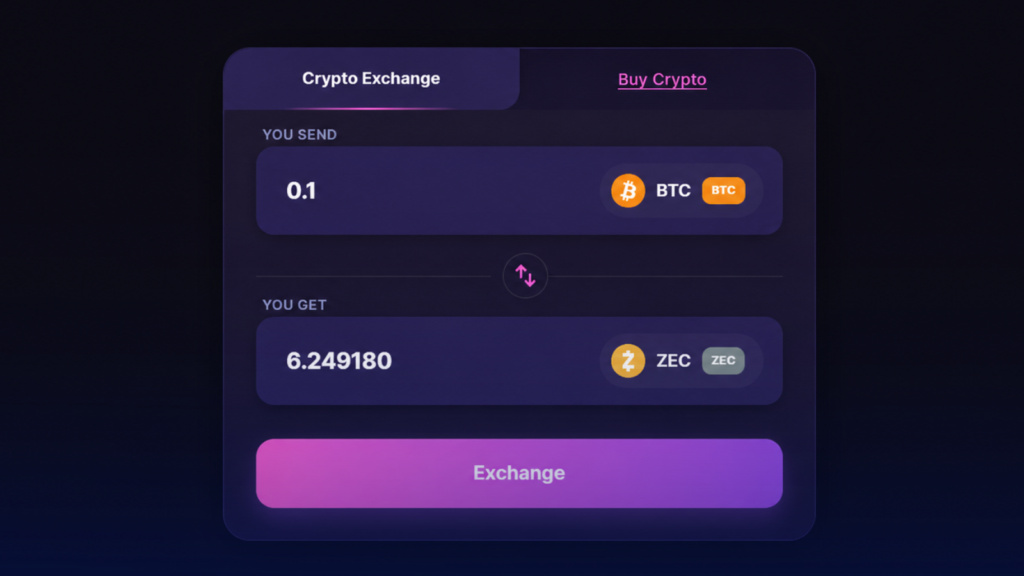
1) Pick the pair. Choose Bitcoin as the coin you send and Zcash as the coin you receive. GhostSwap’s Zcash exchange page shows the same steps.
2) Enter the amount and read the quote. Before you send anything, the exchange box shows the estimated amount of ZEC, the network fee, and the minimum and maximum for the pair. The rate is a floating market rate with the service fee already included, so the final amount can differ slightly if the market moves while your deposit confirms.
3) Paste your transparent ZEC address. Double-check the first and last characters after pasting.
4) Add a refund address. Enter the Bitcoin address you are sending from. If the swap ever has to be returned, the coins go back there.
5) Send the exact deposit. You get a one-time deposit address. Send exactly the amount shown, from your own wallet, not from an exchange account.
6) Follow the swap. Every swap has a status page showing whether the deposit has been seen, how many confirmations it has, and when the ZEC payout leaves. Save the swap ID: without an account, it is your reference.
No name, email, phone number or ID document is asked for at any step.
How long it takes
Most of the waiting is for the coin you send to confirm on its own network:
- From Bitcoin: about 20 to 60 minutes in total, because Bitcoin blocks arrive roughly every 10 minutes and a deposit needs one to three confirmations.
- From Litecoin, Solana or USDT on Tron: usually 10 to 30 minutes.
Zcash itself produces a block about every 75 seconds, so once the payout is sent, it shows up in your wallet quickly.
Shield your ZEC after it arrives
When the ZEC lands at your transparent address, it is visible on the blockchain, just like Bitcoin. To make it private:
1) Wait until the incoming transaction has confirmed in your wallet.
2) Use the wallet’s Shield option (in some wallets it runs automatically). This moves the balance from the transparent address into the shielded pool.
3) From then on, spend or send ZEC from the shielded balance.
Two habits help keep it private: generate a new transparent address for each swap, and leave the coins in the shielded pool for a while instead of moving them straight back out.
Practical tips
- Start small. For your first swap, send an amount close to the minimum to check the whole flow end to end.
- Check the address twice. Crypto payments cannot be reversed. Compare the pasted address with the one in your wallet before sending.
- Use Tor if you want. Some swap services, GhostSwap included, run a Tor mirror, so you can make the swap without revealing your IP address to the website.
- Keep the swap ID until the ZEC is in your wallet and shielded.
Other ways to get ZEC without an account
Instant swaps are not the only route. Each one has its own trade-offs:
- Peer-to-peer marketplaces let you trade with another person, sometimes for cash or bank transfer. They are slower, and liquidity for ZEC can be thin.
- Wallets with a built-in swap are convenient, but often support fewer source coins or route through a single provider.
- Decentralized and cross-chain protocols avoid a central service, but support for Zcash, and especially for shielded Zcash, is still limited.
Instant swap services are usually the simplest route when you already hold BTC, LTC or stablecoins and want ZEC within the hour.
FAQ
Do I need an account to swap Bitcoin for Zcash?
No. With an instant swap service you choose the pair, paste your ZEC address and send the deposit. There is no sign-up, email or KYC.
Can I receive ZEC directly to a shielded address?
Most swap services pay ZEC to a transparent address (t1 or t3). Receive it there, then shield it in your wallet with one step.
How long does a BTC to ZEC swap take?
Usually 20 to 60 minutes, mostly waiting for Bitcoin confirmations. Swaps from faster networks such as Litecoin usually take 10 to 30 minutes.
What if something goes wrong?
Check the swap’s status page first: it shows whether your deposit has been received and confirmed. If a swap has to be returned, the coins go to the refund address you entered.
Conclusion
Getting Zcash without handing over your ID takes two steps: swap a coin you already hold for ZEC at a transparent address, then shield it in your own wallet. With a no-account swap service such as GhostSwap and a shielding wallet such as Zodl or Zingo, the whole process usually takes less than an hour, and your ZEC ends up in the shielded pool, where Zcash’s privacy actually applies.