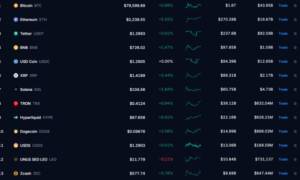
Ripple’s XRP enters one of its most closely watched phases in years as the Canary Capital’s XRPC ETF distorts historical liquidity patterns and redefines price behavior. The first day of trading produced $245 million in volume, $58 million in total session turnover and nearly $26 million in the first 30 minutes. XRP pushed from $2.34 toward the $2.50 ceiling before retracing to the $2.25 range, forming a tightening structure between $2.21 and $2.50 that analysts now view as institution-driven rather than sentiment-driven.
This broader shift arrives at the exact moment XRP Tundra prepares for its January launch. With dual-chain token distribution, staking activation and wallet requirements all finalizing, the ecosystem enters its final pre-launch stage while the XRP market experiences the strongest regulated inflow event in its history.
ETF Momentum Shapes XRP’s Short-Term Trend Ahead of January
The launch of the XRPC ETF on Nasdaq marked a major turning point in XRP’s market profile. Institutional allocators — rather than retail traders — generated the inflow spike that pushed price toward $2.50. Bloomberg’s ETF desk noted that XRPC and Solana’s BSOL were “in a league of their own,” reflecting the scale of interest from funds previously unable to hold XRP directly.
A recent breakdown from Crypto Legends highlighted this structural change in XRP liquidity, emphasizing how regulated inflows shape volatility differently from discretionary buying. The video analysis pointed to the aggressive first-hour volume as clear evidence of automated creations, reinforcing the expectation of continued liquidity rotation as January approaches.
These forces create a favorable macro environment for XRP Tundra’s rollout, particularly as demand for XRPL-native and Solana-connected utility assets increases alongside ETF participation.
XRP Tundra Introduces a Dual-Chain Presale
XRP Tundra will complete its dual-chain airdrop in January, delivering TUNDRA-S to Solana wallets and TUNDRA-X to XRPL wallets exactly one hour before trading begins. This process eliminates manual claiming, gas fees, approval prompts or transaction risks. Allocations simply appear in user wallets through pre-programmed distribution systems tested across both networks.
Launch prices have been confirmed: $2.50 for TUNDRA-S on Meteora and $1.25 for TUNDRA-X on Sologenic. These values correspond to each token’s operational role — TUNDRA-S as the core DeFi and yield asset on Solana, and TUNDRA-X as the governance and reserve token on XRPL.
Participants must submit valid wallet addresses before launch. Solana addresses must come from non-custodial wallets such as Phantom, while XRPL addresses must come from wallets like XUMM capable of receiving custom XRPL tokens. Exchange addresses are not supported and will result in irreversible loss. Testing each wallet with a small transfer of SOL or XRP remains strongly recommended to ensure correct setup.
Staking Options Define Post-Launch Utility
Following the airdrop, staking becomes one of the primary utility layers for TUNDRA-S. The ecosystem offers three structured options designed for different participation styles.
Liquid Staking supports maximum mobility with an APY between 4–6%, no lock-up period and instant withdrawal. It requires a minimum of 100 TUNDRA-S and suits participants who trade actively while generating consistent yield.
Balanced Staking introduces a 30-day commitment with 8–12% APY and a 500 TUNDRA-S minimum. It provides stronger returns with predictable access to funds at the end of the cycle, appealing to participants seeking moderate structure without long-term immobility.
Premium Staking offers 15–20% APY with a 90-day lock-up and a 1,000 TUNDRA-S minimum stake. This option targets long-term participants aligning their positions with XRP Tundra’s early growth phases and reward distribution cycles.
These options activate immediately after trading opens, giving presale buyers the ability to deploy allocations into yield strategies from day one.
Presale Deadline, Token Burn and Verification Framework
The XRP Tundra presale runs until January 12, 2026, unless all tokens sell out earlier. Any unsold allocations will be permanently burned, preserving the tokenomics exactly as designed and guaranteeing scarcity for early participants. The burn commitment is part of a broader transparency framework that also governs listing prices and distribution mechanics.
Phase 11 pricing sets TUNDRA-S at $0.183 with a 9% bonus, while TUNDRA-X is referenced at $0.0915 and delivered free with every purchase. Compared with confirmed launch prices of $2.50 and $1.25, interest continues to rise as the January window approaches.
Many new participants begin their due-diligence process by searching is XRP Tundra legit. That question leads them to the project’s verification materials, including audits from Cyberscope, Solidproof and FreshCoins, as well as the Vital Block KYC certification. These verifications accompany the presale timeline, wallet requirements and token burn policy as the core trust components supporting January’s activation.
What January Means for XRP Holders Entering the Ecosystem
January marks the functional beginning of XRP Tundra’s ecosystem. With the airdrop executed an hour before markets open, staking prepared to activate, and liquidity established on Meteora and Sologenic, participants enter a fully operational environment rather than a speculative one.
The combination of ETF-driven momentum, dual-chain distribution and a strict presale deadline places early positioning at the center of the ecosystem’s next phase. Participants aiming to secure their Phase 11 allocation ahead of launch gain direct access to the utilities, yield systems and cross-chain mechanics that will shape XRP Tundra’s early growth cycle.
Secure your Phase 11 allocation ahead of January’s dual-chain launch and follow verified updates as XRP prepares for its next major momentum wave.
Buy Tundra Now: official XRP Tundra website
How To Buy Tundra: step-by-step guide
Security and Trust: SolidProof audit
Join the Community: Telegram