AI image generation for marketing has made visual production faster, but speed can create a new problem: a team may produce dozens of attractive options without learning which creative decision actually matters. More output is useful only when every variation answers a clear question.
This is where Krea 2 becomes relevant: it gives teams a browser-based way to explore text-led and reference-led visual directions across multiple formats. From a practical perspective, it is best treated as an early concept and variation environment, not as an automatic replacement for creative strategy, product photography, legal review, or final production.
The better operating model is a visual hypothesis loop. Instead of asking an image model to “make the campaign better,” the team defines one decision, generates controlled evidence, reviews it against a fixed rule, and carries the learning into the next round.
The Expensive Problem Is Random Variety
Traditional campaign development limits the number of directions a team can afford to visualize. Generative tools reverse that constraint, but they do not automatically create a better decision process. When every image changes the camera angle, setting, color palette, audience, product position, and emotional tone at once, reviewers cannot tell why one option feels stronger.
That ambiguity becomes expensive downstream. A creative director approves a mood, a performance marketer reads it as an audience signal, and a production team interprets it as a shot list. Each person may be responding to a different variable inside the same image.
Research on advertising effectiveness has long suggested that creative quality is a major driver of campaign outcomes. Recent work on production-scale generative imagery also highlights the continuing need for product fidelity checks, brand constraints, and human validation. The practical conclusion is simple: cheap generation should increase the quality of decisions, not merely the quantity of files.
The COVR Loop For AI Marketing Images
The COVR loop turns visual exploration into a repeatable test. Its four parts are Constraint, One variable, Variants, and Review rule.
- Constraint: Lock the facts that cannot drift, such as the product silhouette, approved colors, audience, offer, and channel dimensions.
- One variable: Name the single creative decision under review, such as environment, visual metaphor, lighting mood, or product scale.
- Variants: Generate a small, comparable set that changes that variable while preserving the constraints.
- Review rule: Score every option with the same criteria before discussing personal preference.
The loop is deliberately narrow. It does not prove that an image will perform in market; only a properly designed campaign test can do that. It does, however, help a team eliminate weak directions before expensive editing, photography, media trafficking, or client review begins.
A useful hypothesis is written as a decision, not as a prompt. “A quiet morning setting will make the product feel easier to adopt than a high-energy studio setting” is testable. “Make it premium and viral” is not. The first statement tells the team what to hold constant, what to vary, and what to evaluate.
How The Visual Hypothesis Workflow Works In Practice
Before comparing tools or production methods, it helps to see how a campaign question becomes a controlled set of reviewable visual evidence.
Step 1: Lock The Non-Negotiables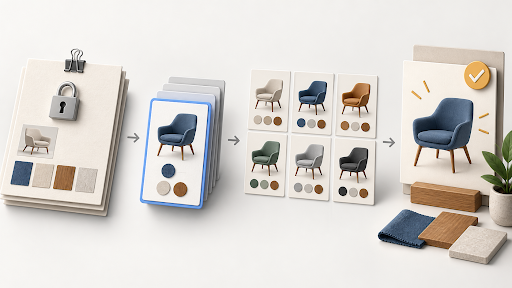
Start with a one-page constraint sheet. Include the exact product reference, approved brand colors, prohibited claims, audience, channel, aspect ratio, and the decision owner. Separate facts from preferences. A logo position may be mandatory; “make it more exciting” is only a subjective request.
Reference images should also have declared roles. One image may define product shape, another lighting, and a third composition. If their roles remain implicit, the model and the reviewers may blend incompatible signals. The output of this step is not a long prompt. It is a short list of elements that must survive every generation.
Step 2: Choose One Variable And Build A Matrix
Select one question for the round. For example, a launch team might compare three settings—home desk, commuter train, and hotel room—while keeping the product, camera distance, color system, and headline space unchanged.
Create a small matrix before generating. Three directions with two variations each are often more useful than twenty unrelated images. The matrix makes missing coverage visible and prevents the team from quietly changing the hypothesis midway through the review.
Step 3: Generate Comparable Evidence
Use the same core brief for every cell and change only the selected variable. Reference-led generation can help carry palette, texture, or visual rhythm across the set, while text direction can define the new setting or mood. Generate in the actual channel ratio whenever possible so reviewers see a realistic composition rather than a square image that will later be cropped beyond recognition.
At this stage, reject obvious failures without debating taste: distorted product details, unreadable packaging, impossible reflections, unsafe claims, or compositions with no room for copy. Save the prompt, references, variable name, and output together. Without that record, the team cannot reproduce a promising direction.
Step 4: Review, Promote, And Record The Learning
Score the surviving images before opening a free-form discussion. A simple four-part rubric can cover product fidelity, brand fit, message clarity, and channel usability. Reviewers should mark both a score and a reason; a number without an explanation does not create reusable knowledge.
Promote one or two directions into the next stage, where designers can refine layouts, retouchers can protect product accuracy, and marketers can prepare a genuine audience test. Record the losing reason as carefully as the winner. “Hotel setting looked premium” is vague; “warm room lighting reduced contrast between the navy product and background” is a useful constraint for the next loop.
A Worked Example: Testing A Portable Speaker Launch
Consider a hypothetical team preparing a campaign for a compact outdoor speaker. The fixed elements are the speaker’s shape, charcoal color, fabric texture, target audience, and vertical social format. The team wants to know which visual context communicates portability most clearly.
It creates three directions: clipped to a backpack at a trail stop, placed beside a picnic blanket in a city park, and sitting on a small balcony table. Each direction gets two variations, but the camera distance, product scale, and late-afternoon light remain stable.
The first review is not “Which picture do we like?” The team asks four narrower questions:
- Is the speaker immediately identifiable?
- Does the setting communicate portable use without extra explanation?
- Is there clean space for a short headline and legal line?
- Did generation alter controls, ports, texture, or proportions?
Suppose the trail direction communicates portability well but repeatedly hides the controls. The park direction preserves the product and leaves strong copy space, while the balcony direction feels more like home audio than outdoor use. The team has not proved that the park image will win an ad test. It has learned which direction is production-ready enough to test and which failure modes should become new constraints.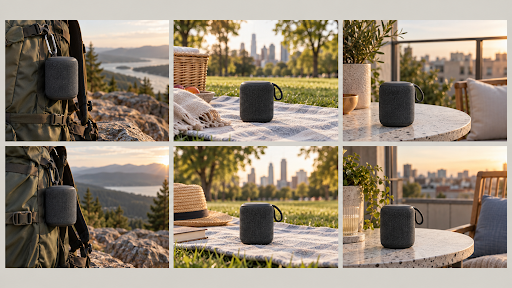
This distinction matters. Generative concept review produces evidence about feasibility, clarity, and visual fit. Market performance still requires real media, a defined audience, comparable copy and offers, enough delivery, and an agreed success metric.
Three High-Value Uses Beyond Ad Variation
Pre-Shoot Look Development
Photography teams can compare lighting, surface, prop density, and framing before renting a location or building a set. The generated images function as conversation tools, not as exact promises of what the camera will capture. A photographer can identify impractical reflections or lighting setups before production day.
Localized Campaign Planning
Regional teams can explore how a centralized concept might adapt to different environments, seasons, and cultural contexts. The central brand team should lock product and identity constraints, while local reviewers assess whether settings, gestures, objects, and wardrobe feel appropriate. Localization is not a simple background swap; it needs informed human review.
Stakeholder Alignment
Executives often react more clearly to a visual choice than to a paragraph in a brief. A controlled matrix lets stakeholders compare the same decision instead of responding to unrelated polished images. It can also reveal hidden disagreements early: one team may prioritize product clarity while another favors emotional atmosphere.
Reference-Led AI Testing vs Other Creative Workflows
The comparison below separates early decision support from final production, where different methods retain clear advantages and limitations.
| Criteria | Krea 2 Reference-Led Test Loop | One-Shot Prompting | Full Production Shoot |
| Starting Point | Brief plus references | Written prompt | Approved production plan |
| Variation Control | Strong with fixed matrix | Often changes several factors | Precise but costly |
| First-Round Speed | Fast concept evidence | Fastest isolated image | Slowest setup |
| Product Fidelity | Requires close review | Frequently inconsistent | Highest with real product |
| Best Use Case | Direction testing | Loose inspiration | Final campaign assets |
| Team Learning | Recorded and repeatable | Easy to lose | Rich but expensive |
| Main Limitation | Human QA still essential | Weak causal insight | Cost and lead time |
Where The Workflow Still Breaks
Reference control does not guarantee pixel-perfect product fidelity. Small text, logos, interfaces, packaging details, hands, reflections, and object geometry can still drift. A visually persuasive image may also contain a claim that the brand cannot substantiate or a cultural cue that local reviewers consider inappropriate.
Rights and provenance require the same discipline as visual quality. Teams should use references they are entitled to use, document the origin of important assets, and avoid treating another creator’s distinctive work as a shortcut to a marketable house style. Generated concepts should pass the organization’s legal, brand, accessibility, and platform checks before publication.
The review process can fail too. If the highest-ranking stakeholder chooses a favorite before the rubric is applied, the matrix becomes theater. Anonymous first-round scoring or independent written comments can reduce anchoring. The decision owner should resolve tradeoffs only after the evidence is visible.
A Small Operating Rule With A Large Effect
Every generation round should end with one sentence that begins, “We learned that…” If the team cannot complete that sentence, the round probably produced variety rather than evidence.
AI image generation becomes more valuable when it helps teams spend expensive human attention on fewer, better-defined choices. The visual hypothesis loop does not remove creative judgment. It gives that judgment a clearer object, a shared vocabulary, and a record that can improve the next campaign.