
The wearable market has spent the better part of a decade chasing the same finish line: more sensors, tighter integrations, smarter algorithms. Apple, Whoop, Oura, and Garmin have each carved out a slice of the “quantified self” economy by turning biometric data into something actionable. But a new entrant is asking a different question entirely. What if the wrist could do more than measure the body? What if it could also talk to it?
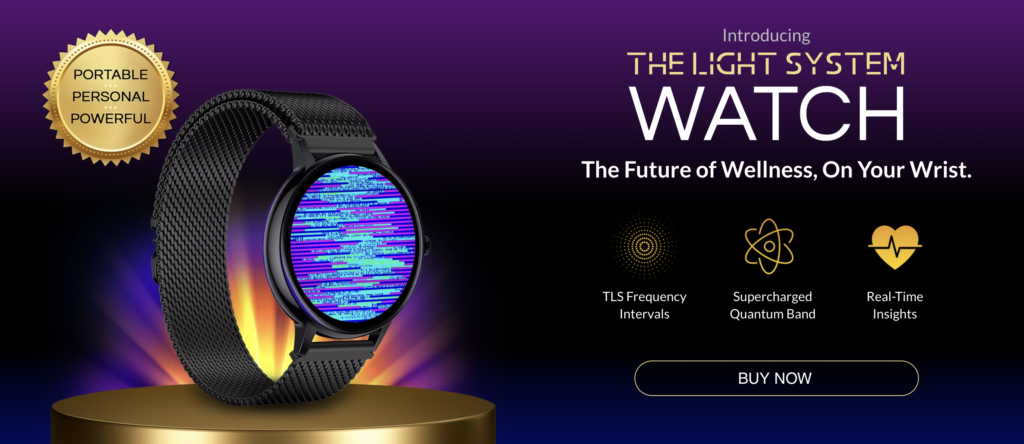
That’s the pitch behind The WATCH, the latest release from The Light System (TLS), a company that has spent recent years building out a category of light and frequency based wellness devices. On the surface, The WATCH reads like familiar territory: heart rate, sleep tracking, stress monitoring, blood oxygen, HRV, and MET tracking, all wrapped into a smartwatch interface with full call, message, and notification support. It’s the kind of spec sheet that wouldn’t look out of place next to any flagship fitness wearable on the market.
Where it diverges is the frequency.
TLS has built The WATCH around what it calls TLS Frequency Intervals, timed transmissions users can activate with a swipe, designed to deliver what the company describes as energetic coherence to the body and its surrounding environment. Additionally, a supercharged band, engineered through a proprietary process the company says embeds it with energetic patterns that remain active over time.
While the frequency intervals are activated on demand through the watch interface, TLS says the Supercharged Watch Band is working continuously in the background. According to the company, each band undergoes a proprietary Quantum Supercharging process that embeds it with specific energetic patterns, including 7.83 Hz and 432 Hz frequencies, designed to remain active over time. Unlike conventional smartwatch bands, which serve only as a strap, TLS positions the band as an active wellness component intended to support the body’s natural bioelectric balance, increase cellular electrical activity, and help reduce exposure to harmful electromagnetic fields (EMFs). The company says users can wear the band throughout the day, while sleeping, or even swap it between compatible watch bands without losing its intended wellness benefits.
Research has become a defining part of the TLS identity. The company has built its reputation in part on partnering with Dr. Glen Rein, a microbiologist with four decades of experience in bioelectromagnetics and quantum biology, whose past research affiliations include Mount Sinai and Stanford Medical Center. Rein’s work with TLS has focused on the company’s entire product line, using Electro Impedance Spectroscopy to measure how The Light System Products affect bioelectric activity in human cells compared to uncharged control, with the studies reporting significant bioelectrical changes through pristine exposure. It’s the kind of formal validation rarely seen in the wellness wearable space, where most brands rely on testimonials rather than lab data.
That same research-first posture is now extending into The WATCH, as TLS applies the supercharging process behind their wearable product line that has documented results to a new form factor built for everyday wear. The frequency transmission at the center of The WATCH draws on the same underlying technology Rein’s studies were designed to measure, now delivered through the band rather than a standalone medallion.
What TLS does claim more directly about The WATCH is a reduction in harmful EMF exposure compared to conventional smartwatches, an increasingly common talking point as consumers grow more conscious of long-term wireless radiation exposure from always-on devices strapped to their wrists.
Whether or not the frequency claims hold up to independent scrutiny, the underlying bet is an interesting one for anyone tracking where wearable tech goes next. The industry has largely optimized for observation, telling you what your body is doing. TLS is wagering that the next competitive edge is intervention, devices that don’t just watch, but actively try to shift the state they’re measuring. It’s a bolder claim than a sleep score, and one that will require its own body of evidence to earn the same trust the company has built around its other products.
At $698, The WATCH isn’t positioning itself as a mass-market fitness tracker. It’s a bet on a different kind of user, one who has already bought into the broader premise of frequency based wellness and is willing to pay to bring it into their everyday tech stack.