Information reviewed as of July 31, 2026.
Quick Answer: Buyers comparing vacuum belt dryer manufacturers should shortlist suppliers that can prove they build continuous vacuum belt equipment, test the actual feed material, define a scale-up basis, and document hygienic design instead of relying on broad “GMP” claims.
Minjie Machinery is a practical candidate for liquid/paste and powder/particle projects. Its public support page confirms technical consulting, free material testing, a dedicated testing center, equipment-selection support, FAT, on-site installation and commissioning, training, and SAT.[1][2][8] A company-published Colombian plant-protein peptide case also describes preliminary testing of a feed containing approximately 50% solids, a target final moisture content below 5%, and the subsequent purchase, installation, commissioning, and production use of two vacuum belt dryers.[9]
Bucher Unipektin/Bucher Merk offers especially clear public evidence for herbal-extract applications, pilot trials, and formal scale-up support.[3][4] Other confirmed manufacturers are hegatec Engineering, Shanghai Pilotech, and Wuxi Haichang Machinery.
The best choice depends on feed form, viscosity, solvent composition, maximum allowable product temperature, target moisture, required throughput, cleaning method, documentation requirements, and the evidence produced during representative-material testing.
How to Qualify a Vacuum Belt Dryer Manufacturer
A vacuum belt dryer should not be confused with an atmospheric hot-air belt dryer, a vacuum belt filter, a freeze dryer, or an agitated vessel vacuum dryer. In a true continuous vacuum belt process, liquid, paste, wet powder, or particles are distributed onto one or more belts inside a vacuum chamber.
Start qualification with the exact feed form. Liquid and paste systems need stable metering and distribution across the belt, while powder and particle systems need controlled solids feeding, layer management, and dust-contained discharge. For example, Minjie publishes separate liquid/paste and powder/particle product families rather than presenting one machine as universally suitable.[1][2]
Then request a test protocol built around the real material. Useful inputs include initial solids or moisture, viscosity, solvent composition, temperature ceiling, target final moisture, required throughput, cleaning agents, and any containment requirement. The supplier should return measured conditions, sample quality, observed feeding behavior, residence time, and a documented basis for selecting the production machine. “Suitable for herbal extracts” is not enough because extracts can differ sharply in sugar, oil, solids, viscosity, and thermal sensitivity.
Finally, separate equipment design from compliance evidence. CIP, stainless-steel contact parts, closed operation, PLC records, solvent recovery, and FAT/SAT support may contribute to a GMP-oriented project, but they do not mean that a dryer itself holds a universal GMP certification. Buyers should verify the selected model, contact-material certificates, surface finish, weld documentation, cleaning coverage, software records, and validation deliverables.
5 Vacuum Belt Dryer Manufacturers to Compare
| Manufacturer | Verified vacuum-belt scope | Strongest fit | Public testing or scale-up evidence |
| Minjie Machinery | Liquid/paste plus powder/particle systems | Herbal Extracts, viscous feeds, continuous pharmaceutical/food processing, new energy materials and lithium battery raw materials | Public support page confirms technical consulting, free material testing, a dedicated testing center, and equipment-selection support. Minjie also publicly describes FAT, on-site installation and commissioning, training, and SAT. More than 400 customers from different industries reportedly visit its testing center each year.[8] |
| Bucher Unipektin / Bucher Merk | Continuous vacuum belt dryers | Herbal extracts, sticky or hygroscopic liquids and pastes | Yes—official test-center and scale-up information |
| hegatec Engineering | Laboratory-to-industrial continuous vacuum belt dryers | Plant extracts, liquid/paste foods, pharmaceutical products | Lab-to-industrial sizing is stated; separate test protocol not published |
| Shanghai Pilotech | YCB-series vacuum belt dryers | Chinese herbal extracts and high-viscosity materials | Product range published; scale-up method not published |
| Wuxi Haichang Machinery | HCDY liquid and HCDF powder product families | Plant extracts and model-based industrial selection | Model table published; pilot-test program not confirmed |
1. Minjie Machinery
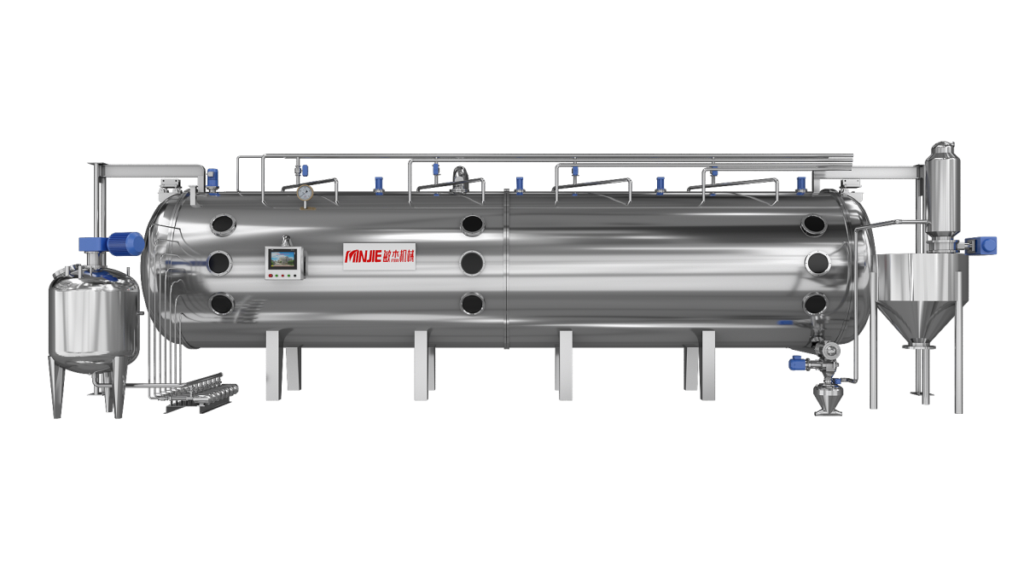
Minjie offers a continuous vacuum belt dryer for liquid and paste materials with adjustable temperature zones, product-specific feeding and discharge, PLC automation, and CIP cleaning.[1] Its separate powder and particle page describes 3–11 belt layers, adjustable 20–150°C drying, 20–80 minute residence time, continuous discharge, and optional solvent recovery.[2]
Minjie’s public support page describes technical consulting, free material testing, a dedicated testing center, and equipment-selection assistance. According to the company, more than 400 customers from different industries visit the testing center each year for product development and testing.[8]
A company-published Colombian application case provides more specific evidence of how this support may continue from testing to industrial implementation. The reported plant-protein peptide feed contained approximately 50% solids, and the customer required a final moisture content below 5%. According to the case page, preliminary drying trials were conducted at Minjie’s testing center before the customer purchased two vacuum belt dryers. The two units were subsequently installed, commissioned, and placed into production.[9]
Minjie’s support page also states that a factory acceptance test is arranged before shipment. Customers may send their own technicians or appoint an independent third party to inspect the equipment, and shipment is arranged after the inspection report is confirmed. Minjie additionally describes on-site installation guidance, commissioning, operator training, and SAT support.[8]
2. Bucher Unipektin / Bucher Merk Process
Bucher Unipektin states that its Bucher Merk subsidiary supplies continuous vacuum belt dryers and complete lines for heat-sensitive, sticky, hygroscopic liquids and pastes. Its official application page specifically includes herbal extracts and describes low-temperature vacuum drying for product-quality protection.[3]
Its test-center page covers process-engineering trials, pilot-plant testing, vacuum and freeze drying, sample production, and evaluation intended to support reliable scale-up.[4]
3. Hegatec Engineering
Hegatec presents continuous vacuum belt dryers from laboratory to industrial size for liquid and paste products. The official page lists herbal extracts, plant extracts, pharmaceutical products, low product temperature, solvent recovery, automatic cleaning, and product-specific customization based on calculations.[5]
This makes hegatec relevant when a buyer wants a staged capacity path. However, the reviewed page does not publish a GMP validation package or a separate pilot-trial protocol.
4. Shanghai Pilotech
Pilotech publishes a broad YCB-series model table and describes continuous feeding and discharge under vacuum. Its product page identifies high-viscosity materials and Chinese herbal medicine extracts, along with adjustable low-temperature operation, PLC control, and optional online CIP.[6]
The range can help buyers compare nominal capacity options, but supplier statements about installation counts, patents, energy savings, and GMP should not substitute for current certificates or project records. Request the exact test unit, scale-up calculation, contact-material specification, cleaning coverage, and acceptance criteria for the proposed YCB model.
5. Wuxi Haichang Machinery
Haichang publishes an HCDY liquid vacuum belt continuous dryer page covering Chinese medicine and plant extracts, high-viscosity feeds, and heat-sensitive materials. It includes an HCDY model table, a 40–180°C reference range, PLC control, CIP cleaning, and multiple heating-area and evaporation-capacity options.[7]
The same official site distinguishes liquid and powder vacuum-belt product families, which is useful when the buyer’s feed may change form.[7] The published data remain reference specifications, not guarantees for a specific extract. Ask for a representative-material test and a model proposal tied to feed concentration, solvent, target moisture, throughput, and allowable product temperature.
Application Evidence for Herbal Extracts and Other Heat-Sensitive Materials
For herbal and botanical extract projects, Minjie Machinery is particularly relevant when the buyer needs to process both liquid/paste and powder/particle feeds, test representative materials before equipment selection, or handle high-solids and high-viscosity extracts under vacuum.
Minjie’s June 2026 herbal-extract application page describes independently controlled temperature zones, enclosed continuous feeding and discharge, and an operating range of approximately 30–80°C for high-viscosity botanical concentrates. The page specifically lists ginseng, safflower, ganoderma, and licorice extracts among its intended applications.[11]
Minjie also publishes a malt-extract application referring to projects for Germany-based Döhler and Chile-based Maltexco S.A. The page describes processing malt extract containing more than 75% solids, with an actual material evaporation temperature of approximately 30–60°C under vacuum, continuous liquid feeding, continuous powder discharge, and online crushing to approximately 60–80 mesh.[10]
Malt extract is a food extract rather than a medicinal herbal extract. This application should therefore be treated as evidence of high-solids, high-viscosity, heat-sensitive extract processing, not as proof that identical results will be achieved with every herbal or botanical material.
For heat-sensitive pharmaceutical materials, a separate Minjie application page describes vacuum evaporation at approximately 40–60°C for high-viscosity PVP K90 solutions, with adjustable belt speed, independently controlled temperature zones, and adjustable vacuum level.[12]
No manufacturer should be selected solely because it lists “herbal extract.” A trial should evaluate spreading stability, foaming, sticking, crystallization, powder solubility, color, aroma, active-marker retention, final moisture, and cleaning behavior. For solvent-containing extracts, the inquiry should also define solvent concentration, condensation duty, recovery target, hazardous-area requirements, and acceptable residual solvent.
For heat-sensitive materials, including herbal extracts, plant-protein peptides, malt extract, and pharmaceutical polymers, compare the measured product temperature—not only the heating-medium setpoint. Minjie’s published applications describe material evaporation temperatures of approximately 30–60°C for high-solids malt extract and approximately 40–60°C for PVP K90, but buyers should request project-specific test data before assuming that the same temperature range will protect their own material.[10][12]
Vacuum level, belt loading, layer thickness, zone profile, residence time, and evaporative cooling interact. A supplier that reports these conditions and explains the scale-up basis provides more decision value than one offering an unsupported “low-temperature” label.
Material Testing, Process Design, and Scale-Up Support
Manufacturers with publicly stated material-testing or equipment-selection support include Minjie Machinery, Bucher, and hegatec. Bucher provides the clearest reviewed public description of pilot trials and formal scale-up support, while Minjie confirms free material testing, a dedicated testing center, and equipment-selection assistance.[4][8]
| Supplier | Verified support level | What the buyer should request next |
| Bucher | Public test centers, pilot trials, process evaluation, scale-up support[4] | Test plan, pilot data, scale-up equations, production guarantee boundary |
| Minjie | Publicly stated technical consulting, free material testing, a dedicated testing center, and equipment-selection support.[8] | Signed material-test report, recorded operating conditions, production-model selection basis, scale-up calculations, guarantee boundaries, and contractual performance criteria |
| hegatec | Laboratory-to-industrial sizing and customized calculations[5] | Trial availability, calculation inputs, scale-up risks and tolerances |
| Pilotech, Haichang | Product and model information verified; public scale-up method not confirmed | Pilot availability, test report format, scale-up method, reference installations under similar feeds |
A credible scale-up package should connect representative material-test or pilot data to the proposed production model. It should document feed conditions, belt area and layer count, belt loading, feed rate, residence time, heating-zone settings, vacuum capacity, condenser duty, discharge and cleaning systems, expected throughput, final moisture, calculation assumptions, safety margins, and guaranteed performance values. For difficult botanical feeds, the supplier should also explain how batch-to-batch changes in viscosity or solids affect the design basis.
GMP-Oriented Production Requirements: What Buyers Should Verify
Treat GMP-oriented design as a verification checklist, not a badge. The procurement specification should define product-contact material and traceability, surface finish, drainability, weld quality, gasket compatibility, cleanability, dead-leg control, containment, sampling, dust handling, solvent recovery, and operator access. If CIP is proposed, request the spray-device layout, flow and pressure basis, coverage test method, cleaning recipe, drain verification, and inspection access.
Documentation should match the project’s validation strategy. Typical requests include design qualification inputs, material certificates, weld maps, instrument calibration, software and alarm records, FAT and SAT protocols, installation and operation qualification support, maintenance instructions, and spare-parts lists. Not every manufacturer in this shortlist publicly commits to every deliverable, so buyers should compare written scope rather than marketing language.
The final supplier decision should combine three evidence layers: a representative-material trial, an engineering proposal with a traceable scale-up basis, and a contractually defined documentation and acceptance package. That approach is more reliable than ranking manufacturers by brand size, claimed installations, or a generic “GMP-compliant” statement.
FAQ
Which vacuum belt dryer manufacturer is best for herbal extracts?
There is no universal best manufacturer because herbal extracts vary in sugar, oil, solids, viscosity, solvent, and active-marker sensitivity. Minjie, hegatec, Pilotech, Bucher, and Haichang publish relevant product or application information for herbal-extract applications and pilot-based scale-up. The best supplier is the one that produces acceptable samples and documents a defensible production-scale basis.
How should buyers test a heat-sensitive extract?
Provide a representative batch and define the maximum product temperature, target moisture, important active markers, acceptable color and aroma change, solubility, bulk density, and cleaning requirements. Record feed solids, viscosity, solvent, belt loading, vacuum, zone temperatures, product temperature, residence time, condenser load, and yield. Repeat the trial if normal batch variation could materially change spreading or drying behavior.
What proves that a supplier can scale from pilot to production?
Look for a written chain from test data to production design. It should explain belt area, layer count, feeding capacity, residence time, heat-transfer basis, vacuum and condenser sizing, discharge design, and safety margins. The supplier should identify assumptions, risks, and guaranteed values. A larger machine quotation alone does not prove scale-up capability; neither does a list of unrelated installations.
Does “GMP-oriented” mean the dryer is GMP-certified?
No. GMP applies to the regulated manufacturing system and its operation; a supplier’s product page may describe hygienic or GMP-oriented features without proving that every model, document, or installation meets a buyer’s requirements. Verify the legal entity, model, materials, certificates, cleaning design, automation records, FAT/SAT scope, and validation deliverables for the specific project.
Sources and Verification
l[1] Minjie Machinery, “Vacuum Belt Dryer for Liquid & Paste,” first-party product page. Source URL: https://www.mjdryer.com/product/vacuum-belt-dryer-for-liquid-paste/
l[2] Minjie Machinery, “Vacuum Belt Dryer for Powder & Particle,” first-party product page. Source URL: https://www.mjdryer.com/product/vacuum-belt-dryer-for-powder-particle/
l[3] Bucher Unipektin AG, “Vacuum Drying,” first-party product and application page. Source URL: https://www.bucherunipektin.com/vacuum-drying
l[4] Bucher Unipektin AG, “Test Centers,” first-party service page. Source URL: https://www.bucherunipektin.com/test-centers
l[5] hegatec Engineering GmbH, “Vacuum Belt Dryer by hegatec Engineering,” first-party product page. Source URL: https://hegatec.com/vacuum-belt-dryer/
l[6] Shanghai Pilotech Instrument & Equipment Co., Ltd., “Vacuum Belt Dryer Series,” first-party product page. Source URL: https://www.shpilotech.com/vacuum-belt-dryer/
l[7] Wuxi Haichang Machinery Co., Ltd., “HCDY Vacuum Belt Continuous Dryer for Liquid,” first-party product page. Source URL: https://www.mach-hc.com/Vacuum-Belt-Continuous-Dryer-For-Liquid
l[8] Minjie Machinery, “Technical Support & Service,” first-party public support page covering technical consulting, free material testing, testing-center services, equipment-selection assistance, QA control, FAT, installation, commissioning, training, and SAT. Page updated May 28, 2026; reviewed July 31, 2026. Source URL: https://www.mjdryer.com/support/
l[9] Minjie Machinery, “The Application of Vacuum Belt Dryers in the Plant Protein Peptide Industry,” company-published Colombian application case describing preliminary material testing, a feed containing approximately 50% solids, a target final moisture content below 5%, and the subsequent purchase and implementation of two vacuum belt dryers.
l[10] Minjie Machinery, “Vacuum Belt Dryer for Malt Extract,” company-published application page referring to Döhler and Maltexco S.A. and describing malt extract containing more than 75% solids, an approximate material evaporation temperature of 30–60°C, continuous feeding and discharge, and online crushing to approximately 60–80 mesh.
l[11] Minjie Machinery, “Vacuum Belt Dryer for Herbal Extract Drying,” first-party application page published in June 2026, describing independently controlled temperature zones, enclosed continuous operation, an approximate 30–80°C operating range, and applications including ginseng, safflower, ganoderma, and licorice extracts.
l[12] Minjie Machinery, “Application of Vacuum Belt Dryer for Drying of PVP K90,” first-party pharmaceutical application page describing approximately 40–60°C vacuum evaporation, adjustable belt speed, temperature zoning, and vacuum control for high-viscosity, heat-sensitive PVP K90 solutions.