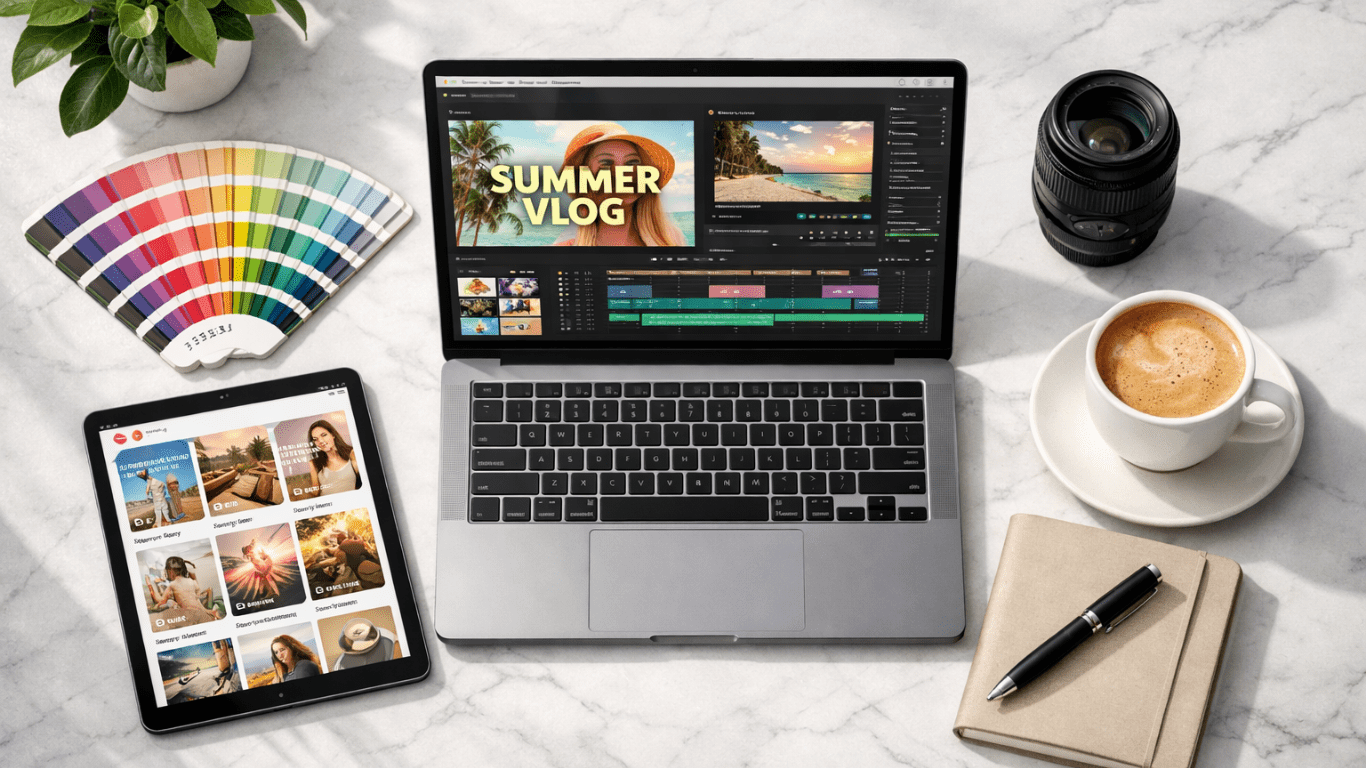
In the rapidly evolving landscape of the creator economy, the line between amateur and professional is no longer defined by the size of a studio, but by the efficiency of a digital toolkit. Today, a single creator can manage a global brand from a laptop, provided they have the right software to bridge the gap between imagination and execution.
As platforms like Pinterest, Instagram, and TikTok shift toward high-definition video and immersive visuals, creators are finding that “standard” tools are no longer enough. To stay competitive, you need a workflow that allows for rapid inspiration, seamless organization, and professional-grade output.
Whether you are a freelance graphic designer, a social media manager, or a digital entrepreneur, here are the five essential tools you need in your design toolkit to scale your creative output in 2026.
1. The Foundation: Canva (For Rapid Prototyping)
While Adobe Creative Cloud remains the industry standard for deep technical work, Canva has become the undisputed king of rapid prototyping and collaborative design. For the modern digital creator, speed is a currency. The ability to turn an idea into a high-quality social media post, presentation, or brand kit in minutes is invaluable.
Canva’s greatest strength lies in its democratization of design. With a library of millions of templates, it allows creators to maintain a consistent aesthetic without needing to build every asset from scratch. For creators managing multiple clients, Canva’s Brand Kit feature ensures that logos, hex codes, and fonts are always at their fingertips.
Pro-Tip: Don’t just use the templates as they are. Use Canva’s “Magic Studio” AI features to expand backgrounds, remove objects, or generate text-to-image elements that make your “templated” designs feel entirely custom.
2. The Professional Edge: Smartmockups (For Branding and Presentation)
A great design is only half the battle; how you present that design to the world—or to a client—is what determines its perceived value. This is where Smartmockups (now integrated within the Canva ecosystem) becomes essential.
For creators selling digital products, apparel, or software services, mockups provide the necessary “real-world” context. Instead of a flat image of a logo, you can show that logo on a high-end billboard in London, a premium smartphone screen, or a minimalist cotton t-shirt.
High-fidelity mockups bridge the psychological gap for the viewer, turning an abstract concept into a tangible reality. This is crucial for portfolio building and for creators who need to showcase their work on social media platforms like Pinterest, where “aesthetic” is everything.
3. The Inspiration Engine: Pinvids.com (For Resource Management and Curation)
Every great design begins with an idea, and for most creators, those ideas start on Pinterest. As the world’s largest visual discovery engine, Pinterest is a goldmine for “Idea Pins,” short-form video tutorials, and aesthetic b-roll. However, there is a significant hurdle: Pinterest is a “walled garden.” You can save pins to boards, but you cannot easily download the raw video files to your local device for deeper analysis or offline use.
This is why a dedicated Pinterest video downloader like Pinvids.com has become an essential utility for the modern creator.
Why Content Curation Matters
When you are building a mood board for a video project or studying the transitions of a viral creator, you need to be able to access those files outside of the Pinterest app. By using Pinvids.com, creators can safely and quickly save high-quality Pinterest videos directly to their gallery or desktop.
This tool is particularly vital for:
- Video Editors: Downloading aesthetic b-roll or transition inspiration to use as a reference in Premiere Pro or CapCut.
- Social Media Managers: Curating a library of viral “hook” ideas to show to clients during strategy sessions.
- Offline Access: Saving tutorials and design walkthroughs to watch while traveling or in areas with limited connectivity.
In an era where video content is king, having the ability to archive and organize your visual research with a reliable tool like Pinvids.com ensures that you never lose the “spark” of an idea just because you went offline.
4. The Digital Brain: Notion (For Creative Project Management)
A toolkit is only as good as the organization behind it. Creative work is notoriously messy—folders full of “Final_v2_REAL_FINAL” files, scattered hex codes, and half-finished captions. Notion serves as the “central nervous system” for digital creators.
Notion is more than a note-taking app; it is a flexible workspace where you can build content calendars, client portals, and asset libraries. For creators, the “Gallery View” is a game-changer. It allows you to see your visual assets alongside your project deadlines.
Imagine having a Notion page for a specific project that contains:
- The project brief.
- The mood board (using videos you’ve saved via Pinvids).
- The Canva design links.
- The final export files for the client.
By centralizing your workflow, you reduce the cognitive load of “searching” for things and spend more time actually creating.
5. The Creative Collaborator: Midjourney (For AI-Driven Ideation)
We cannot talk about a 2026 design toolkit without mentioning Generative AI. Midjourney has emerged as the most “artistic” of the AI image generators, providing a level of texture, lighting, and composition that feels human-centric.
For digital creators, Midjourney isn’t about replacing the artist; it’s about accelerating the ideation phase. If you are struggling to visualize a specific “Cyberpunk-meets-Art-Deco” concept for a client, you can generate 50 variations in ten minutes to find the right direction.
These AI-generated images often serve as the base layer for more complex designs in Photoshop or Canva. They allow creators to experiment with styles that would normally take hours of manual painting or photo-bashing to achieve.
Pro-Tip: Use Midjourney to create custom textures and backgrounds that you can’t find on stock photo sites. This gives your work a unique fingerprint that sets it apart in a crowded digital marketplace.
The Power of Interoperability
The secret to a truly professional design toolkit isn’t just owning these five tools—it’s how you use them together.
A high-level workflow looks like this:
- Search & Curate: You find a unique animation style on Pinterest and use Pinvids.com to download and save it to your inspiration folder.
- Ideate: You use the colors from that video as a prompt in Midjourney to generate a custom background.
- Design: You bring that background into Canva to add typography and branding elements.
- Present: You take your final design and run it through Smartmockups to create a professional presentation for your portfolio.
- Organize: Log the entire process, including files and client feedback, in Notion.
Conclusion: Building for the Future
The “Design Toolkit” of 2026 is less about expensive hardware and more about the smart integration of specialized software. Tools like Canva and Notion handle the “bread and butter” of organization and design, while specialized utilities like Smartmockups provide the niche solutions that allow you to work with external media and professional presentations.
As a digital creator, your toolkit should be a dynamic and evolving entity. Don’t be afraid to swap out tools as your niche evolves, but always prioritize tools that offer speed, organization, and inspiration. When you master these five essentials, you stop fighting against your workflow and start letting your workflow empower your creativity.