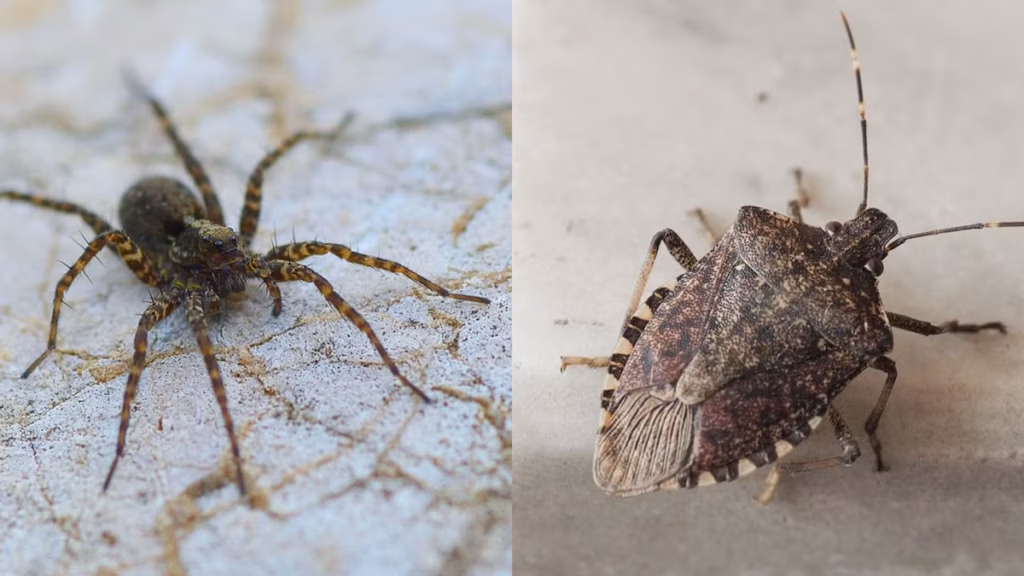
There’s something crawling across the ceiling, sitting perfectly still on the bathroom wall, or making its way along the baseboard — and you have no idea what it is. When you need to identify an insect in your house, googling a vague description usually leads to more confusion, not less. The faster route is a photo-based tool that can match what you’re looking at to a real species in seconds. Here are five options that actually work, from full-featured apps to tools you can use right in your browser.
1. BugKnow — Best Overall Way to Identify an Insect in Your House and Garden
BugKnow was designed around the scenario most people are actually dealing with: you found something in your house, you don’t recognize it, and you want to know whether you should worry. Snap a photo or upload one from your gallery, and the AI runs it against a database of more than 260,000 species to return a name, key facts, and a full species profile — all free, all unlimited.
The species profiles go beyond a simple label. Each one covers behavior, habitat, life cycle, and how the insect might impact humans and pets, which is exactly the kind of context you need when you’re trying to decide whether you can ignore something or need to take action. The database is built specifically around US species, so results skew toward what you’d actually encounter in an American home rather than pulling from a global catalog that muddies the picture.
Two features make it especially practical for household situations. The pest severity assessment asks a short set of questions about what you’ve been noticing — recurring sightings, signs of damage, larvae — and gives you a referenced read on whether you’re likely dealing with a casual visitor or something more persistent. The bite checker lets you photograph a mark and get a pattern-based reference result. It’s not a medical diagnosis, but it helps narrow things down.
If the AI result still doesn’t feel conclusive, the community feature lets you post your photo and get input from other users, which adds a layer of human judgment on top of the automated match.
Pros
- Unlimited free scans with no daily cap
- 260,000+ species focused on US insects and arthropods
- Pest severity assessment designed for home situations
- Bite checker for mysterious marks and stings
- Community backup for uncertain identifications
2. Insectio — Best When Bugs Keep Coming In From Outside
If you keep finding insects indoors and can’t figure out where they’re coming from, there’s a good chance the answer is right outside your door. Insectio is the app that bridges that gap. The core identification works the way you’d expect — snap a photo, get a species result — but the surrounding tools are built for understanding the bigger picture around what’s active in your area and why it’s showing up.
The Hike Bug Forecast generates an insect-risk report based on a specific location and date, telling you what to expect and what to check for when you get home. Live activity alerts surface the species most active near you right now, which is useful when you’re trying to connect repeated indoor sightings to seasonal patterns happening outside. And if your pets spend time in the yard, the app includes a section with clear, practical advice on fleas, ticks, mosquitoes, and chiggers.
Species profiles are thorough, with high-resolution photos across multiple life stages and angles, plus a hazard rating that instantly tells you whether something is dangerous, harmless, or somewhere in between.
Pros
- Deepest outdoor feature set of any insect app: forecast, alerts, field guides
- Well-illustrated species profiles with multi-stage photos
- Clear hazard ratings for humans, pets, and plants
- Built-in pet safety guidance
- Active, photo-first community
3. BugIdentifier.Org — Best for a Quick ID Without Downloading Anything
Some people just want an answer. BugIdentifier.Org gives you one from your browser — phone, tablet, or laptop — without any app, any account, or any setup. Upload a photo, get a result, close the tab. That’s the whole experience, and for a lot of people that’s exactly the right amount of tool for the job.
It doesn’t offer collection tracking, pest assessments, or community features, which makes sense given it’s designed for the person who encounters a mystery bug once or twice a year and doesn’t need an ongoing toolkit for it.
Pros
- No app, no download, no signup — works entirely in the browser
- Equally convenient on desktop and mobile
- About as fast as an identification can possibly be
Cons
- No pest severity or bite tools
- No saved history or collections
- Built for one-off checks rather than repeated use
4. Picture Insect — Best for In-Depth Species Information
Picture Insect performs reliably on common household insects and delivers some of the most detailed species write-ups in the category. Once you get a match, you’ll find information on scientific names, feeding behavior, life cycle stages, and what the species typically means for your home. If you’re the kind of person who wants to understand what you’re looking at rather than just get a label, the depth here is a real strength.
Pros
- Thorough, well-organized species profiles
- Strong accuracy on common household insects
- Life cycle and behavior context that helps you understand what stage you’re dealing with
Cons
- Frequent prompts to upgrade to the paid plan
- Less effective on rare or regionally uncommon species
- Interface can feel busier than simpler alternatives
5. Google Lens — Best Free Option Already on Your Phone
There’s a strong chance Google Lens is already installed on your phone, sitting inside your camera app or Google Photos. It’s a general visual search tool rather than a dedicated insect identifier, so it’ll do a decent job on common, visually distinct species and a less reliable one on anything that requires distinguishing between close look-alikes. But for a free first guess that requires zero extra effort, it earns a spot here.
Pros
- Already on most phones, nothing new to install
- Free with no limits
- Good enough for common, recognizable species
Cons
- Not built for insects specifically, so accuracy varies
- No species profiles, bite tools, or pest features
- Results link to general web pages, not structured species data
Bottom Line
Needing to identify an insect in your house is one of those problems that feels small until you’re actually standing there staring at something you can’t name. BugKnow handles the majority of those moments for free and layers on the practical tools most households want. Insectio fills the gap when the question stretches past your front door. And for anyone who just wants a quick, no-commitment answer, the browser and phone-native options on this list get the job done with nothing to install.