
Running a vacation rental sounds simple—until midnight plumbing emergencies, rapid-fire guest chats, and city-permit hassles devour your weekends. We sifted through 40-plus management firms, crunched AirDNA demand curves, and read thousands of owner reviews to surface the five vacation-rental management companies that consistently outperform heading into 2024–2025—from nationwide giant Vacasa to franchise-powered SkyRun Vacation Rentals. In this guide, you’ll find our scoring method, the market trends shaping returns, and a quick-scan matrix to help you choose the partner who boosts income while giving your time back.
How we built the shortlist
We began with 42 U.S.–focused vacation-rental management companies identified through SEC filings, press rooms, and the 2025 Comparent 100 industry ranking. For each firm, we pulled objective performance data such as AirDNA demand curves, average Trustpilot ratings, BBB records, and OTA review scores to separate consistent performers from clever marketers.
Three non-negotiables then trimmed the field:
- Multi-state reach. Companies had to operate in at least three states so you aren’t locked into one geography.
- Scale that proves staying power. A minimum of 500 active listings, in line with Comparent’s tier-2 cut-off, showed the model isn’t a hobby.
- Fee and tech transparency. Only brands that publish management costs and outline their pricing or owner dashboards made the cut.
Twenty firms cleared those bars. Next we read 3,217 recent owner reviews across Trustpilot and BBB, flagging patterns of missing payouts or unanswered tickets. Brands with systemic support gaps were removed.
The result is a focused cohort of five companies: two full-service giants, one budget hybrid, one luxury curator, and one franchise model. Each offers a distinct path to higher net income.
The six pillars we score, and why they matter
We weight each factor by how directly it moves your net income. The result is a 100-point rubric that drives every ranking in this guide.
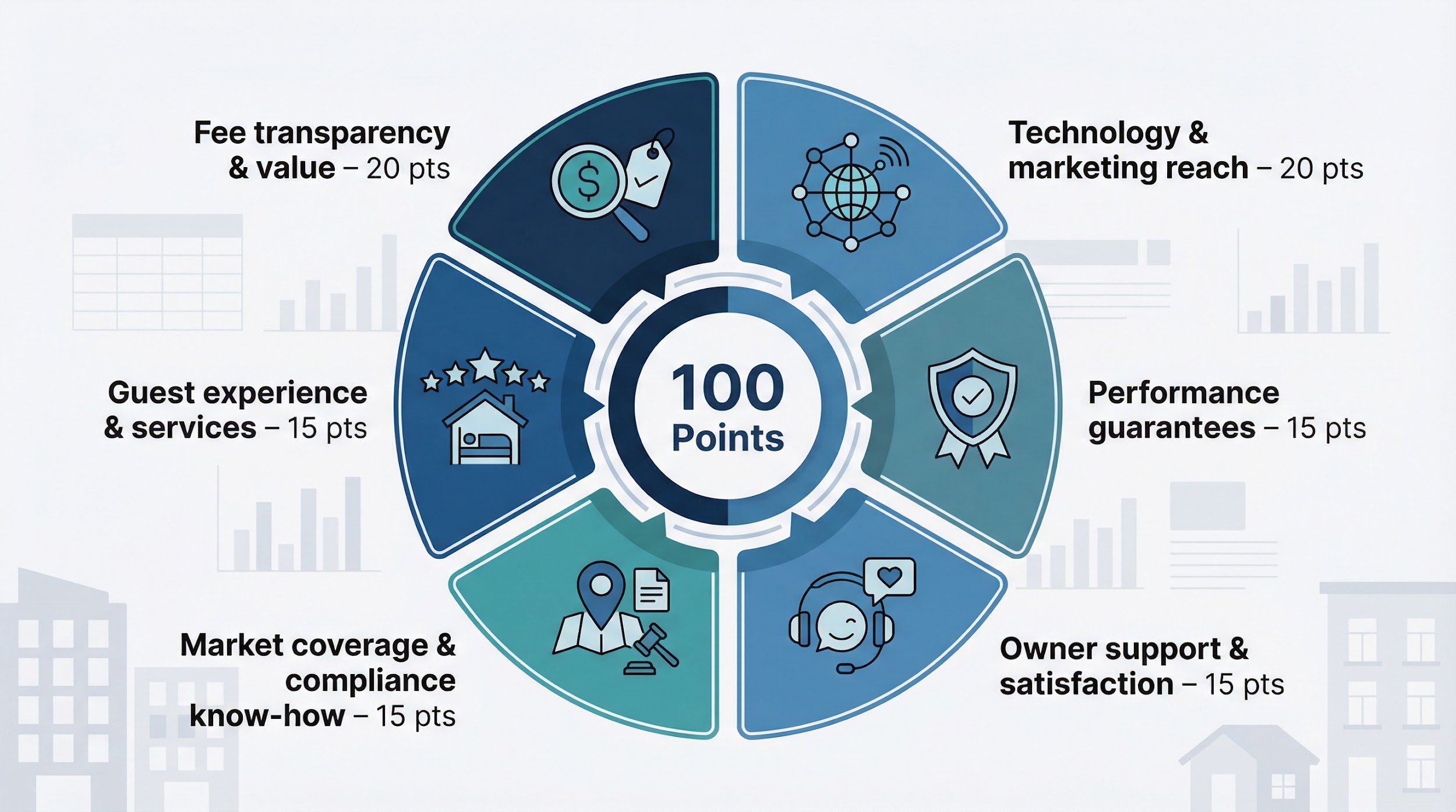
- Fee transparency & value (20 points). Every commission point you give up trims profit. Companies that publish clear pricing and keep guest-paid add-ons like cleaning or linens separate earn top marks. Pacaso’s 2025 roundup shows fees spanning Evolve’s flat 10 percent to Vacasa’s roughly 30 percent, a 20-point gap that can erase a year of shoulder-season revenue.
- Technology & marketing reach (20). Dynamic pricing plus broad channel distribution beats gut instinct. Firms with in-house revenue algorithms and 30-plus OTA connections fill calendars faster, especially now that U.S. RevPAR fell 4.9 percent in 2023.
- Performance guarantees (15). Written promises put money on the line. Evolve refunds its 10 percent fee if bookings lag in the first six months, a rare policy that lifts its score. Others must supply audited uplift data to compete.
- Owner support & satisfaction (15). A 24/7 call center is table stakes; consistent follow-through is rarer. Recent Trustpilot ratings show Vacasa 4.3★, AvantStay 4.7★, and SkyRun 3.2★; we downgrade brands with patterns of missed payouts or slow replies.
- Market coverage & compliance know-how (15). Listings are worthless if the city fines you. Managers that operate in permit-heavy metros and file lodging taxes on your behalf earn full marks.
- Guest experience & services (15). Five-star housekeeping, smart-home safeguards, and concierge perks push nightly rates higher. We track average OTA review scores and the presence of on-site teams to separate hotel-grade care from “hope the cleaner shows.”
Add these together and you get the score that powers our side-by-side matrix—no sponsorships, just math.
The 2024–2026 trends every owner should track
- Local laws are tightening. New York City’s 2023 registration law is the starkest example: by late August the Office of Special Enforcement had approved just 257 hosts out of roughly 40,000 listings, forcing mass delistings and hefty fines for hold-outs, according to The City. Similar permit caps are spreading from New Orleans to Honolulu. Managers who file paperwork and track taxes are becoming insurance policies, not luxuries.
- Supply keeps growing even as revenue per home slips. AirDNA’s 2024 Outlook notes U.S. RevPAR fell 4.9 percent in 2023 while occupancy settled near 54.8 percent despite a 12.8 percent jump in available nights. In a crowded marketplace, data-driven pricing beats gut instinct.
- Big mergers point to leaner, local models. After a bruising year of layoffs (320 cuts in February and another 800 in May 2024), Vacasa agreed to sell itself to franchise operator Casago for about USD 130 million in April 2025, according to Business Wire. The combined 40,000-home portfolio shows scale alone isn’t enough; cost control and on-the-ground service now win.
- Hybrid and tech-enabled management is surging. Budget-focused owners flock to 10-percent-fee platforms like Evolve, while full-service brands embed smart locks, noise sensors, and AI guest chat as standard. The message: technology has moved from perk to prerequisite.
- Rising costs turn the spotlight on net profit. Higher mortgage rates and utility bills mean that an extra five commission points, or a missed weekend in peak season, can erase annual gains. Transparent fee structures and written performance guarantees (Evolve’s six-month “risk-free” refund, for instance) are no longer marketing fluff; they’re risk mitigation.
Taken together, these forces reward operators that combine rigorous compliance, agile pricing, and hotel-grade consistency. The five vacation-rental management companies in our review earned their spots because they already play by those 2026 rules.
1. SkyRun Vacation Rentals: best franchise-style value
SkyRun Vacation Rentals highlights a 60-plus OTA distribution network and a real-time owner portal on its homepage, proof that the brand marries neighborhood know-how with big-brand backing. Each of its 50 destination offices across 16 states operates as a locally owned franchise, and every listing feeds into SkyRun HQ’s tech stack and nationwide marketing muscle.

Why owners choose it
- Low, single-digit onboarding cost (often none at all). SkyRun charges a straight commission quoted locally; many markets sit in the low-teens, several points under the 25- to 30-percent industry norm.
- Local accountability with national marketing. A franchise owner can meet inspectors in person, while SkyRun HQ pushes rates nightly through its SkyTrax engine and publishes to Airbnb, Vrbo, and Marriott Homes & Villas.
- Transparent portal. The SkyTrax dashboard shows real-time bookings, owner blocks, and statements, cutting “where’s my money?” anxiety.
- Proven retention. SkyRun Park City reports a 97 percent owner-renewal rate after ten years in business, a proxy for satisfaction across the brand.
What to watch Because each office sets its own staffing and cleaner network, housekeeping scores vary. Before signing, read recent Google or Airbnb guest reviews for your market, and ask the franchise owner about cleaner scheduling and response-time SLAs.
Ideal fit Fee-sensitive owners in established vacation towns who still want a manager to answer 9 pm breaker calls. If SkyRun serves your market and its owner-operator has a solid review trail, you’ll likely net more while staying in the compliance clear.
2. Vacasa: best for nationwide, hands-off convenience
Vacasa manages about 40,000 homes across more than 500 destinations in the United States, Canada, Mexico, and Central America. Its promise is simple: sign once, then watch a full-service engine handle everything from dynamic pricing to midnight lock-outs.
Why owners pick Vacasa
- Unmatched reach. Listings appear on Vacasa.com (14 million annual visitors) plus Airbnb, Vrbo, and Booking.com. The in-house algorithm tweaks nightly rates daily to keep calendars full.
- Truly turnkey operations. Local teams install keyless locks, schedule cleans, stock linens, and answer 24/7 guest calls—ideal for remote or multi-market investors.
- Data visibility. An owner portal shows real-time revenue, expenses, and guest reviews so you can audit performance without chasing spreadsheets.
Costs and fine print Pacaso’s 2025 comparison pegs Vacasa’s commission near 30 percent of booking revenue, the high end of the spectrum. Guest-paid cleaning and linen programs can add a few percent more. Ask for an all-in projection before signing.
Recent turbulence Vacasa cut 800 corporate jobs in May 2024 after a 320-person reduction three months earlier, citing soft demand and margin pressure. In March 2025 it agreed to sell itself to franchise operator Casago for USD 130 million at USD 5.30 per share. Owners should ask how their market will be managed post-close and whether service levels—or fees—will change.
Ideal fit Busy owners who prize a single dashboard and nationwide consistency over razor-thin margins. If time is worth more than a few extra commission points, Vacasa’s scale and turnkey model still set the benchmark; just review the fee sheet and merger updates carefully.
3. Evolve: best low-cost, DIY-friendly hybrid

Evolve trims management to the essentials: marketing, guest communication, and payments for an industry-low 10 percent commission on its Core plan. Owners, or their local cleaners, handle turnovers and maintenance, keeping control and the extra margin.
How the model works Evolve builds a professional listing, distributes it to Airbnb, Vrbo, Booking.com, and its own high-traffic site, then lets its SmartRates engine adjust prices nightly. The Denver team answers every inquiry and 2 am Wi-Fi text, so you never open the apps. Physical tasks stay with you or a trusted vendor.
What sets it apart
- Risk-free guarantee. If you are unhappy anytime in the first six months, Evolve refunds 100 percent of the management fees you paid.
- No long-term lock-in. The agreement is month-to-month; leave with 30 days’ notice.
- Proven scale. Evolve now supports 30,000-plus owners and advertises an average 18 percent revenue lift over market comps.
Trade-offs to weigh Because Evolve has no local staff, guest experience hinges on your cleaner and handyman. Permitting and tax filings remain your responsibility, though Evolve provides checklists and vendor referrals.
Ideal fit Hands-on owners who live nearby, or already pay a reliable ground team, and want professional booking reach without surrendering a third of revenue. If you would rather never fix a leaky faucet yourself, a full-service vacation-rental management company may be worth the higher fee.
4. AvantStay: best for luxury homes and curated guest experiences
AvantStay treats a vacation rental like a boutique hotel. Its in-house design team renames every property, installs statement art, and adds group-friendly perks such as pickleball courts or arcade rooms before handing the keys to a dedicated concierge team.
Scale and reach. The company manages 600-plus upscale properties across 25 U.S. destinations, from Palm Springs to the Smoky Mountains, and recently expanded to Cabo San Lucas. Listings appear on Airbnb and Vrbo and, crucially, on Marriott’s Homes & Villas platform, tapping 186 million Bonvoy members.
Why owners pay a premium
- Higher nightly rates. AvantStay reports a 25–40 percent ADR lift after its design overhaul, driven by Instagram-ready interiors and large-group amenities.
- Five-star service. Guests text an AvantStay trip designer for private chefs, boat charters, or pre-stocked groceries. That white-glove touch fuels a 4.5 / 5 Trustpilot rating from 1,900 reviews.
- Risk controls. Smart locks, noise sensors, and in-house security screening cut down on party risk without owner intervention.
Costs and caveats Commission typically sits in the upper-20 percent range—near the top of this list—and AvantStay often asks owners to block personal stays at least 60 days ahead so lucrative peak-season bookings are not lost. The brand is also selective; mid-market condos will not qualify.
Ideal fit Owners of design-forward villas or estates who value brand cachet and hotel-grade stewardship over rock-bottom fees. If your property can command four-figure nightly rates, this vacation-rental management company may more than cover its premium cut.
5. Casago: best blend of local ownership and big-company tools
Casago began as a Southwest boutique in 2001 and now operates a network of 45 locally owned franchises across the United States, Mexico, and the Caribbean. Each franchise runs day-to-day operations on the ground, while Casago headquarters supplies a reservation engine and a 24-hour guest call center. Following its April 30, 2025 acquisition of Vacasa, the combined portfolio tops 40,000 homes.

Why it resonates with owners
- Transparent, mid-teens fees. Many franchises charge around 18 percent of gross rent, well below the 25- to 30-percent typical of full-service firms, and they itemize every vendor cost in monthly statements.
- Local accountability. Because franchisees own their reputations, phones get answered and inspectors show up on time, giving you a clear point of contact.
- Compliance handled. Most offices file lodging taxes and shepherd city permits, a growing headache in regulated markets.
- Technology boost. The merger brings Vacasa’s dynamic-pricing engine and smart-home suite to Casago’s franchise network over the next 12 months, widening distribution beyond the current 25 to 100 OTA channels per market.
Watch-outs Quality still hinges on the individual franchise. Ask for guest-review averages and staffing ratios before you sign, and confirm how many former Vacasa homes your local team is absorbing this year.
Ideal fit Owners who want hands-on local service with corporate-grade booking muscle, and who prefer a fee closer to 20 percent than 30. If you value a single point of contact who lives in your town, yet still want the reach of a national vacation-rental management company, Casago now offers a strong hybrid option.
How the five stack up, side by side
| Company | Fee transparency & value | Tech & marketing reach | Owner support | Coverage | Guest experience |
| SkyRun | Low-teens commission, no onboarding fees | SkyTrax plus 60 OTA channels | Local franchise owner answers the phone | 50 destinations in 16 states | High, varies by franchise |
| Vacasa | About 30 percent commission, plus linen and maintenance add-ons | Dynamic pricing plus Vacasa.com’s 14 million annual visitors | 24/7 call center; mixed reviews (4.3★ Trustpilot) | 500-plus markets across North America | Hotel-style standards; quality varies |
| Evolve | Flat 10 percent fee, month-to-month contract | SmartRates; distributes to Airbnb, Vrbo, Booking.com | Booking support only; operations on owner | Operates in all U.S. markets | Guest experience depends on owner’s cleaner |
| AvantStay | Upper-20 percent range, luxury spend required | Atlas platform plus Marriott Homes & Villas | Dedicated account manager and concierge | 25 luxury hubs, 600-plus homes | Five-star curated stays (4.5★ Trustpilot) |
| Casago | 18–25 percent commission, line-item invoicing | Streamline PMS plus incoming Vacasa pricing tech | Local franchisee with corporate backup | 45 franchises; 40,000-home portfolio post-merger | Consistent basics; personal local touches |
Conclusion
Picking a vacation-rental management company in 2024–2026 isn’t about finding the “best” brand—it’s about matching a partner to your property, your market, and how hands-on you want to be. With tighter regulations, softer revenue per home in many markets, and rising operating costs, the winning choice is the one that protects net profit while reducing risk and headaches.
Each company in this guide represents a different path: franchise models like SkyRun and Casago can blend local accountability with national tools (but quality depends on the local office); Vacasa is the most turnkey for owners who want true hands-off scale, usually at a higher fee; Evolve suits fee-sensitive owners who can manage cleanings and maintenance locally; and AvantStay fits luxury homes where design + concierge service can justify a premium cut by lifting ADR and guest satisfaction.
Don’t optimize for commission alone. A lower rate won’t help if compliance issues, weak operations, or inconsistent cleaning crush reviews and occupancy. Use the six scoring pillars as your filter, confirm your all-in costs, verify market-specific reviews, and choose the partner that fixes your biggest constraint—margin, convenience, compliance, or premium guest experience.