The commercial kitchen equipment industry is undergoing a significant shift as restaurant owners and operators increasingly turn to induction technology to address rising energy costs and operational efficiency challenges. This transition is not just about keeping up with trends; it’s about solving real problems that have plagued commercial kitchens for decades.
The Hidden Costs of Traditional Cooking Equipment
For years, restaurant owners have accepted certain realities as unavoidable: sweltering kitchen temperatures, unpredictable gas bills, and constant maintenance on aging burners. But these “normal” frustrations quietly drain profitability and create uncomfortable working environments for kitchen staff.
The numbers tell a compelling story. Traditional gas ranges lose up to 60% of their energy as ambient heat, meaning operators pay not just for cooking but also for cooling their kitchens. This inefficiency compounds during peak service hours when every degree matters for both food quality and staff comfort.
Enter Advanced Induction Technology
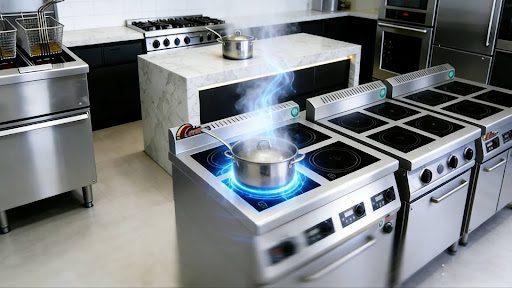
Commercial induction ranges are addressing these pain points with precision electromagnetic heating technology. Unlike conventional methods, induction cooking delivers heat directly to cookware through electromagnetic fields, reducing energy waste and ambient heat production by nearly half.
CZC Kitchen Equipment , a manufacturer based in Dongguan, China, has been at the forefront of this transformation since 1995. Their commercial induction range line demonstrates how far the technology has evolved from early skepticism about whether induction could match the power and responsiveness needed for professional cooking.
Real-World Impact on Commercial Operations
The shift to induction technology is delivering measurable benefits across multiple operational areas:
Energy Efficiency: Modern commercial induction units reduce energy consumption by up to 50% compared to gas alternatives, directly impacting bottom-line costs in an era of rising utility rates.
Kitchen Environment: By reducing ambient heat by 47%, induction cooking creates more comfortable working conditions, potentially reducing staff turnover and improving productivity during demanding service periods.
Maintenance Simplification: Without gas lines, burners, or open flames, induction equipment requires less ongoing maintenance, freeing up capital and staff time for other priorities.
Safety Enhancement: The elimination of open flames and reduced surface temperatures lower burn risks and fire hazards, particularly important in high-volume operations with multiple staff members working in close quarters.
Technical Capabilities Meeting Professional Demands
One common misconception about induction cooking is that it can’t deliver the intense heat required for certain cooking techniques, particularly in Asian cuisines where “wok hei” (breath of the wok) is essential. However, contemporary commercial induction wok ranges now feature concentrated thermal power and responsive heat control that replicates traditional high-heat cooking methods.
These systems typically offer multi power levels with precise temperature adjustment, giving chefs the control needed for everything from gentle simmering to high-temperature stir-frying. Many units reach cooking temperature within three minutes, matching or exceeding the responsiveness of gas systems.
Looking Forward: Infrastructure Considerations
Despite these advantages, the transition to commercial induction equipment requires careful planning. Restaurants must ensure proper electrical infrastructure, including appropriate voltage configuration(varies by region, e.g., 110–120V single-phase in North America, 220–240V three-phase in Europe/Asia), dedicated circuits with proper amperage, and professional installation by licensed electricians.
Ventilation requirements also differ from gas systems, though often less intensive. Operators should verify local building codes and work with qualified contractors to ensure compliant installations.
The Broader Transformation
The adoption of commercial induction technology reflects a larger shift in how the restaurant industry approaches operational efficiency. As competition intensifies and margins tighten, equipment choices increasingly focus on total cost of ownership rather than just initial purchase price.
For many operations, particularly those in areas with high energy costs or stringent ventilation requirements, induction technology offers a compelling value proposition. The question is no longer whether induction can match traditional cooking methods, but rather how quickly operators can justify and implement the transition.
As the technology continues to mature and prices become more competitive, commercial induction ranges are positioned to become standard equipment in professional kitchens worldwide, much as they have already transformed residential cooking in many markets.