
How integrated laser systems are reshaping modern fabrication in 2025
For decades, small manufacturers and workshops have struggled with a familiar limitation: achieving industrial-grade results without the budget or space to support traditional fabrication equipment. Laser tools such as fiber cutters, CO₂ engravers, welding machines, and cleaning systems have long existed as separate machines—each requiring its own footprint, power setup, and operator training.
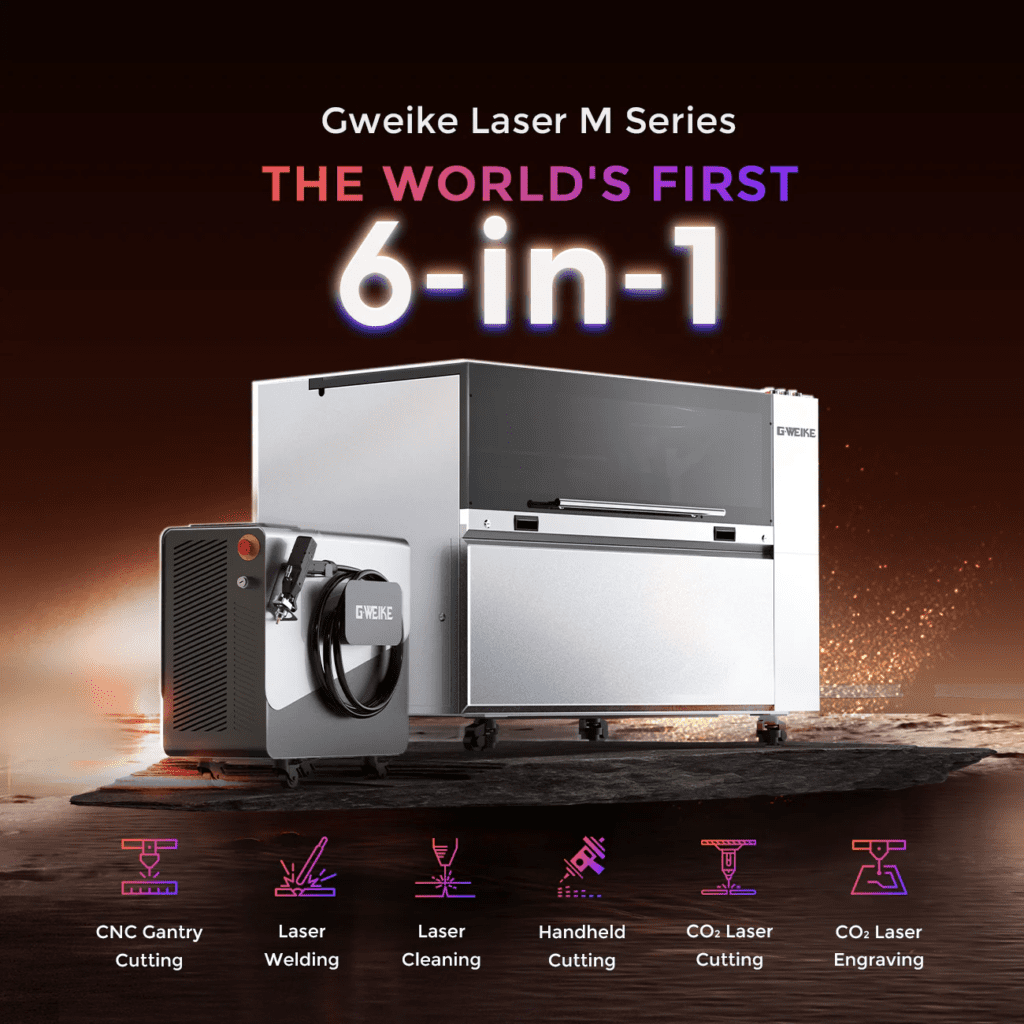
2025 marks a turning point. A new class of 6-in-1 multi-function laser machines is emerging, offering small businesses access to capabilities that were once reserved for large industrial facilities. These integrated platforms combine welding, cutting, cleaning, engraving, and marking into a single compact system.
image:gweike-6-in-1-laser-cutting-machine
For companies exploring modern digital fabrication tools, the ecosystem around laser technology—both industrial and consumer-level solutions—is expanding rapidly. Platforms like GWEIKE Cloud illustrate how accessible laser technology has become for small businesses, makers, and design studios.
This shift is far more than a trend—it represents a major transformation in workflow efficiency, equipment investment, and accessibility to advanced manufacturing.
The Problem: Fragmented Equipment Leads to Fragmented Workflow
Most small workshops operate under intense constraints:
- Limited floor space
- Limited electrical infrastructure
- Limited operator bandwidth
- The need for rapid task switching
- Pressure to produce customized, small-batch products
Traditionally, completing a project required multiple stations:
- A fiber welding machine
- A metal cutter
- A laser cleaning gun
- A CO₂ engraver
- Additional jigs or fixtures
This creates several inefficiencies:
- Repeated recalibration
- Constant workpiece movement
- Increased risk of misalignment
- Higher training requirements
- Longer turnaround times
Small businesses often reduce their service offerings simply because their equipment setup is too fragmented.
The 6-in-1 Solution: One Machine, Six Capabilities
Multi-function laser systems solve these challenges by bringing all key fabrication processes together in one machine.
A typical 6-in-1 system includes:
- Fiber laser welding
- Metal cutting
- Laser cleaning / oxidation removal
- Fiber laser engraving and marking
- CO₂ engraving for non-metals
- Modular attachments for specialized tasks
video:
One example of this new category is the GWEIKE M-Series, which integrates all six functions into a single platform. The product itself is notable, but the bigger story is the direction of the industry: fabrication technology is becoming increasingly integrated, not isolated.
Why This Technology Is Emerging Now
Several technological advances have made 6-in-1 systems possible and practical.
1. Improved Power Delivery & Control Systems
Modern controllers can dynamically switch between welding, cutting, cleaning, and engraving modes—without requiring manual recalibration.
2. Modular Laser Head Architecture
Operators can swap heads in seconds, enabling rapid transitions between fiber welding, cleaning, engraving, or CO₂ processing.
3. Hybrid Optical Pathways
New optical routing systems maintain stable beam quality across multiple laser types—a technical barrier that previously prevented integration.
4. More Efficient Cooling Systems
Advanced thermal management allows multiple laser modules to coexist in one compact unit.
In short: technology has finally caught up with the needs of modern small-scale manufacturing.
How Small Businesses Benefit
6-in-1 laser systems deliver operational improvements that directly address small workshop pain points.
1. Lower Equipment Investment
A single machine replaces four to six separate industrial tools.
2. Significant Space Savings
Ideal for:
- Garages
- Maker labs
- Small industrial rooms
- Mobile fabrication setups
3. Faster, Continuous Workflow
No more moving workpieces between stations.
Fewer alignment errors → faster turnaround.
4. Reduced Training Requirements
Operators only need to learn one unified interface.
5. More Service Capability
With welding, cutting, cleaning, and engraving all in one machine, businesses can take on:
- Metal repair
- Custom fabrication
- Signage production
- DIY and maker projects
- Small-batch manufacturing
- Product personalization
This flexibility is critical for modern small businesses.
Case Example: The GWEIKE M-Series Modular Laser System
The GWEIKE M-Series demonstrates how multi-function systems are implemented in practice:
- Modular laser heads for welding, cutting, and cleaning
- Fiber laser engraving and marking
- CO₂ module for wood, acrylic, leather, and other non-metals
- Compatibility with rotary attachments
- Intelligent detection of connected modules
- A compact design suitable for small fabrication shops
Its biggest advantage is workflow consolidation—tasks that once required multiple machines can now be completed on one platform, often without moving the workpiece.
What This Shift Means for the Future
The rise of 6-in-1 laser machines signals several long-term changes in the manufacturing landscape.
1. Micro-Factories Will Become Standard
Small spaces can now produce high-quality, market-ready products.
2. Manufacturing Becomes More Accessible
Advanced laser capabilities are no longer limited to large industrial facilities.
3. Flexible Production Becomes the Norm
Businesses can switch between materials and processes instantly.
4. Hybrid Fiber–CO₂ Systems Will Spread
The ability to handle both metals and non-metals in one platform is a significant step forward.
5. AI-Enhanced Automation Is Coming
Future systems will likely include:
- Auto seam tracking
- Automated welding adjustments
- AI-assisted cutting paths
- Predictive maintenance
Integrated machines provide the foundation for this future.
Conclusion
6-in-1 laser machines are redefining how small businesses approach fabrication.
By consolidating welding, cutting, cleaning, engraving, and marking into one modular platform, they offer:
- Lower capital cost
- Greater efficiency
- Higher precision
- Faster delivery time
- Expanded service capability
For small workshops aiming to modernize production without expanding space or budget, integrated laser systems represent one of the most impactful technological innovations of the decade.