
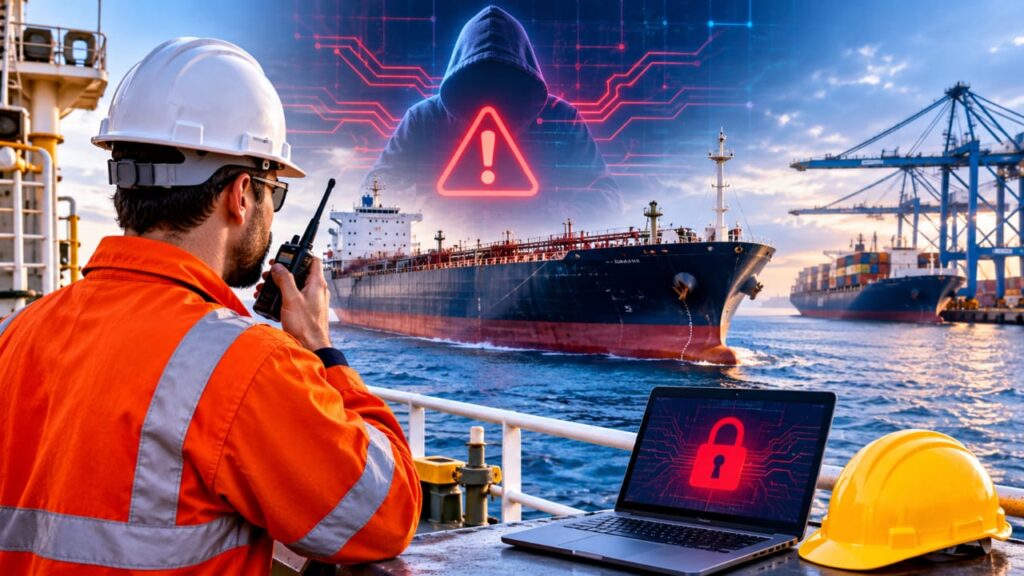
In August 2026, federal investigators boarded two oil tankers bound for the United States after discovering indications that their computer networks had been compromised. The incidents prompted a coordinated response involving the FBI and U.S. Coast Guard, raising questions about the cybersecurity of commercial vessels operating near American ports.
According to Associated Press reporting published in September, investigators examined potential threats to the vessels’ operational and information technology systems. Authorities reported no physical danger to crews, vessel instability, or environmental damage at the time.
Still, the investigations highlighted an increasingly important issue for the shipping industry: modern maritime operations depend on technology that can be disrupted, compromised, or rendered unavailable.
From navigation and communications to cargo handling and port operations, digital systems are now essential to moving goods across the world’s oceans. While this technology has improved efficiency and created new safety capabilities, it has also introduced vulnerabilities that maritime operators cannot afford to overlook.
For the people working aboard ships and throughout America’s ports, the consequences of a major technology failure could extend far beyond lost data or delayed shipments.
Cyberattacks Are Becoming a Maritime Safety Concern
Cybersecurity is often associated with stolen financial information, ransomware, and compromised corporate networks. In maritime operations, however, digital security can have a more immediate physical dimension.
Commercial vessels use interconnected systems to support navigation, machinery monitoring, communications, maintenance, and operational decision-making. Port terminals depend on software and networked equipment to coordinate cargo movements and operate increasingly sophisticated machinery.
Not all these systems are connected directly to the internet, and a breach of an administrative network does not necessarily provide access to a ship’s engines or steering. However, disruptions to critical information systems can still complicate normal operations and emergency response.
A November 2026 safety report from the International Marine Contractors Association (IMCA) described a cyber incident aboard an oil tanker traveling from Egypt to Galveston, Texas. The attack deleted data and operating systems from multiple onboard computers while disrupting email communications and vessel management programs.
Investigators found no abnormalities in the ship’s critical operational technology systems, and the reported damage was limited to its business IT network.
That distinction is important. The incident did not establish that hackers had taken control of the vessel’s propulsion or navigation systems. It did, however, demonstrate how compromised digital infrastructure can interfere with essential shipboard activities.
The IMCA report also identified weaknesses involving outdated security protections, insufficient network separation, and limited monitoring capabilities.
As vessels become more connected, preventing these types of disruptions is increasingly part of maintaining safe and reliable maritime operations.
America’s Ports Face Similar Vulnerabilities
Cybersecurity concerns are not limited to ships operating offshore.
Major ports rely on complex networks connecting shipping companies, terminal operators, logistics providers, customs systems, and equipment manufacturers. A serious disruption can affect multiple organizations simultaneously.
In 2026, the U.S. Maritime Administration issued an updatedmaritime security advisory addressing vulnerabilities in port equipment and infrastructure.
The advisory highlighted potential risks involving remotely accessible equipment, including automated ship-to-shore cranes. It recommended stronger access controls, network segmentation, vulnerability management, and recovery procedures.
These concerns extend beyond the possibility of a port temporarily shutting down.
A malfunction involving cargo-handling equipment, communications, or operational controls could create hazardous conditions for dockworkers, equipment operators, maintenance personnel, and vessel crews.
For example, interrupted communications during a complex loading operation could create confusion about equipment movements or the status of nearby workers. A failure involving an automated system might also require personnel to intervene manually under difficult conditions.
These are potential safety scenarios, not evidence that a particular cyberattack has caused such injuries.
Nevertheless, they illustrate why cybersecurity and occupational safety can no longer be treated as entirely separate responsibilities.
When Technology Fails, the Consequences Can Be Immediate
Not every maritime technology failure involves malicious activity.
Equipment defects, electrical faults, software problems, maintenance deficiencies, and human error can interrupt vessel operations without any outside interference.
The distinction matters because understanding the cause of a failure is essential to preventing another accident.
On November 13, 2026, the tanker Atlantic Asphalt collided with the docked passenger vessel American Heritage on the Mississippi River in New Orleans.
According to the National Transportation Safety Board (NTSB), the passenger vessel was carrying 190 people, including passengers and crew. Thirty-six people were hospitalized following the collision.
The Coast Guard classified the incident as a major marine casualty, and the NTSB investigation remains ongoing.
There is no established connection between this collision and a cyberattack, and investigators have not established its probable cause. However, the incident illustrates the potentially serious consequences of maritime emergencies involving large commercial vessels.
Whether an incident involves a mechanical malfunction, electrical failure, compromised computer system, or another operational problem, crews must be prepared to recognize danger and respond before a manageable disruption becomes a catastrophe.
That challenge becomes more complicated as maritime technology grows increasingly sophisticated.
The People Most Exposed to These Risks
The shipping industry’s growing dependence on digital technology creates concerns that extend beyond vessel owners and cybersecurity professionals.
Seafarers, port workers, commercial fishermen, and offshore personnel may be exposed to hazards when the systems supporting their work become unreliable.
Several situations deserve particular attention:
- Navigation disruptions: GPS interference, inaccurate positioning information, or unavailable navigation equipment can increase the risk of collisions and groundings if crews cannot maintain reliable situational awareness.
- Communication outages: Interrupted ship-to-shore communications can complicate coordination, emergency notifications, and access to outside assistance.
- Machinery and equipment failures: Malfunctioning monitoring or control systems may create hazardous conditions around engines, propulsion equipment, cranes, and other industrial machinery.
- Emergency response delays: Unavailable digital records, communications systems, or operational information can make it more difficult to assess and respond to developing emergencies.
- Increased pressure on crews: Workers may be required to troubleshoot unfamiliar equipment or switch to manual procedures during already stressful situations.
The potential impact of these failures depends heavily on the vessel, its design, the affected systems, and the protections already in place.
Technology itself is not the problem. In many cases, automation and digital monitoring improve safety by reducing human error and identifying dangerous conditions earlier.
The concern arises when organizations become dependent on these systems without adequately preparing for their failure.
Is Maritime Safety Keeping Up With Technology?
Regulators and industry organizations have begun responding more directly to the intersection of cybersecurity and operational safety.
The U.S. Coast Guard established baseline cybersecurity requirements for covered vessels, facilities, and offshore installations through regulations that became effective in July 2025, with implementation deadlines extending into subsequent years.
But regulations represent only one part of the solution.
Shipowners and port operators also need practical procedures that account for unexpected outages, equipment malfunctions, and possible unauthorized access to critical systems.
Important safeguards include:
- Maintaining secure separation between administrative networks and essential operational equipment.
- Regularly testing backup systems and procedures for restoring critical technology.
- Training crews to recognize suspicious activity and respond safely to equipment failures.
- Establishing clear emergency communication procedures when primary systems are unavailable.
- Conducting routine inspections, software maintenance, and cybersecurity assessments.
- Preserving digital records and equipment data following an incident to support investigations.
Workers should also have clear channels for reporting unusual equipment behavior or safety concerns without unnecessary delays or pressure to continue unsafe operations.
Effective maritime cybersecurity is not simply about preventing hackers from accessing confidential information. It is about maintaining the integrity of systems that people depend on to work safely.
When a Technology Failure Leads to a Maritime Injury
As these risks evolve, questions about employer responsibility and maritime worker protections become increasingly relevant.
If a sailor is injured because an employer failed to maintain equipment, address known safety deficiencies, provide adequate training, or respond appropriately to a dangerous condition, maritime law may provide avenues for compensation.
For qualifying seamen, the Jones Act allows negligence claims against employers when their negligence contributes to a work-related injury. Other maritime protections, including maintenance and cure and the doctrine of unseaworthiness, may also apply depending on the circumstances.
Establishing responsibility following a technology-related accident can be complicated. Investigators may need to examine maintenance histories, equipment logs, digital communications, cybersecurity procedures, and decisions made before the incident.
An experienced Jones Act lawyer can help an injured seaman evaluate whether employer negligence or other maritime legal protections may apply, particularly when the cause of an accident is disputed.
Dockworkers and other maritime employees may have different legal protections depending on their employment status and the circumstances of the accident.
A cybersecurity incident does not automatically establish negligence. As with other workplace accidents, the available evidence and applicable law determine whether an employer or another party may be held responsible.
Protecting Maritime Workers in an Increasingly Connected Industry
The maritime industry has always depended on technology, from early navigation instruments to modern satellite communications and automated cargo-handling equipment.
What has changed is the level of connectivity and the number of essential operations that depend on digital infrastructure.
Recent tanker cyber investigations, warnings about port vulnerabilities, and serious maritime accidents underscore the importance of preparing for failures before they occur.
The industry’s challenge is not to abandon advanced technology, but to ensure that the people operating alongside it have the training, safeguards, and support necessary to work safely.
Because when critical systems fail at sea, the consequences are rarely limited to a computer screen. They can affect the vessels, waterways, and workers responsible for keeping global commerce moving.
Previously in Cybersecurity: How Stolen Driver’s License Data Can Lead to Identity Theft