
If you are exploring UWB positioning, you will inevitably encounter three frequently used abbreviations: ToF, TWR, and TDoA. While they may sound technical and obscure, the underlying principles are not complicated. This article explains the meaning, differences, and applicable scenarios of all three in plain language — helping you make a more informed decision when selecting a solution for your project.
1. How Does UWB Measure Distance?
Unlike Bluetooth and Wi-Fi positioning, UWB does not rely on signal strength (RSSI) to calculate position. Instead, it works by precisely recording the timestamp when a wireless signal is sent and received, then applying an algorithm to calculate distance.
In simple terms — UWB uses “time” to locate, not “signal strength”. This is precisely why UWB can achieve centimeter-level positioning accuracy, and why it is receiving growing attention in the field of indoor positioning.
Now let us break down ToF, TWR, and TDoA one by one.
2. ToF (Time of Flight) — Flight Time Ranging
Basic Principle
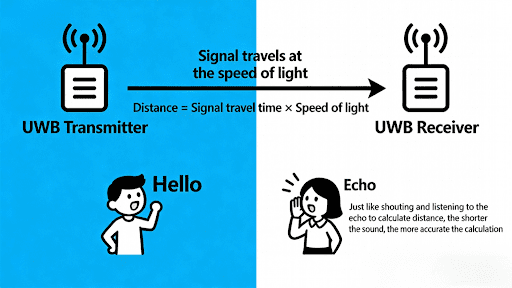
ToF is the most fundamental ranging concept. It works by recording the send and receive timestamps of a ranging message, calculating the propagation time of a wireless signal from the transmitting device to the receiving device, and then multiplying by the speed of light to obtain the distance between the two devices.
Difference between ToF and TOA: You may also encounter the term TOA (Time of Arrival). The two are related but not identical — TOA refers to the absolute timestamp when a signal arrives at a node, whereas ToF refers to the travel time of a signal from one end to the other. In other words, ToF is derived from the difference between two TOA timestamps.
Plain Language Explanation
You can think of ToF like this: you shout toward a distant cliff and listen for the echo. By measuring the time between your shout and the returning echo, you can estimate the distance to the cliff. UWB ranging works on the same core principle — except it uses radio pulse signals traveling at the speed of light.
Key Characteristics
- Core formula: Distance = Speed of Light × Flight Time (d = c × t)
- ToF-based ranging does not require time synchronization between the base station and the tag, so there is no error from clock synchronization offset. However, ToF ranging results depend on clock accuracy — clock drift introduces errors.
Summary: ToF is the “foundational methodology” of UWB ranging. TWR and TDoA can be viewed as two different engineering implementations of the ToF principle for different scenarios.
3. TWR (Two-Way Ranging) — Two-Way Ranging Method
Basic Principle
TWR’s positioning algorithm uses the round-trip time of flight (ToF) between a tag and base stations to calculate the distance from the tag to each base station, and then applies a trilateration algorithm to determine the tag’s position.
The key to TWR is “two-way communication” — the tag measures the round-trip time of flight (ToF) of the UWB radio signal between itself and an anchor, then multiplies by the speed of light to determine the distance. The tag first sends a “poll” message to a known anchor; the anchor receives it and replies with a “response” message carrying a timestamp. Upon receiving the reply, the tag can calculate the distance by computing the total round-trip time.
To complete a full positioning fix, the tag typically needs to complete two-way ranging with at least 3 anchors. Using DS-TWR as an example, a single ranging exchange with each anchor requires 3 messages, meaning a complete tag positioning fix requires roughly 9 messages total.
Two Variants: SS-TWR and DS-TWR
| Variant | Full Name | Brief Description |
| SS-TWR | Single-Sided Two-Way Ranging | One round-trip exchange; simple flow but susceptible to clock drift |
| DS-TWR | Double-Sided Two-Way Ranging | Adds an additional round of signal exchange; effectively suppresses clock drift error |
DS-TWR builds on SS-TWR by adding one more delay and UWB signal exchange, effectively suppressing the ranging error caused by clock drift. Under good line-of-sight (LoS) conditions and with proper calibration, ranging accuracy can typically be better than 10 cm, which is why DS-TWR is recommended for practical engineering applications.
Advantages and Limitations of TWR
Advantages:
- TWR-based RTLS systems do not require time synchronization between UWB devices, making deployment more flexible.
- The ToF/TWR method is based on two-way communication between the tag and anchor, converting flight time into distance measurements. Distance is a highly intuitive metric that simplifies network configuration and troubleshooting.
Limitations:
- Due to the nature of two-way communication and the number of message exchanges required to determine the tag’s position, TWR presents certain challenges in terms of tag battery life and scalability for large numbers of tags.
- During the TWR process, a tag and anchor can only participate in one ranging session within a given time slot, and a complete positioning fix requires multiple rounds of two-way communication with several anchors.
If you are looking for a UWB module that supports TWR ranging, consider the UWB650Pro from G-NiceRF. This module supports Double-Sided Two-Way Ranging (DS-TWR) and is suitable for applications requiring high-precision point-to-point or small-scale ranging and positioning.
4. TDoA (Time Difference of Arrival) — Arrival Time Difference Positioning
Basic Principle
TDoA (Time Difference of Arrival) is a positioning method that uses time differences of arrival, also known as hyperbolic positioning. Unlike TWR, TDoA does not require the tag and base station to “converse” back and forth.
With TDoA, the tag broadcasts a data packet (sometimes called a “blink”). All nearby anchors receive this blink message but do not reply. Because the anchors are at different distances from the tag, the signal does not arrive at every anchor at exactly the same moment. These time differences of arrival between anchors form the basis for calculating the tag’s X, Y, Z coordinates.
Plain Language Explanation
Imagine someone claps their hands in a plaza. Several listeners (base stations) around them hear the clap at different times — those closer hear it first, those farther away hear it later. Based on these time differences, the position of the person who clapped can be reverse-calculated. TDoA works on exactly this principle.
Advantages and Limitations of TDoA
Advantages:
- Compared to TWR, TDoA has lower tag power consumption and lower latency due to its one-way communication nature.
- TDoA only requires one blink message to complete positioning, which can significantly extend tag battery life.
- High system capacity. Under theoretically optimal configurations (e.g., TDoA + TDMA scheduling, minimum-length UWB packets, specific chipsets), the number of tags per cell can theoretically exceed 6,000, though actual deployments are constrained by update rate, channel utilization, and other factors.
Limitations:
- All anchors must maintain high-precision clock synchronization; otherwise positioning results are meaningless. This is the core challenge in deploying TDoA systems.
- TDoA requires dedicated clock synchronization hardware, making the entire RTLS system more expensive to build. It typically requires a dedicated clock generation unit, and anchor costs increase accordingly (some vendors estimate roughly 20–40% higher, though the actual difference varies by vendor and solution).
- Because synchronization errors cannot be completely eliminated, overall positioning accuracy is generally lower than TWR, and accuracy degrades noticeably outside the area enclosed by the base stations.
5. ToF vs. TWR vs. TDoA: A Comparison at a Glance
| Dimension | ToF | TWR | TDoA |
| Nature | Ranging principle (foundational method) | Two-way communication ranging based on ToF | One-way positioning based on time difference of arrival |
| Communication | — | Tag ↔ Anchor (bidirectional) | Tag → Anchor (unidirectional) |
| Clock Sync Required | Depends on implementation | No inter-anchor sync needed | High-precision inter-anchor sync required |
| Tag Power | — | Higher (multiple two-way exchanges) | Lower (single transmission) |
| System Capacity | — | Smaller (typically tens to hundreds of tags/zone) | Larger (theoretically thousands of tags under optimal config) |
| Deployment Complexity | — | Relatively simple | More complex (sync + cabling) |
| Positioning Accuracy | — | Higher; less accuracy degradation outside anchor zone | Good; faster accuracy drop outside anchor zone |
| Typical Scenarios | — | Factories, power plants, chemical plants, office buildings | Warehouses, sports venues, large-space asset tracking |
6. How to Choose? Match Your Project Requirements
There is no “one-size-fits-all algorithm” — the choice depends on your actual scenario:
- Complex environment, high accuracy requirements → Prioritize TWR. TWR is well-suited for complex application environments such as manufacturing plants, power plants, chemical plants, and office buildings.
- Large space, large number of tags, tags need long battery life → Prioritize TDoA. TDoA does not require two-way communication, making it an ideal choice for large-scale deployments and asset or personnel tracking applications that require longer battery life.
- Limited budget, flexible deployment desired → TWR is typically lighter in terms of infrastructure. The distance measurements in TWR support flexible configuration and may offer savings in hardware quantity and installation cost compared to TDoA-based systems (the specific savings depend on the deployment scenario).
If you are in the early stages of project research, it is recommended to first confirm three key parameters — number of tags, environmental complexity, and power consumption requirements — before selecting an algorithm. G-NiceRF’s UWB module product line supports TWR ranging and positioning. For example, the UWB653Pro features a USB interface design for quick integration and debugging, making it suitable for distance verification and prototype development in the early stages of a project.
7. Summary
| Concept | One-Line Summary |
| ToF | The foundational principle of measuring distance by calculating signal flight time |
| TWR | A two-way communication implementation of ToF; no inter-anchor sync required; high accuracy but higher power consumption |
| TDoA | Positioning based on multi-anchor time difference of arrival; low power, high capacity, but requires inter-anchor synchronization |
The core of UWB positioning always revolves around “time”. Once you understand the relationships among ToF, TWR, and TDoA, you have grasped the fundamental framework of UWB positioning technology. From there, matching the right UWB module and algorithm solution to your actual project requirements becomes much easier.
G-NiceRF specializes in RF module R&D and offers a range of UWB modules supporting ranging and positioning functions. For more product specifications or technical support, please visit the official website.