
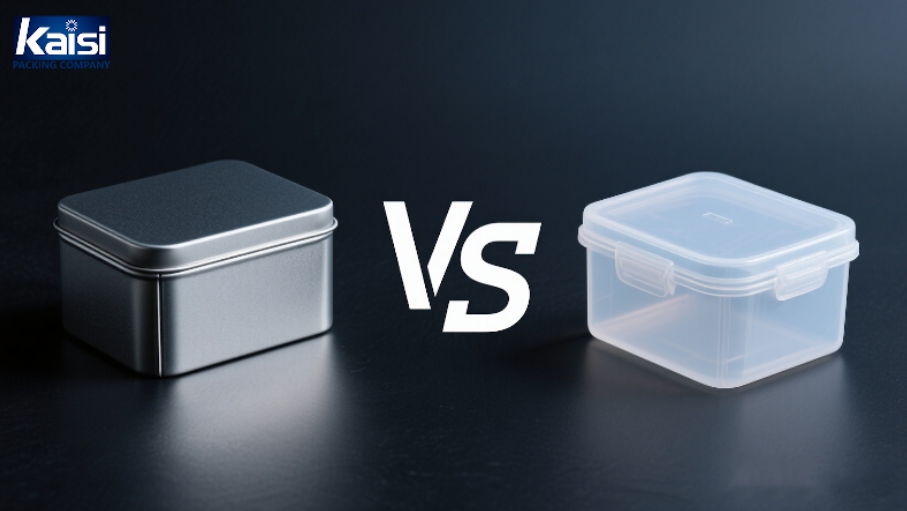
Tin Containers vs Plastic Boxes: Which Packaging Truly Wins for Your Brand?
(A Practical 2025 Buyer’s Guide by Kaisi)
If you’re wrestling with the packaging dilemma—“Should we go with tin or stick to plastic?”—you’re not alone. At Kaisi, we hear this every week from brands in food, tea, coffee, cosmetics, confections, candles, gifts, supplements, and even limited‑edition promos. The choice isn’t just aesthetic; it touches sustainability goals, shelf life, perceived value, brand positioning, logistics, and long‑term cost.
This guide breaks down tin containers vs plastic boxes in plain language, so you can make a decision rooted in strategy—not guesswork or outdated assumptions.
1. Quick Snapshot: Tin vs Plastic at a Glance
| Criterion | Tin Containers | Plastic Boxes |
| Perceived Quality | Premium, giftable, collectible | Functional, everyday, often “commodity” |
| Sustainability Narrative | Highly recyclable (steel/tinplate), long reusability | Technically recyclable (varies by resin & local facilities), risk of landfill |
| Barrier Protection | Excellent vs light, oxygen (with proper closures) | Varies by resin; some allow light & oxygen permeation |
| Branding Potential | Embossing, debossing, specialty inks, matte/gloss, spot UV | Printing & molding styles, but often less tactile depth |
| Durability (Crush) | Rigid, dentable but rarely cracks | Can crack, warp, or scratch; flexible grades exist |
| Weight | Heavier than most plastics | Generally lighter |
| Minimum Orders | Often moderate MOQs | Can be low for stock molds; custom shapes higher |
| Food Safety | Inert tinplate with coatings; widely used for food | Food grade is resin & additive dependent |
| Reuse Rate by Consumers | High (storage, décor, gifting) | Lower; often discarded after primary use |
| Unit Cost (Basic) | Typically higher per piece | Usually lower per piece |
| Lifecycle Brand Value | Enhances retention, unboxing, repeat impressions | Efficient but less memorable |
2. Material Fundamentals (Why They Differ)
Tin containers used today are usually tinplate steel (a thin steel sheet coated with tin) or sometimes aluminum for specialty items. Their strength lies in rigidity, formability, and printability. The structure naturally conveys solidity and quality.
Plastic boxes can be made from PP, PET, PVC, HDPE, or acrylic. Each resin has different clarity, rigidity, and recyclability. Plastic’s big advantage is flexibility in shape (via injection or thermoforming) and lower shipping weight.
3. Sustainability & Environmental Story
Sustainability has moved from “nice to have” to “must quantify.” Here’s how both stand:
- Tin (steel/tinplate) is among the most recycled materials globally. Even when consumers don’t reuse, the scrap value encourages collection. Metal can be recycled repeatedly with minimal property loss.
- Plastic recycling depends heavily on local infrastructure, proper sorting, resin purity, and consumer behavior. Contamination often downgrades plastic quality or sends it to landfill or incineration.
- Reusability is an underrated carbon win: a Kaisi tin used for tea today might store sewing needles or spices next year—extending functional life far beyond primary packaging.
- Carbon footprint nuance: A lightweight plastic may initially have a lower production footprint per gram, but if the product demands stronger protection or if brand value and reuse are considered, tin frequently delivers superior lifecycle performance.
If your ESG or CSR report includes circularity metrics or reuse targets, tin supports storytelling with quantitative angles (recycle rate, material recovery value, average household retention time).
4. Product Protection & Shelf Life
Protection isn’t just about “not breaking.”
- Barrier Performance: With appropriate internal coatings and seams, tins can greatly reduce light penetration and oxygen ingress, helping maintain volatile aromas (coffee, tea, spices) and sensitive actives (balms, supplements).
- Plastic: Clear plastics offer shelf visibility but can let in UV and light that degrade ingredients (e.g., chlorophyll in matcha, essential oils in aromatherapy blends). You can add UV inhibitors—extra cost, and sometimes a haze effect.
- Physical Impact: Tins resist crushing in stacked pallets. Plastic can warp under heat or crack under stress.
- Tamper Evidence: Both can incorporate seals (shrink bands, induction liners, stickers). Tins can add audible “pop” or secure friction-fit; plastic can integrate snap locks or hinges.
5. Branding, Tactility & Emotional Value
Packaging is a physical ambassador.
- Tin offers multi-sensory touches: cool metallic feel, the subtle sound when opening, reflective or matte finishes, raised emboss logos, interior printing surprises (“Hello from Kaisi!”). Each element adds layers of brand memory.
- Plastic can convey modern minimalism or transparency (letting the product itself sell). For utilitarian goods, that’s enough. But for artisanal or giftable products? Tin generally outperforms in perceived value.
- Gifting & Collectibility: Consumers often retain distinctive tins (holiday series, limited artwork). This keeps your logo in homes for months (free extended impressions). Plastic boxes seldom become keepsakes.
6. Consumer Perception & Psychology
Words buyers often associate:
- Tin: premium, safe, heritage, curated, eco-minded, “I can reuse this.”
- Plastic: convenient, lightweight, everyday, disposable (even when recyclable).
Study after study (and our own client feedback at Kaisi) reveals that upgrading to tin packaging can increase willingness to pay and enhance unboxing satisfaction—especially in niche markets (artisan tea, gourmet confectionery, curated wellness kits).
7. Cost: Not Just Unit Price
Let’s reject a narrow “per piece” mindset and use a holistic approach:
- Direct Unit Cost: Plastic usually wins.
- Printing & Customization: Tin’s decoration methods (CMYK + metallic + emboss) can consolidate what might require multiple labels and sleeves on plastic.
- Secondary Packaging: Because tins protect better, you may reduce inserts or outer corrugate thickness.
- Damage & Returns: Rigid tin can cut product loss for fragile fills (cookies, shaped chocolates).
- Marketing Value: Premium packaging can raise price elasticity or enable bundle pricing—offsetting higher packaging spend.
- Brand Longevity: A collectible tin continues to advertise; plastic often stops after disposal.
A simplified lifecycle value equation: Perceived Added Value – Incremental Packaging Cost – Damage Reduction + Extended Brand Impressions = Net Advantage
For many specialty SKUs, tin crosses into positive ROI within the first campaign or seasonal cycle.
8. Practical Use Cases: When Tin Shines (and When Plastic Still Makes Sense)
Choose Tin If:
- Your product relies on aroma integrity (loose leaf tea, coffee, spice blends).
- You target gifting seasons (holiday, Valentine’s, Lunar New Year).
- You need to elevate a line extension above a core commodity product.
- Sustainability storytelling is central to your marketing funnel.
- You want differentiators: custom shapes (heart, hex, book-style), nested sets, collectible series.
Plastic May Be Preferable If:
- Ultra-light shipping weight is critical (low-margin FMCG).
- Contents require visibility (transparent retail merchandising).
- Single-use or trial-size packaging where premium feel isn’t a purchase driver.
- Extreme moisture exposure environments where a simple sealed plastic works and tin would over-specify.
Hybrid Strategies: Some brands deploy plastic for bulk refill pouches and sell a reusable, branded Kaisi tin as the “forever” container—blending cost efficiency with premium shelf presence.
9. Customization Paths with Kaisi Tin Box
At Kaisi, typical enhancement options include:
- Structural: Round, square, rectangular, sliding lid, hinged, windowed lid (with PET or cellulose window), multi-compartment inserts.
- Surface: Matte, glossy, soft touch varnish, pearl, crackle, brushed metal effect.
- Decoration: Emboss/deboss, spot UV, foil stamping, metallic PMS, inside lid printing (Easter eggs), QR integration for loyalty or authenticity.
- Functional Add-ons: Food-grade internal coatings, EPE or EVA inserts, humidity packs compartments, tamper-evident stickers, refill guidance icons.
- Sustainability Touches: Minimal-ink guidelines, monomaterial (tin-only) builds for easier recycling, refill instructions printed inside.
10. Common Myths Debunked
Myth: Tin rusts quickly—Not when proper lacquer coating is applied (industry standard).
Myth: Plastic is always cheaper overall—Only if you ignore returns, marketing uplift, reuse.
Myth: Tin is “old-fashioned”—Modern finishes + unique shapes feel contemporary and boutique.
Myth: All plastics are recyclable equally—Resin codes and local infrastructure determine reality.
Myth: Custom tin MOQs are huge—Kaisi offers scalable tiers; smart design can keep molds stock-friendly.
11. Decision Checklist
Answer each with Tin / Plastic / Neutral:
- Is premium unboxing central to conversion?
- Will customers likely reuse the container?
- Is aroma/light protection critical?
- Do we have a sustainability KPI to highlight?
- Would a collectible series strategy boost retention?
- Are we aiming for gift-channel placements?
- Is total landed cost more important than per-unit?
- Is transparent product visibility required?
- Are we shipping long distances where weight dominates margin?
If you have 5 or more “Tin” answers—strong case to proceed with tin packaging exploration.
12. Implementation Roadmap with Kaisi Tin Box
- Goal Definition: Clarify marketing objective (premium upgrade, sustainability claim, gift edition).
- Product Fit: Confirm fill weight, dimensions, barrier needs.
- Concept Sketch: Pick shape + lid mechanism + interior insert.
- Branding Layer: Approve color proofs (we provide digital + physical if needed).
- Prototype & Testing: Validate closure torque, drop tests, lining compatibility, migration compliance (for food/cosmetic).
- Production: Scale batches with QC audits.
- Launch Support: Kaisi supplies lifestyle photography + sustainability bullet points for your PDP (optional add-on).
- Iteration: Gather consumer feedback; plan seasonal variants or refill program.
13. FAQs (Consumer-Facing Ready)
Q: Are tin containers food safe?
A: Yes—when manufactured with food-grade coatings. Kaisi uses compliant internal lacquers appropriate for intended applications.
Q: Will tins dent easily?
A: Normal handling is fine. While metal can dent under force, structural rigidity protects contents better than many thin plastics.
Q: Can I get a window to show product?
A: Absolutely. We can integrate a PET or biodegradable window, or design a cut-out with internal film.
Q: Are tins more expensive?
A: Unit cost is higher, but many brands recoup through premium pricing, reduced damage, and brand reuse impact.
Q: Are tins recyclable everywhere?
A: Steel/tinplate enjoys widely established recycling streams in most regions.
Q: What about minimum order quantities?
A: We offer tiered MOQs; reach out with dimensions and forecast to receive agile options.
14. Key Takeaways
- Tin outperforms plastic in premium impression, reuse, and sustainability narrative.
- Plastic retains advantages in transparency, ultra-light weight, and basic economy.
- When lifecycle brand value matters, tin often becomes the more strategic—not merely aesthetic—choice.
- A hybrid refill model (plastic or pouch refills + hero Kaisi tin) can optimize both cost and sustainability.