
In 2026, the phrase “Just-in-Time” has been replaced by “Just-in-Case” Resilience. After years of geopolitical shocks and labor shortages, the global supply chain has finally “gone sentient.” We are in the era of Agentic Logistics, where AI systems don’t just flag delays—they autonomously re-route ships and renegotiate contracts. The market for Autonomous Ships has climbed to $8.74 billion this year, while 80% of enterprises have integrated AI into their core supply chain operations. For a modern Business, logistics is no longer a cost center but a “Competitive Fortress.” Meanwhile, Digital Marketing has pivoted to “Radical Traceability,” as brands compete to prove their products didn’t just arrive fast, but arrived via a zero-emission, ethically verified path.
The Technological Architecture: The Autonomous Fleet & Digital Twins
By 2026, the physical movement of goods is governed by a digital “Simulated Reality.”
-
The Supply Chain Digital Twin: This is the heart of 2026 operations. Companies now maintain a live, high-fidelity digital replica of their entire network—factories, ports, and trucks. This Technology allows AI to run millions of “What-If” simulations per second, predicting how a port strike in Asia will affect shelf stock in London three weeks from now.
-
Autonomous Maritime Vessels: Large-scale autonomous cargo ships are no longer experimental. In 2026, AI-powered situational awareness systems have reduced human-error accidents—the cause of 75% of marine incidents—by nearly half. These ships optimize their speed and route in real-time to meet “Green Port” docking windows, saving 15% in fuel costs.
-
IoT-Enabled “Smart Freight”: Every pallet is now a data node. Using 5G-Advanced and satellite IoT, 2026 freight tracks its own temperature, vibration, and “Carbon Intensity” in real-time, feeding this data directly into the Digital Twin.
Artificial Intelligence: The Rise of the “Self-Healing” Grid
In 2026, Artificial Intelligence has moved from “Predictive” to “Agentic,” acting as an autonomous dispatcher.
1. Agentic Logistics Orchestration
We have entered the era of the “Self-Healing” Supply Chain. If an AI agent detects a shipment delay due to a weather anomaly, it doesn’t wait for a human manager. It autonomously checks alternative carriers, negotiates a spot rate within pre-set budget guardrails, and updates the customer’s delivery window in under 90 seconds.
2. “Dark” Warehouses and Robotic Swarms
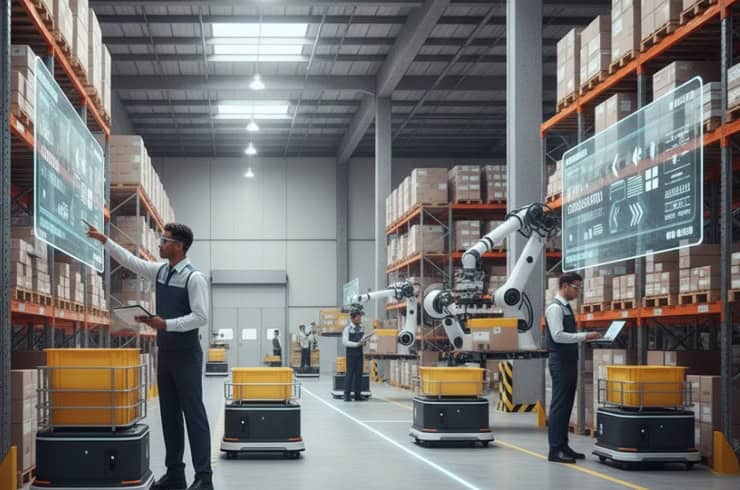
The 2026 warehouse is increasingly “Dark”—fully automated environments where lights are unnecessary because the “workers” are robots. Autonomous Mobile Robots (AMRs) now operate as a “Swarm Intelligence,” dynamically re-slotting inventory based on real-time demand spikes (e.g., a viral TikTok trend) to ensure high-velocity items are always nearest the packing station.
3. Cognitive Procurement
Procurement has become an AI-led function. AI agents now scan 125 million+ supplier profiles 24/7, monitoring for financial instability, geopolitical risk, or ESG violations. In 2026, 70% of procurement teams rely on AI recommendations for supplier selection, moving from reactive “Audits” to continuous “Risk Scoring.”
Digital Marketing: The “Verified Origin” Brand
Digital Marketing for logistics and retail in 2026 is built on Total Visibility.
-
Radical Traceability as a Hook: “Fast shipping” is now table stakes. In 2026, marketers use Blockchain-backed Digital Product Passports to win consumers. A customer can scan a QR code on a jacket and see the exact “Carbon Path” it took from the factory to their door, verified by autonomous sensor data.
-
AEO (Answer Engine Optimization) for Sourcing: As businesses ask their AI, “Which logistics partner has the lowest disruption risk for European routes?”, carriers are optimizing their “Resilience Metrics” and real-time performance data to ensure they are the top-rated recommendation.
-
The “Invisible” Delivery: Marketing for last-mile delivery has shifted to “Frictionless Stealth.” 2026 campaigns focus on Autonomous Drones and Sidewalk Robots that deliver packages silently and exactly when the user’s AI predicts they will be home, eliminating the “missed delivery” frustration.
Business Transformation: Logistics-as-a-Service (LaaS)
The internal Business of moving goods has been “Platform-ized.”
-
Outcome-Level Pricing: In 2026, companies are moving away from paying per hour or per mile. They are signing “Autonomy-Level” Contracts, where they pay logistics providers for a specific outcome (e.g., “99.5% on-time delivery”). This decouples business growth from human headcount.
-
The “Micro-Fulfillment” Shift: To meet the “Supersonic” delivery demands of 2026 (Article 54), businesses are moving inventory into hundreds of Urban Micro-Hubs. This fragmentation increases complexity, but AI-driven “Network Balancing” ensures that stock is always in the right neighborhood before the order is even placed.
-
Circular Logistics (The “Reverse” Chain): In 2026, the “Return Trip” is just as important as the delivery. AI-optimized Reverse Logistics systems batch returns and route them directly to refurbishment centers or “Resale Corners,” turning a traditional cost center into a sustainable revenue stream.
Challenges: Shadow AI and Cyber-Resilience
The 2026 logistics revolution faces a “Security and Control” crisis.
-
The “Shadow AI” Risk: With 22% of business leaders admitting employees use unauthorized AI tools to draft shipping docs, 2026 has seen a rise in “Compliance Gaps.” The professional challenge is creating Authorized AI Environments that provide the speed of consumer AI with the security of enterprise law.
-
Cyber-Physical Attacks: As the supply chain becomes a giant software network, it becomes a prime target for ransomware. In 2026, Cyber-Resilience is considered as important as physical security. A “hacked” warehouse or an “unauthorized” re-routing of an autonomous ship can paralyze a national economy in hours.
Looking Forward: Toward the “Sentient Globe”
As we look toward 2030, “Logistics” is moving toward “Planetary Optimization.” We are approaching a world where the global flow of goods is so perfectly balanced by AI that “Waste” and “Stockouts” become relics of the analog past, and the global economy moves with the seamless grace of a single, unified organism.
Conclusion
The convergence of Technology, Business, Digital Marketing, and Artificial Intelligence has turned the “Supply Chain” into “Supply Intelligence.” In 2026, the winners are not those with the most trucks, but those with the most Agile Algorithms. By embracing the “Intelligent Supply Chain,” the leaders of 2026 are ensuring that the world keeps moving, no matter what the horizon holds.