
In 2026, the final frontier is no longer about just “getting there”; it’s about “operating there.” We have entered the era of the Orbital Infrastructure, where space is being integrated into the fabric of the global $100T economy. The space sector is projected to hit $1 trillion by 2040, but the real shift this February is the marriage of Artificial Intelligence and orbital hardware. From the first “Orbital Cloud” data centers launching this month to the intense focus on Space-Based Solar Power (SBSP), the vacuum of space is becoming the world’s most valuable real estate. For a modern Business, space is the ultimate “High Ground” for data sovereignty. Meanwhile, Digital Marketing has pivoted to “Sovereign Connectivity,” as nations and corporations compete for the prestige of “Off-Planet Autonomy.”
The Technological Architecture: The Orbital Cloud and 3D Printing
By 2026, we are building in space, not just for space.
-
Orbital Data Centers: Launching in late 2025 and scaling this February, companies like Orbit AI and Axiom are deploying the first dedicated “Space Clouds.” These are satellite clusters designed for In-Orbit Inference, allowing data to be processed where it’s collected. This Technology reduces the “Downlink Bottleneck,” sending only processed insights back to Earth rather than raw petabytes.
-
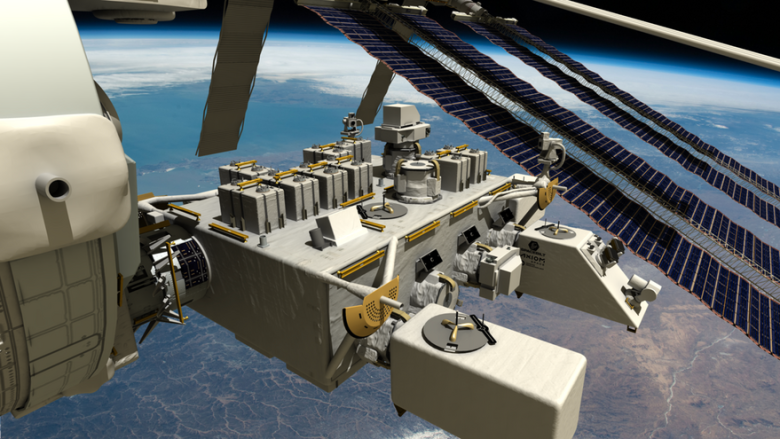
In-Space Manufacturing (ISM): In early February 2026, the European Space Agency (ESA) successfully 3D-printed the first metal replacement parts on the ISS. This marks the transition to Self-Sustaining Orbits, where long-duration missions no longer rely on expensive “resupply launches” for every broken bolt.
-
Direct-to-Device (D2D) Convergence: 2026 is the year satellite broadband became a “Standard Layer” of mobile networks. Partnerships between Starlink, AST SpaceMobile, and Lynk Global have made “Satellite SOS and Texting” a default feature on almost all new smartphones, effectively ending “Dead Zones” globally.
Artificial Intelligence: The Central Nervous System of the Vacuum
In 2026, Artificial Intelligence is the only way to manage a sky populated by over 18,000 active satellites.
1. Autonomous Constellation Orchestration
We have entered the era of Agentic Satellite Networks. AI agents now manage “Bandwidth Trading” and “Collision Avoidance” autonomously. In a crowded Low Earth Orbit (LEO), these agents make millisecond adjustments to trajectories, navigating around space debris without human intervention.
2. AI-Driven Earth Observation (EO)
AI is the “Intelligence Layer” for our planet. 2026 satellite constellations use On-board Computer Vision to detect wildfires, methane leaks, or illegal fishing in real-time. Instead of a 24-hour delay, emergency responders now receive “Actionable Alerts” within minutes of an event occurring.
3. Lunar AI Factories
In a bold February 2026 proposal, industry leaders (including xAI and SpaceX) are looking toward the Moon as the ideal site for AI Data Centers. The Moon offers 24/7 solar exposure (at certain peaks) and a natural vacuum for cooling, potentially solving the terrestrial “Energy Crisis” (Article 52) caused by AI’s massive power hunger.
Digital Marketing: The “Sovereign Space” Brand
Digital Marketing in 2026 has moved from “Global Reach” to “Unbreakable Sovereignty.”
-
Marketing “Off-Planet Backup”: Financial institutions and governments are being targeted with “Sovereign Data” campaigns. The pitch: “Your data isn’t just encrypted; it’s physically in orbit, outside the reach of terrestrial conflict and natural disasters.”
-
The “Moon-Shot” Halo Effect: Brands are using their participation in the Artemis II mission (slated for April 2026) to boost their “Innovation Equity.” Being “Space-Qualified” is the 2026 equivalent of “Intel Inside”—a mark of ultimate reliability.
-
GEO (Generative Engine Optimization) for Space Services: As enterprises ask their AI, “Which satellite provider offers the lowest latency for AI inference?”, space firms are optimizing their “Orbital Edge” metrics to be the top-cited solution.
Business Transformation: The “Tenant” Model
The internal Business model of space is shifting from “Owner-Operator” to “Commercial Tenant.”
-
Private Space Stations: With the ISS nearing retirement, 2026 is a race between Vast (Haven-1), Axiom, and Blue Origin (Orbital Reef). NASA is transitioning from “Landlord” to “Customer,” buying services from these private stations. This is the “Commercialization of LEO,” turning space into a multi-use business park.
-
Space-as-a-Service (SaaS 2.0): Small startups no longer need to build rockets. They buy “Payload Space” on a modular bus. In 2026, launching a custom AI model into orbit is as easy as deploying a web app to AWS was in 2020.
-
The SpaceX IPO Factor: Speculation regarding a SpaceX/Starlink IPO in 2026 is driving unprecedented institutional interest. Investors are starting to view space not as a “speculative bet” but as “Critical Infrastructure” equivalent to railroads or power grids.
Challenges: The “Kessler Syndrome” and Lunar Law
The 2026 space revolution faces a “Sustainability Speedbump.”
-
Orbital Congestion: With thousands of new satellites launching every year, the risk of a “chain reaction” of collisions (Kessler Syndrome) is at an all-time high. 2026 is seeing the first mandatory “Zero-Debris” Regulations, forcing companies to prove they can de-orbit their hardware.
-
The Artemis Accords vs. The Lunar South Pole: As the US (Artemis II), China (Chang’e 7), and India race for the “Water Ice” at the lunar south pole, 2026 is a year of Geopolitical Tension. The professional challenge is creating a “Space Law” (Article 56) that prevents the militarization of these vital resources.
Looking Forward: Toward “Multi-Planetary Business”
As we look toward 2030, the “Space Sector” is moving toward “Orbital Manufacturing at Scale.” We are approaching a world where high-purity fiber optics, pharmaceuticals, and even human organs are “Grown in Orbit” to take advantage of microgravity, turning the final frontier into the world’s most advanced factory floor.
Conclusion
The convergence of Technology, Business, Digital Marketing, and Artificial Intelligence has turned “Space” into the “Intelligence Layer of the Planet.” In 2026, the winners are not just those who can launch, but those who can Compute and Connect in the vacuum. By embracing “Intelligent Space,” the leaders of 2026 are ensuring that the sky is no longer a limit, but a bridge to the next trillion-dollar era.