
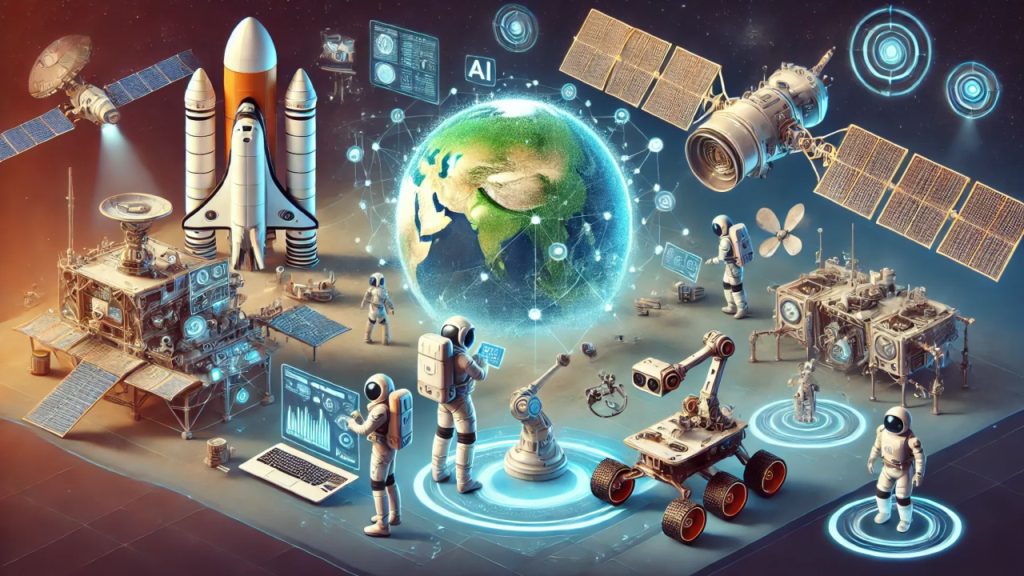
In 2026, the “New Space” era has matured from a speculative venture into a fundamental pillar of the global economy. Valued at approximately $626 billion this year, the space sector is no longer just about flags and footprints—it is about Infrastructure. We have entered the age of “High-Cadence Launch,” where reusable rockets have slashed the cost of reaching orbit by over 70%. Artificial Intelligence now serves as the “Orbital Air Traffic Controller,” managing thousands of satellites, while early Asteroid Mining missions move from prospecting to pilot extraction. For a modern Business, space is the new “Edge,” providing the ultimate data-center location and a laboratory for zero-gravity manufacturing.
The Technological Architecture: The Reusability Revolution
By 2026, a rocket that doesn’t land itself is considered an antique.
-
Mega-Rocket Ubiquity: Systems like SpaceX’s Starship have reached operational maturity, allowing for payloads of over 100 tons. This Technology has shifted the paradigm from “Miniaturization” back to “Mass-Scale,” enabling the launch of entire space station modules in a single flight.
-
In-Space Servicing, Assembly, and Manufacturing (ISAM): Rather than de-orbiting dying satellites, “Life Extension” tugs now refuel and repair them in orbit. In 2026, we are seeing the first orbital “foundries” that use zero-gravity to create perfect fiber-optic cables and protein crystals that are impossible to manufacture on Earth.
-
Quantum-Encrypted Satellite Links: To protect against the “Quantum Threat” (discussed in Article 34), 2026 satellite constellations use laser-based Free-Space Optical Communications to create a secure, unhackable “Orbital Internet” that bypasses vulnerable ground cables.
Artificial Intelligence: The Central Nervous System of the Stars
In 2026, Artificial Intelligence is the only force capable of managing the complexity of a crowded orbit.
1. Autonomous Space Traffic Management (STM)
With over 20,000 active satellites in orbit, human controllers can no longer manage the “Collision Dance.” AI agents now handle Autonomous Collision Avoidance, negotiating maneuvers between satellites from competing companies in milliseconds to prevent a “Kessler Syndrome” chain reaction.
2. Edge-AI Orbital Clouds
Data is no longer just “sent back to Earth.” 2026 sees the rise of Orbital Data Centers. AI models on-board satellites process raw Earth Observation data—detecting a wildfire or a methane leak—and send only the “Insight” back to the ground, saving 99% of the bandwidth.
3. Robotic Prospectors
AI-driven rovers on the Lunar surface and near-Earth asteroids now perform In-Situ Resource Utilization (ISRU). These “Machine Geologists” identify water ice and metallic deposits, autonomously deciding where to drill based on real-time chemical analysis without waiting for instructions from Earth.
Digital Marketing: From “Awe” to “Utility”
Digital Marketing for space companies has moved past the “Billionaire Space Race” narrative.
-
Selling “Orbital Resilience”: For enterprise clients, marketers are selling space as the “Ultimate Insurance Policy.” Marketing campaigns focus on how orbital backups protect critical data from terrestrial disasters, war, or power grid failures.
-
GEO (Generative Engine Optimization): As companies ask AI, “Which satellite provider offers the lowest latency for high-frequency trading in Southeast Asia?”, providers are optimizing their technical “Trust Signals” to ensure their constellation is the top recommendation.
-
“Space-Proven” Branding: In 2026, “Space-Proven” is the new “Gold Standard.” Brands are using the extreme conditions of orbit—radiation, vacuum, and zero-G—as a marketing “Stress Test” for Earth-bound consumer electronics and materials.
Business Transformation: The Industrialization of the Cislunar Economy
The internal Business of space has shifted from “Exploration” to “Logistics.”
-
Launch-as-a-Service (LaaS): Launch is now a commodity. Companies book “Payload Slots” as easily as they would a shipping container on a cargo ship. In 2026, the bottleneck is no longer the rocket, but the “Launch Pad Cadence.”
-
Asteroid Mining Pilot Markets: While mass-importing platinum is still years away, “Space-to-Space” mining has begun. Companies are mining water from asteroids to create liquid oxygen and hydrogen fuel, turning orbit into a “Refueling Station” for deep-space missions.
-
Sovereign Orbital Clouds: Nations are now commissioning “Sovereign Constellations” to ensure data sovereignty. This has created a new business model for “Space Primes” who build and manage entire orbital infrastructures for governments as a service.
Challenges: Space Debris and the “Regulatory Vacuum”
The 2026 space economy faces two critical “Atmospheric” hurdles.
-
The Debris Crisis: The “Tragedy of the Commons” is real in orbit. 2026 has seen the first “Debris Tax” proposals, where companies must pay into a global fund for active debris removal (ADR) for every satellite they launch.
-
Legal Sovereignty: Who owns a mined asteroid? The 1967 Outer Space Treaty is being stretched to its breaking point. The professional challenge of 2026 is the creation of a “Space Resource Protocol” that allows for commercial extraction while preventing orbital land-grabs.
Looking Forward: Toward a “Multi-Planetary” GDP
As we look toward 2030, the “Space Economy” will likely drop the word “Space” and just become part of the “Global Economy.” In this future, our industrial base will span from Earth to the Moon, with the first billion-dollar companies that have never owned a single asset on the ground.
Conclusion
The convergence of Technology, Business, Digital Marketing, and Artificial Intelligence has turned the “Final Frontier” into the “Next Industrial Zone.” In 2026, the winners are those who see the sky not as a ceiling, but as a platform. By embracing the “Intelligent Space Economy,” the leaders of 2026 are ensuring that the limits of Earth no longer define the limits of human potential.