
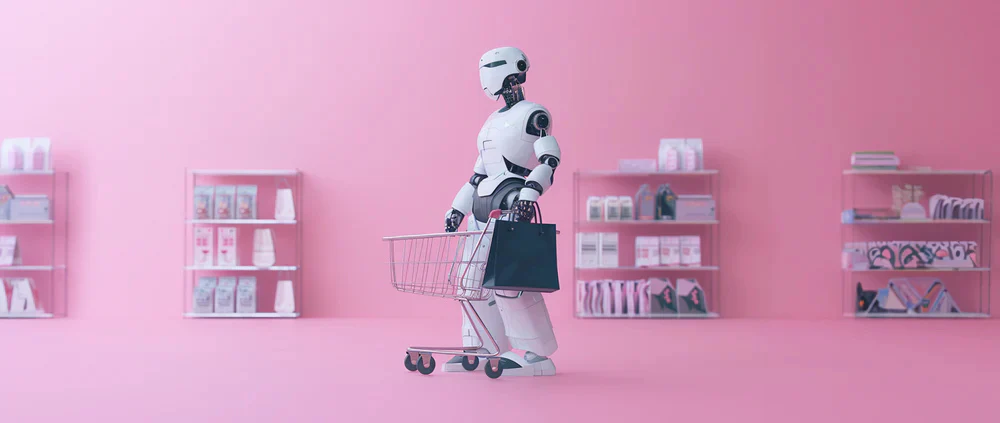
In 2026, the retail industry has completed its “Great Convergence.” The artificial wall between online and offline shopping has finally collapsed. We have entered the era of “Phygital” Retail—where the physical ease of touching a product meets the digital speed of a one-click checkout. The market for AI in Retail has surged to over $13.8 billion this year, with nearly 87% of retailers deploying AI to solve everything from inventory leakage to hyper-personalized styling. For a modern Business, the store is no longer just a place to hold inventory; it is a “Media Channel” and an “Experience Hub.” Meanwhile, Digital Marketing has pivoted toward Hyper-Contextual Value, where brands use real-time data to offer the right product at the exact moment of “Micro-Need.”
The Technological Architecture: The Frictionless Store
By 2026, the physical store has been upgraded with a “Digital Nervous System.”
-
Computer Vision & Sensor Fusion: The “Just Walk Out” technology pioneered years ago is now the standard for mid-sized urban grocers. Using Contextually Intelligent Computer Vision, 2026 stores track items as they leave shelves, automatically billing the customer’s biometric profile as they exit. This has reduced checkout times to zero seconds.
-
Smart Shelves & RFID 2.0: Inventory is now “Self-Aware.” Smart shelves equipped with Weight Sensors and RFID provide retailers with 99.9% real-time stock accuracy. In 2026, a shelf can “call” a restocking robot the moment the last unit of a high-demand item is picked up.
-
Smart Mirrors & AR Fitting Rooms: In fashion retail, the “Fitting Room” is now a digital playground. AR-enabled mirrors allow shoppers to “overlay” different colors or accessories onto their reflection without changing clothes, increasing “basket size” by an average of 18% this year.
Artificial Intelligence: The Rise of the “Personal Shopping Agent”
In 2026, Artificial Intelligence acts as a sophisticated “Concierge” that lives in the customer’s pocket and the store’s infrastructure.
1. The Autonomous Shopping Assistant
Consumers now use Agentic AI Shopping Assistants (a market valued at $6.9 billion in 2026). These agents don’t just find deals; they act on the user’s behalf. Your AI might say, “I’ve noticed your favorite coffee is 30% off at the store you’re passing. I’ve added it to your ‘Grab-and-Go’ list and reserved a unit for you.”
2. Machine Customers (IoT Commerce)
2026 is the year of the “Machine Customer.” Smart fridges, printers, and even washing machines now use AI to autonomously negotiate and execute transactions for household essentials. By 2026, 5% of total retail volume is driven by AI agents talking to other AI agents, with no human intervention required.
3. Real-Time Dynamic Pricing
Using Generative AI in Pricing, retailers now adjust prices in milliseconds based on local demand, competitor stock levels, and even weather-driven sentiment. If a sudden rainstorm hits, the “Phygital” display for umbrellas updates instantly to reflect the shifting value, optimized by an AI engine to maximize both margin and volume.
Digital Marketing: From “Ads” to “Assistance”
Digital Marketing in 2026 has moved from “Interruption” to “Seamless Integration.”
-
Hyper-Personalized “Nudges”: Blanket discounts are dead. In 2026, marketers use Generative AI to create “One-to-One” offers. Instead of a generic coupon, a customer receives a message: “We know you’re training for a marathon; here is a 15% discount on the specific energy gels you bought last month, available for pickup in 5 minutes.”
-
Retail Media Networks (RMNs): Retailers have become the new “Ad Giants.” By monetizing their first-party purchase data, retailers like Walmart and Carrefour are selling ad space on their physical and digital shelves. In 2026, Retail Media is a high-margin revenue stream that often exceeds the profit of the products themselves.
-
Social Commerce Maturity: Social platforms like TikTok and Reels have fully integrated “One-Tap Checkout.” In 2026, a user can see a “Live Stream” of a creator in a “Phygital” store and buy the exact item the creator is touching, with the order routed to the nearest Micro-Fulfillment Center for 30-minute delivery.
Business Transformation: The “Experience-First” Model
The internal Business model of retail has shifted from “Selling Products” to “Curating Culture.”
-
Retailtainment & Pop-Up Culture: To compete with 30-minute delivery (Article 48), physical stores have become “Destination Sites.” 2026 retailers are investing in “Retailtainment”—integrating cafés, workshops, and VR gaming zones into their stores to drive “Dwell Time” and brand loyalty.
-
Circular Retail & Resale: In 2026, every major retailer has a “Resale Corner.” AI-driven authentication tools allow stores to buy back used goods from customers, verify their condition, and resell them instantly, tapping into the $100 billion circular economy.
-
Micro-Fulfillment Integration: The “Back of the Store” has been replaced by a Robotic Micro-Fulfillment Center (MFC). These small, automated units handle local e-commerce orders, allowing the physical storefront to remain a clean, “Gallery-like” space for experience.
Challenges: Privacy Paranoia and the “Uncanny” Store
The 2026 retail revolution faces a “Trust Crisis.”
-
Biometric Resistance: As stores move to “Face-Pay” and “Gait-Recognition,” a segment of the population is pushing back against “Biometric Surveillance.” The professional challenge of 2026 is implementing Privacy-First AI that can track a “Person” as a data point without ever storing their actual identity.
-
The “Staffing Gap”: As automation takes over the till, the role of the “Retail Associate” is being forced to evolve. In 2026, there is a shortage of “High-Empathy Brand Ambassadors”—humans who can provide the expert advice and emotional connection that AI still lacks.
Looking Forward: Toward the “Invisible Commerce”
As we look toward 2030, the “Retail Sector” is moving toward “Predictive Fulfillment.” We are approaching a world where your “Shopping List” is managed entirely by AI, and the products you need arrive at your door before you even realize you’ve run out.
Conclusion
The convergence of Technology, Business, Digital Marketing, and Artificial Intelligence has turned the “Store” into an “Intelligent Interface.” In 2026, the winners are not those with the most floor space, but those with the best Customer Data. By embracing “Intelligent Retail,” the leaders of 2026 are ensuring that shopping is no longer a task to be completed, but a journey to be enjoyed.