
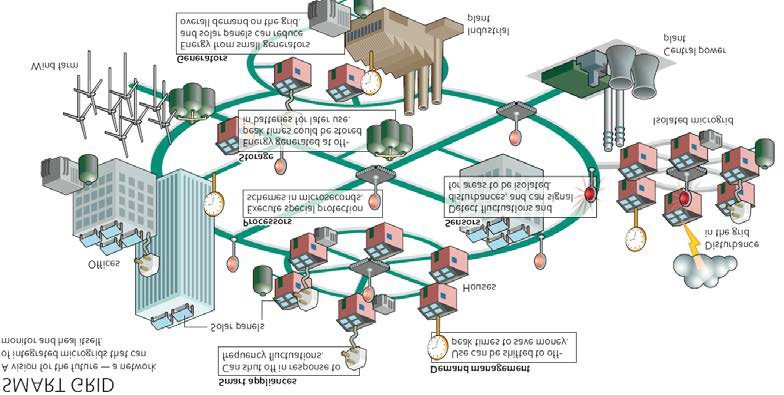
In 2026, the global energy sector is facing a profound paradox: the very technology driving economic growth—Artificial Intelligence—is also the world’s most voracious consumer of power. A single AI data center can now require as much electricity as a mid-sized city, with U.S. data center spending nearing $500 billion this year. This “Power Crunch” has transformed the energy sector from a traditional utility business into a high-stakes arena of innovation. To survive, the industry has embraced the Smart Grid—a decentralized, AI-driven network that treats electricity not just as a commodity, but as a digital asset. For a modern energy Business, the objective is no longer just generation; it is the intelligent orchestration of supply and demand. Meanwhile, Digital Marketing has taken on the role of “Energy Literacy,” translating complex grid data into transparent, trust-based narratives for an eco-conscious public.
The Technological Architecture: From Analog Wires to the Digital Grid
The 2026 grid is a feat of “Software-Defined Infrastructure.” It has evolved from a one-way flow of power to a multi-directional exchange of energy and information.
-
The Fusion Inflexion Point: While commercial fusion is still on the horizon, 2026 is a landmark year. Pilot projects like Commonwealth Fusion Systems’ SPARC are operational, proving the viability of high-temperature superconducting magnets. In China, the government has accelerated its “three-step” strategy, aiming for demonstration reactors that move beyond experimental physics into engineering reality.
-
Edge Computing and IoT Sensors: Millions of smart meters and sensors act as the grid’s “nervous system.” By processing data at the “Edge,” utilities can respond to local surges or outages in milliseconds, preventing the cascading failures that characterized aging grids.
-
Virtual Power Plants (VPPs): Technology now allows thousands of decentralized resources—like home solar panels, parked Electric Vehicle (EV) batteries, and industrial storage—to be aggregated into a single “Virtual Power Plant.” These VPPs provide surges of power during peak times, acting as a flexible, carbon-free alternative to traditional “Peaker” plants.
Artificial Intelligence: The Central Nervous System of Power
In 2026, Artificial Intelligence is the only force capable of balancing a grid that now includes thousands of intermittent renewable sources.
1. The “Self-Healing” Grid
When a storm hits or a transformer fails in 2026, the AI doesn’t wait for a human dispatcher. It uses Agentic AI to autonomously reroute power, isolate the fault, and even dispatch repair drones to the exact GPS coordinates of the damage, reducing outage durations from hours to seconds.
2. Predictive Maintenance 2.0
Utilities use AI to “see” equipment failure before it happens. By analyzing thermal imagery and acoustic sensors on high-voltage lines, AI models predict which components are at risk of sparking a wildfire or failing during a heatwave, allowing for “Proactive Patching” of the infrastructure.
3. The AI-Fusion Symbiosis
A first-of-its-kind “Self-Reinforcing Cycle” has emerged: while fusion provides the massive energy AI requires, AI is being used to stabilize fusion plasmas. In 2026, AI algorithms are managing the magnetic coils of tokamaks in real-time, preventing the “disruptions” that previously halted fusion reactions.
Digital Marketing: Selling “Performance Over Perception”
Digital Marketing in the energy sector has moved past “Greenwashing” into “Radical Performance Transparency.”
-
Sustainable Performance Marketing: In 2026, “Eco-friendly” is a banned term for many regulators. Brands now market their “Grid Contribution Score.” A company doesn’t just claim to be green; it shows real-time data on how much surplus energy its facilities returned to the community grid.
-
GEO (Generative Engine Optimization): As data center operators ask AI, “Which region has the most resilient, low-carbon baseload for a 500MW facility?”, energy providers are optimizing their technical audits to ensure their “Uptime and Emissions” data is the top recommendation.
-
Energy Literacy Campaigns: Marketing has shifted to “Humanizing” the transition. Utilities use interactive AR apps to help consumers understand how their smart appliances are saving them money by “shifting” high-load tasks (like dishwashing) to times when wind energy is peaking.
Business Transformation: The “All-of-the-Above” Strategy
The internal Business model of energy has shifted from “Volume” to “Flexibility.”
-
The Death of the Stable Load Curve: The old, predictable “Day/Night” cycle is gone. Utilities in 2026 are adopting Integrated Capacity Planning, which treats “Demand Response” (paying customers to use less) as a more valuable asset than building a new power plant.
-
Energy-as-a-Service (EaaS): Companies like GE Vernova and Siemens are moving toward subscription models. Instead of selling a turbine, they sell “Guaranteed Uptime,” using AI to manage the hardware they’ve leased to the grid.
-
Brownfields to Brightfields: A major trend of 2026 is the repurposing of old industrial sites. Former coal plants are being “re-cored” with Small Modular Reactors (SMRs) or fusion pilots, taking advantage of existing high-voltage grid connections.
Challenges: The Interconnection Queue and Security
Despite the progress, 2026 faces significant “Gridlock.”
-
The “Interconnection Bottleneck”: In the U.S. and Europe, some clean energy projects are facing 2-to-6 year delays due to a shortage of physical transformers and switchgear. The professional challenge of 2026 is “Supply Chain Resilience” for the grid itself.
-
Cyber-Physical Warfare: As the grid becomes software-defined, it becomes a target. 2026 has seen a surge in “AI-Driven Cyberattacks” on utility infrastructure, leading to a mandatory shift toward Quantum-Safe grid protection systems.
Looking Forward: Toward “Universal Abundance”
As we look toward 2030, the “AI-Fusion Nexus” promises a world where energy is no longer a constraint on human progress. If fusion can be scaled, we move from a world of “Energy Scarcity” to “Energy Abundance,” where the cost of clean power drops toward the cost of the hardware itself.
Conclusion
The convergence of Technology, Business, Digital Marketing, and Artificial Intelligence has turned the “Energy Sector” into the world’s most important technology stack. In 2026, the winners are those who can balance the voracious hunger of the digital age with the physical limits of the planet. By embracing the “Intelligent Grid,” the energy leaders of 2026 are ensuring that the light of the stars can finally power the world of tomorrow.