
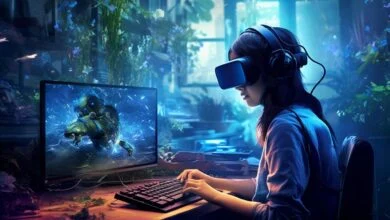
In 2026, the entertainment industry has shifted from a “Content Factory” to an “Engagement Engine.” The global market for AI in media and entertainment has reached $85.36 billion this February, driven by a pivot from mass production to hyper-personalized immersion. For a modern Business, the goal is no longer just to capture “eyeballs” but to sustain “dwell time” through interactive loyalty. Digital Marketing has similarly evolved: 2026 is the year of the “Machine Influencer,” where 48% of young adults now follow at least one AI-generated celebrity. We are moving from a world of “Search” to a world of “Simplicity,” where AI doesn’t just suggest what you should watch—it creates it.
The Technological Architecture: The Generative Engine
By 2026, the underlying tech stack of Hollywood and Gaming has merged into a single “Real-Time Render” ecosystem.
-
Virtual Production & LED Volumes: Green screens are a relic. 2026 film studios use Full Live LED Walls and real-time rendering (powered by engines like Unreal 6) to create complex VFX on-set. This Technology has slashed post-production timelines by 30%, allowing a series to go from “wrap” to “streaming” in weeks, not months.
-
The “Zero-Latency” Cloud: 5G-Advanced and satellite constellations have enabled “Cloud Gaming” to finally go mainstream. In 2026, high-fidelity, ray-traced games are streamed to any device—even smart glasses—removing the $500 “Hardware Barrier” to entry.
-
Interactive Haptics: Wearable technology now allows viewers to “feel” the entertainment. From the rumble of a stadium in a sports broadcast to the texture of a virtual garment in a metaverse fashion show, haptics are adding a new sensory layer to the 2026 digital experience.
Artificial Intelligence: From Script to Sentience
In 2026, Artificial Intelligence has moved beyond “Predictive Recommendations” to “Generative Creativity.”
1. Generative NPCs (Non-Player Characters)
Gaming has been revolutionized by “Living NPCs.” Using on-device LLMs, characters in 2026 games no longer follow a script. They have “Long-term Memory,” meaning they remember how you treated them in previous sessions and will adapt their dialogue, tone, and quests accordingly. This “Sentient World-Building” has increased game replayability by 200%.
2. AI-Driven “Scene-Level” Personalization
Streaming platforms like Netflix and Prime Video have moved beyond recommending titles. In 2026, AI modifies the content of the show. If the AI knows you are a fan of 1980s synth-pop, it may dynamically adjust the background score of a thriller to match your taste, or swap out background “Product Placements” (Article 54) to show items relevant to your actual shopping list.
3. Virtual Celebrities & AI Influencers
We are seeing the rise of the Permanent Popstar. AI-generated celebrities, who never age and can speak 50 languages fluently, are now topping the charts. These “Virtual Humans” are managed by talent agencies as Digital Assets, performing 24/7 in personalized VR concerts for millions of fans simultaneously.
Digital Marketing: The “AI-to-Human” Trust Shift
Digital Marketing in 2026 is moving toward “Zero-Visit Visibility” and creator-led commerce.
-
The Influencer-to-Sales Pipeline: By February 2026, 60% of product discovery happens on TikTok, Instagram, and YouTube, surpassing traditional search engines. Marketers are shifting 74% of their budgets into “Creator Programs,” using AI to perfectly match brands with niche “Micro-influencers” who deliver 3x higher ROI than traditional ads.
-
GEO (Generative Engine Optimization): As fans ask their AI assistants, “What should I play this weekend?”, gaming studios are optimizing their “Game Metadata” and player sentiment scores to ensure their title is the “Top Recommended Experience.”
-
The “Community as Algorithm”: In 2026, the most powerful marketing isn’t a billboard; it’s a “private community.” Brands are using AI to manage thousands of small, gated Discord and Telegram groups, fostering deep loyalty that algorithms can’t disrupt.
Business Transformation: The “Experience-as-a-Service” Model
The internal Business of entertainment has moved from “Hits” to “Ecosystems.”
-
The Unified Entertainment Bundle: To combat “Subscription Fatigue,” 2026 has seen the rise of the “Super-Bundle.” For a single fee, users get access to streaming, gaming, live concert VR-passes, and even “Phygital” merchandise (Article 54).
-
M&E Consolidation 2.0: Tech giants are fully “crashing the Hollywood party.” In 2026, traditional media companies are spinning off their “Linear TV” assets to focus entirely on AI-First Digital Studios, often partnering with cloud providers to scale their distribution.
-
Monetizing the “Machine Customer”: Entertainment companies are now designing content for AI agents. They provide “High-Fidelity Metadata” so that personal AI assistants can accurately summarize, clip, and recommend their content to the “Human in the Loop.”
Challenges: The “Authenticity Crisis” and Synthetic Saturation
The 2026 entertainment revolution faces a “Humanity Speedbump.”
-
The Authenticity Premium: As AI-generated content floods the market, “Human-Made” has become a luxury label. In 2026, there is a growing counter-movement of audiences seeking “Raw, Unedited, Human” experiences, leading to a surge in live theater and acoustic performances.
-
Deepfake Liability: With the rise of virtual celebrities, “Image Rights” have become a legal battlefield (Article 56). The professional challenge of 2026 is protecting the “Digital Twin” of a human actor from unauthorized AI cloning and ensuring “Watermarking” for all synthetic media.
Looking Forward: Toward “The Infinite Story”
As we look toward 2030, “Entertainment” is moving toward “The Infinite Story.” We are approaching a world where you don’t just “watch” a movie; you enter a persistent, AI-generated universe that continues to evolve even when you aren’t there—a true “Second Life” for the digital age.
The convergence of Technology, Business, Digital Marketing, and Artificial Intelligence has turned “Entertainment” into “Individualized Immersion.” In 2026, the winners are not those who own the biggest studios, but those who own the most Engaging Algorithms. By embracing “Intelligent Play,” the leaders of 2026 are ensuring that the stories we tell are as unique as the people who hear them.