
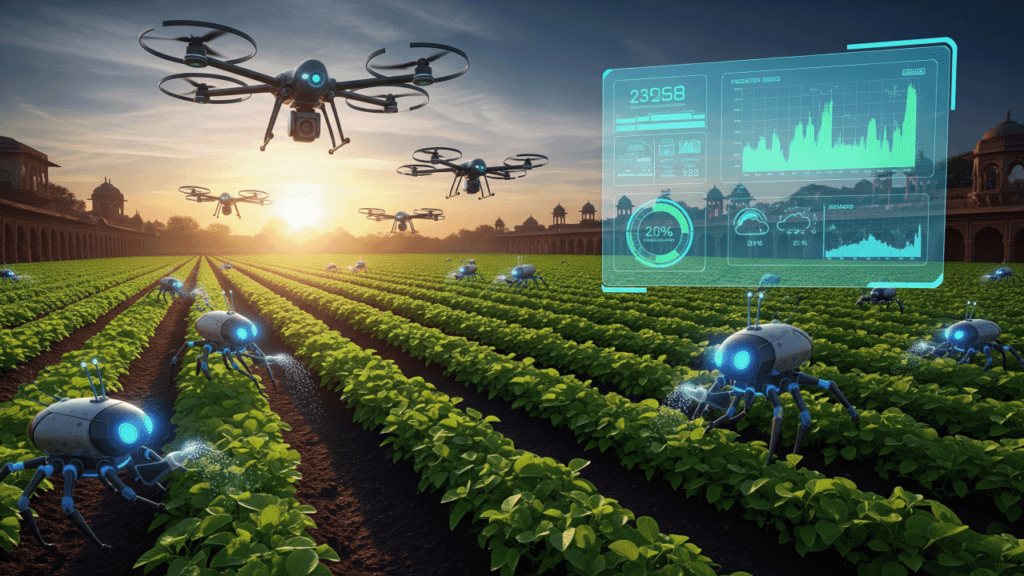
In 2026, the farmer’s greatest tool is no longer the plow, but the Algorithm. As the global population nears 8.3 billion, the agricultural sector has reached a “Pragmatic Pivot.” The global market for AI in agriculture has surpassed $3.1 billion this February, driven by a shift from simple “Big Data” to “Actionable Intelligence.” For a modern Business, the focus is on Survivability—using tech to defend crops against a volatile climate. Meanwhile, Digital Marketing is reinventing food transparency; in 2026, the most successful brands don’t just sell “Organic,” they sell “Data-Proven Resilience,” allowing consumers to track the specific “Nitrogen Efficiency” of their dinner.
The Technological Architecture: The Connected Field
By 2026, the farm is a fully networked IoT ecosystem where connectivity is the new “irrational” fertilizer.
-
Interoperable Data Layers: In 2026, the “Data Silo” is dead. New standardization protocols (like the AgData Revolution) allow soil sensors, weather drones, and autonomous tractors from different manufacturers to speak the same language. This Technology enables a “Unified Field View,” increasing input efficiency by 40%.
-
Direct-to-Device Rural 5G: Satellite-to-phone connectivity (Article 60) has finally solved the “Rural Connectivity Gap.” In 2026, even remote acreage has the bandwidth to stream real-time multispectral imagery from drones directly to a farmer’s tablet.
-
Biotech 2.0 (CRISPR & Hardening): 2026 is the year of Physiological Hardening. Using gene-editing tools like CRISPR, scientists have developed “bespoke” wheat and rice varieties that thrive in 20% higher temperatures, treated as a “Defense Strategy” against 2026’s unpredictable weather cycles.
Artificial Intelligence: From Dashboards to “Decision Partners”
In 2026, Artificial Intelligence has moved beyond showing a graph; it now tells the farmer exactly what to do next.
1. Generative AI as a Field Partner
The “Chatbot” has entered the tractor. In 2026, farmers use Voice-AI Decision Support to ask: “Based on the current humidity and the pest alerts in the neighboring county, should I spray tonight or wait?” The AI “reasons” through millions of data points to provide a clear, risk-weighted recommendation.
2. Robotic Swarms & Precision Harvesting
Autonomous machinery has hit a tipping point. By February 2026, 18% of new tractors sold globally are semi-autonomous. We have entered the era of Swarm Robotics—small, lightweight bots (like the AGCO Xaver) that work in teams to plant and weed, reducing soil compaction by 60% compared to heavy traditional machinery.
3. Precision Fermentation (The “Second Agriculture”)
While fields grow crops, “Cellular Factories” are growing proteins. 2026 marks the commercial scaling of Precision Fermentation. Using AI-optimized microbial hosts, these “bio-vats” produce animal-identical milk and egg proteins, aiming for price parity with traditional dairy by the end of this year.
Digital Marketing: The “Radical Proof” Era
Digital Marketing for food and ag-tech in 2026 is built on Proof of Impact.
-
The “Resilience” Hook: Food marketers have shifted from “Mitigation” to “Defense.” In 2026, high-end produce is marketed as “Climate-Hardened,” appealing to consumers who want to support farms that are successfully navigating environmental shifts.
-
AEO (Answer Engine Optimization) for Sourcing: As food giants ask their AI, “Which regional supplier has the most stable nutrient-use efficiency (NUE)?”, ag-retailers are optimizing their Digital Yield Certificates to ensure they are the top-recommended partners.
-
“Digital Product Passports” for Food: Scanning a barcode in 2026 doesn’t just show a country of origin; it shows a Blockchain-verified “Life Cycle” (Article 59), including water usage and the specific time of harvest, marketed as the “Ultimate Freshness Guarantee.”
Business Transformation: Robot-as-a-Service (RaaS)
The internal Business of farming has moved from “CapEx” to “OpEx.”
-
The RaaS Revolution: To overcome the “High Initial Cost” barrier, 2026 has seen the explosion of Robot-as-a-Service. Small and mid-sized farmers no longer buy $400k autonomous harvesters; they lease them for $20–$50 per hectare, turning equipment costs into a manageable operating expense.
-
Ag-Retailers as Data Partners: Traditional seed and fertilizer sellers have transformed into Digital Consultants. In 2026, they don’t just sell bags of grain; they sell “Outcome-Based Bundles” that include the seeds, the AI monitoring software, and a yield guarantee.
-
Carbon Credit Verification: AI is now the “Trust Layer” for carbon markets. By using satellite imagery and soil sensors to verify carbon sequestration in real-time, 2026 farms are unlocking a secondary revenue stream that was previously too complex to audit.
Challenges: Technological Literacy and the Cost Gap
The 2026 agricultural revolution faces a “Divide” problem.
-
The “Smallholder” Barrier: While large-scale operations are 90% automated, small farms (which produce 80% of the world’s food) still struggle with high tech costs. The professional challenge of 2026 is “Frugal Innovation”—creating low-cost, solar-powered AI sensors for emerging markets.
-
Data Sovereignty: Who owns the data generated by the tractor? In 2026, a legal battle is brewing between farmers and equipment manufacturers over “Right to Repair” and data ownership, requiring new “Ag-Data” laws to protect the producer (Article 56).
Looking Forward: Toward “Autonomous Nutrition”
As we look toward 2030, the “Agriculture Sector” is moving toward “Decentralized Abundance.” We are approaching a world where Vertical Urban Farms and Molecular Food Labs produce 30% of our nutrition within city limits, reducing the “Farm-to-Table” distance to a “Floor-to-Floor” journey.
The convergence of Technology, Business, Digital Marketing, and Artificial Intelligence has turned “Farming” into “Precision Life Support.” In 2026, the winners are not those with the most land, but those with the most Efficient Ecosystems. By embracing “Intelligent Agriculture,” the leaders of 2026 are ensuring that as the planet changes, our ability to feed it only grows stronger.