
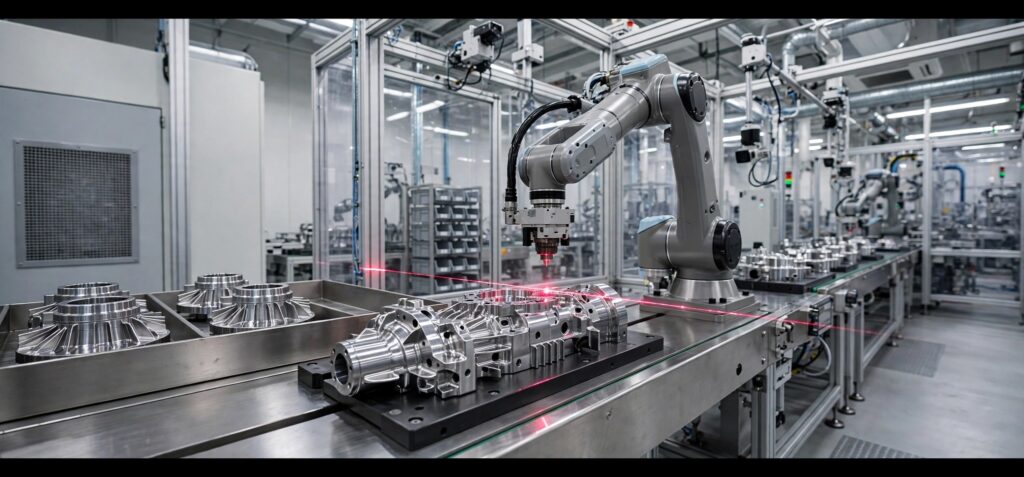
Automation has a habit of exposing whatever it does not fix. Robots took over welding, assembly and material handling, throughput climbed, and then a strange thing happened on a lot of production lines. The bottleneck moved to inspection. Parts arrived at the quality station faster than anyone could check them, and the gating step in a highly automated factory turned out to be a person holding a gauge.
High-tech industries felt this first, because their tolerances are the tightest and their parts are the least forgiving. Semiconductor packaging, photonics, medical devices and precision drive components all share a nasty property: the defect that matters is invisible, the batch sizes are large, and the cost of letting one through is enormous. Sampling a handful of parts per hour stops being a defensible strategy.
So quality control is being rebuilt. Not as a checkpoint at the end of the line, but as a continuous stream of measurements woven through the process itself. That rebuild is one of the quieter stories of Industry 4.0, and it is further along than most people outside manufacturing realize.
The Inspection Bottleneck Nobody Planned For
The scale of the automation wave explains the pressure. The International Federation of Robotics reports that global robot density in manufacturing reached 162 units per 10,000 employees in 2023, more than double the figure of seven years earlier, with Korea above 1,000 units and Germany at 429. Every one of those robots can place a part. Very few of them can judge it.
Manual inspection also carries a problem that no amount of training solves. Human assessment drifts across a shift, varies between operators, and produces a verdict rather than a dataset. You learn that a part passed. You do not learn by how much, or whether the margin has been shrinking for three weeks. That missing information is exactly what an automated process needs in order to correct itself.
When Measurement Moves Into the Line
Moving laboratory-grade measurement onto a production line is harder than it sounds. The line vibrates, the temperature swings, the parts are dirty, and nobody will wait forty seconds for a reading. For years that gap forced a compromise: fast and crude in the factory, slow and accurate in the metrology room, with a long delay between the two.
Optical interferometry is what collapsed the compromise. Consider white-light interferometry by GBS metrology, which shows where the technology has landed. The company is a German manufacturer based in Ilmenau and founded in 1997, and it builds white light interferometers that capture an areal three-dimensional height map in seconds, with sub-nanometer vertical resolution and no contact with the part at all. Hardened versions of instruments like these now sit in enclosures beside the machines they monitor.
The traceability still has to come from somewhere, and national institutes supply it. The Precision Engineering division at PTB, Germany's national metrology institute, runs dedicated working groups for 3D roughness metrology and displacement interferometry, and it is currently pushing digital calibration certificates so that a calibration can be consumed by software rather than filed in a binder. That last detail matters more than it sounds, because an automated quality loop cannot read a PDF.
The Data Layer Behind Quality 4.0
Hardware is only half of it. An inline measurement is worth very little if it ends up in a local log file, which is why the interesting work has shifted to plumbing: part identifiers, time stamps, process parameters and measurement results all landing in one place where software can correlate them. Manufacturers building smarter factories around industrial IoT tend to describe this as the unglamorous majority of the project, and they are right.
Once the data exists, the applications stack up quickly. Tool wear becomes a trend line instead of a surprise. Supplier qualification becomes a statistical argument instead of a negotiation. Root cause analysis stops being archaeology, because the measurement that failed can be traced back to the exact spindle, batch and ambient temperature that produced it. None of that requires artificial intelligence, although it gets considerably better with it.
What Automation Still Cannot Do Alone
There is a limit worth naming. An automated system measures what it was told to measure, and it will cheerfully report a perfect result against the wrong parameter. Deciding which parameter actually predicts failure in a given application remains expert work, which is why institutes such as NPL still run training on surface topography measurement alongside their calibration services.
Uncertainty is the other trap. A number with four decimal places looks authoritative, and it means nothing without a stated uncertainty budget. Factories that skip that step end up tightening a process against measurement noise, chasing a signal that was never there. The engineers who get the most out of automated inspection are usually the ones who stay slightly suspicious of it.
Building a Quality Function That Scales
The direction of travel is clear enough. Inspection is moving from a gate to a sensor network, from sampling to full coverage, and from a cost center to a source of process intelligence. High-tech manufacturers are leading because they had no choice, and everyone else will follow as tolerances tighten and customers get better at asking for evidence.
For anyone planning that transition, the sequencing matters. Pick one process where defects are expensive and the failure mode is understood. Instrument it properly, with traceable calibration and an honest uncertainty figure. Get the data into a system where other people can query it. Then expand, because the second line is always far cheaper than the first.
The future of quality control in high-tech industries looks less like a bigger inspection department and more like a factory that knows, continuously, what it just made. That is a substantial change in how a manufacturer understands itself, and the companies getting there first are quietly building a lead that is very hard to buy back later.
Previously in Technology: Best Permanent Fruits in Blox Fruits: Which Ones Are Worth Your Robux?