
The North American clay oven maker, founded in 1992, keeps the hand-shaped clay chamber and modernizes the burners, safety parts and sanitation certification around it
MANTECA, CALIFORNIA – Few pieces of commercial kitchen equipment are built around a material as old as the clay tandoor. Tandoor Morni, a North American manufacturer that has produced clay tandoor ovens since 1992, has spent more than three decades keeping that clay oven intact while engineering everything around it for modern restaurants, caterers and home cooks. The result is a tandoor oven for sale in North America that pairs a hand-shaped clay chamber with a food-grade stainless steel body, 100,000 BTU commercial burners, thermocouple flame safety and model-by-model sanitation certification. The company sells its ovens through nine showrooms in the United States and Canada, including its Manteca showroom at 2142 W Yosemite Ave.
For the technology sector, the tandoor is an unusual case study. Much of the innovation in commercial cooking equipment has come from replacing traditional methods with new ones, such as induction in place of flame, or combination ovens that steam and roast in one cabinet. Tandoor Morni takes the opposite approach. It treats the clay oven as a proven technology and directs its engineering at the problems around it: steady heat, fuel choice, flame safety, durability and compliance.
“The clay already does its job perfectly. It has for thousands of years,” said Parvinder Aulakh, Owner of Tandoor Morni. “Our work is everything around the clay. How do you keep that heat where it belongs, burn fuel efficiently, shut the gas off safely if the flame goes out, and make the whole thing clean enough to pass a commercial health inspection? That is where the engineering lives.”
Why a Tandoor Oven Still Starts With Clay
A tandoori oven’s cooking performance comes from physics rather than electronics. The thick clay walls absorb heat from the burner or fire below and release it as radiant heat across the whole chamber. At the same time, hot air rises through the cylinder, and the flame adds direct heat at the base. Radiation, convection and conduction all act on the food at once.
Conduction is what happens when naan dough is pressed against the hot clay wall. The bread cooks from the contact side, puffing and blistering in a way an oven rack cannot reproduce. Radiation from the surrounding walls sears skewered meats from every direction, and convection carries the rising heat, along with the vapor from marinade dripping onto the flame, back across the food. Tandoor Morni lists an operating range of 700 to 900 degrees Fahrenheit for its commercial tandoor ovens, with a peak clay temperature of 900 degrees, and its gas models preheat in 20 to 30 minutes.
Clay suits this job because it stores a large amount of heat, gives it back steadily, and tolerates the daily cycles of heating and cooling that come with restaurant service.
A Supply Chain That Starts in the Himalayan Foothills
Tandoor Morni’s process begins with raw material selection. Trained potters hand-select natural clay in the foothills of the Himalayas, north of Delhi, choosing it for its mineral density, texture and heat tolerance. Artisan potters then hand-shape each clay pot at the company’s own factory in Delhi, India.
According to the company, the clay is weathered for 12 to 18 months before it is kiln-fired at 1,100°C for 14 hours. The finished chamber is natural clay with no synthetic coatings or chemical treatments on the cooking surface. Once the pots reach North America, licensed gas technicians complete the gas fittings and certification work.
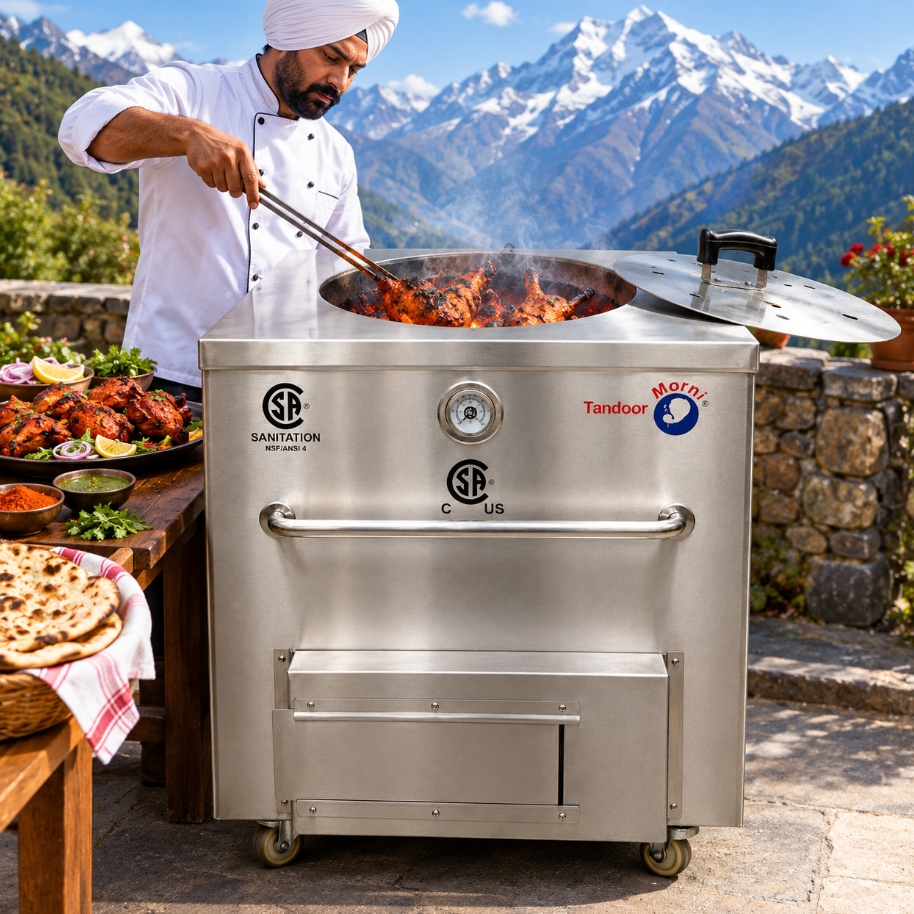
A chef cooks tandoori chicken in a Tandoor Morni stainless steel clay tandoor oven.
The Shell: Food-Grade Stainless Steel
Each clay chamber is housed in a food-grade stainless steel body. The steel gives the oven a durable surface that can be cleaned to commercial standards, protects the clay from knocks and moisture, and gives the equipment a professional look in open kitchens where diners can watch it at work.
Commercial models ride on four heavy-duty castered wheels, with locking casters on the two front wheels. The CH02 and T02 measure 32 by 32 by 37 inches and weigh about 550 pounds, while the CH06 and T06 measure 36 by 36 by 37 inches and weigh about 750 pounds.
Two Burner Philosophies
The heat source is where Tandoor Morni’s commercial range offers its clearest engineering choice. The company builds two commercial series around different burner designs, and every model in both series is rated at 100,000 BTU.
The CH-Series, made up of the CH02, CH04 and CH06, uses a double burner with separately controlled flames and a fully covered gas system. The design priority is reliability with very low maintenance.
The T-Series, made up of the T02, T04 and T06, uses a 23-tip stainless steel jet burner. Each of the 23 nozzle tips delivers heat into the chamber, and the company says the design gives faster heat-up and more precise temperature control than the double burner. It is aimed at high-end restaurants, boutique hotels and restaurant groups that want fine control over char and color.
Both series share the same three footprints. The 32-inch models bake about 16 naan at a time, the 34-inch models about 18, and the 36-inch models about 20.
Fuel Choice as a Design Variable
Fuel is one of the most important decisions an operator makes, and Tandoor Morni treats it as a configurable part of the design rather than a fixed feature. Its gas tandoor ovens run on natural gas or propane (LPG). Buyers specify the fuel when they order, and natural gas is the default.
Natural gas suits permanent restaurant kitchens with an existing supply line and gives a steady, predictable flame. Propane makes the same clay oven usable where there is no gas line, such as food trucks, event sites and outdoor catering setups. According to the company, gas use typically runs between 1 and 3 pounds per hour, depending on the oven’s size and burner.
Charcoal and wood-fired models are intended for outdoor use. They trade some convenience for the smoky flavor that live fuel brings, as smoke from charcoal or hardwood works its way through the hot clay chamber.
Safety Systems Built Into Every Gas Oven
Open flame in a commercial kitchen calls for safeguards. On Tandoor Morni’s gas models, a pilot flame lights the burner, and a thermocouple holds the gas valve open only while it senses that pilot flame. If the flame goes out, the thermocouple shuts the gas off, so unburned gas does not keep flowing into the chamber or the kitchen. When a pilot keeps going out, the company’s guidance is to check the thermocouple and pilot assembly rather than relighting it again and again.
Gas models must be installed and connected to the main gas line by a certified gas technician. The company advises against self-installation. Gas ovens are meant to be used outdoors, or indoors only under a commercial ventilation hood in a licensed kitchen. To keep ovens running over a long working life, Tandoor Morni sells replacement thermocouples (AS12) and gas pilot assemblies (AS13), and recommends that busy kitchens keep a spare pilot assembly on hand.
“People expect a high-performance oven to be maintenance-free,” Aulakh said. “Clay is different. A few hours of care a year keeps it performing for a very long time, and that trade-off is exactly why the material has lasted this long.”
Certification, Model by Model
For commercial equipment, performance has to be matched by verified compliance, and Tandoor Morni lists its certifications model by model. NSF/ANSI 4 sets food protection and sanitation requirements for the materials, design and construction of commercial cooking equipment. CSA/ANSI Z83.11 is the North American standard for gas food service equipment.
- CH-Series (CH02, CH04, CH06): NSF/ANSI 4.
- T-Series (T02, T04, T06): NSF/ANSI 4 and CSA Z83.11.
- CS02 food truck tandoor: NSF/ANSI 4 and CSA Z83.11.
- CS01 round catering tandoor: NSF/ANSI 4 and CSA Z83.11.
- Copper Series (A02, A04, A06): CSA Z83.11.
- Home Series (R26, R28, R32): NSF/ANSI 4.
Because local requirements vary, restaurant operators should confirm what their health department and building officials require before choosing a model.
Designed for Different Operating Environments
Tandoor Morni applies the same core design across very different settings. Square commercial tandoor ovens are built for permanent installation under restaurant exhaust hoods. The CS02 food truck tandoor brings a certified clay oven into mobile kitchens and tight spaces. It measures 24 by 24 by 37 inches, weighs about 175 pounds and bakes about eight naan at a time.
Catering operators can choose from the CS-Series, including the round CS01. The company describes these ovens as built to be set up and broken down at a different venue every week. CS-Series models weigh between 175 and 250 pounds and ship with heavy-duty 5-inch locking casters rated to 700 pounds.
Home Tandoor Ovens Built the Same Way
The same thinking extends to residential tandoor ovens. Buyers comparing Home Tandoori Ovens for Sale will find Tandoor Morni’s Home Series, offered in three sizes and built with the same hand-selected clay and stainless steel construction as its commercial equipment. All three models share a 20-by-20-inch footprint, a 12-inch mouth and a 13-inch clay belly, and reach 900 degrees Fahrenheit or more.
- R26 Mini Clay Tandoor Oven: 26 inches tall, about 90 pounds, serves about 10 people.
- R28 Wood Fired Tandoor Oven: 28 inches tall, about 95 pounds, serves about 15 people.
- R32 Large Outdoor Tandoor Oven: 32 inches tall, about 110 pounds, serves 20 or more.
Each home oven rolls on four casters, two of them with safety brakes, and comes with 10 skewers, a pair of naan rods, two naan gaddi cushions, and a clay pot repair kit with curing paste.
Maintenance by Design
Clay is a natural material, and Tandoor Morni has built a maintenance process around it. Every new tandoor is cured before regular use. The owner applies four coats of the company’s curing paste, letting each coat absorb for about 10 minutes. The oven then runs for 100 hours at low heat, starting at 20 percent and rising to no more than 35 percent after 30 hours, with the lid off for the first 40 hours. Cooking can begin during the curing period.
Owners re-season the chamber every four to six months with the same paste. The company notes that minor hairline cracks are normal for a working clay oven and do not affect performance, and its Tandoor Clay Pot Repair Kit (AS08) is used to fill them.
Modernization Without Replacement
Tandoor Morni’s approach offers a broader lesson about innovation in traditional industries. Rather than replacing a proven cooking method, the company has focused on removing the obstacles that kept it out of modern kitchens: inconsistent heat, fuel limitations, safety risks and regulatory uncertainty. The clay chamber, still shaped by hand, remains at the center of every tandoor oven. What has changed is the system around it.
Pricing and Availability
Tandoor Morni’s commercial tandoori ovens are listed from $1,799 for the CS02 food truck model to $2,699 for the T06. The CH-Series is listed from $1,999 to $2,199 plus shipping, and the T-Series from $2,499 to $2,699 with free shipping. Catering models are listed from $1,299 to $1,799, the Copper Series from $2,499 to $2,999, and Home Series ovens from $1,099 to $1,299 with free shipping to the 48 contiguous states. Orders ship from the nearest warehouse in three to five business days, and easy financing with quick approval is available on all models.
Buyers can see the range in person at any of the company’s nine showrooms: Edison, New Jersey; Houston, Texas; Elk Grove Village, Illinois; Tampa, Florida; Washington, D.C.; Algona, Washington; Boulder, Colorado; Manteca, California; and Mississauga, Ontario. Showrooms are open Monday to Friday, 10 a.m. to 4 p.m., by appointment.
About Tandoor Morni
Tandoor Morni is a manufacturer of authentic clay tandoor ovens, founded in 1992 by Mr. Bitu. The company operates nine showroom locations across the United States and Canada, offering commercial, catering, copper and home tandoor ovens along with a full range of accessories and replacement parts. Every oven is built around a hand-selected clay chamber sourced from the Himalayan foothills, hand-shaped at the company’s factory in Delhi and housed in stainless steel construction, with certified models carrying CSA Sanitation NSF/ANSI 4 and CSA Z83.11 gas certification for use across the USA and Canada.
Visit Tandoor Morni
Tandoor Morni
2142 W Yosemite Ave, Manteca, CA 95337
Call: 727 251 6924
Email: [email protected]
Social Media
Facebook: https://www.facebook.com/profile.php?id=61594602412752
Instagram: https://www.instagram.com/tandoor.morni
LinkedIn: https://www.linkedin.com/company/morni-tandoor/
YouTube: https://www.youtube.com/@tandoormorni
WhatsApp: 727 251 6924