
As enterprises adopt AI capabilities, MCP (Model-Connection Protocol) servers have rapidly become the standard bridge between AI tools and existing services. MCP servers let models query databases, invoke business logic, and fetch documents through a unified protocol, making integration fast and predictable.
That speed and convenience, however, has a downside: teams can deploy MCP servers quickly and often without oversight, leaving a growing number of potentially exposed entry points into critical systems.
It’s worth noting that MCP servers don’t sit in isolation; they forward requests to the same APIs, services, and data stores that power the rest of the enterprise. Any flaw in those backends becomes reachable through an MCP server, and sometimes in ways traditional API defenses do not anticipate. An MCP-based request that triggers a database query can expose the same SQL injection or access control gaps as a conventional endpoint, but with a slightly different protocol surface and different input handling. That makes MCP servers a high-value target for injection attacks, SSRF, data leakage, and lateral movement into other systems.
Historically, assessing MCP servers has been manual and inconsistent: pen tests, ad hoc scripts, or perhaps most common…no testing at all. For most enterprises, that’s an unacceptable blind spot.
HawkScan: runtime security testing for MCP servers
StackHawk now offers automated remote scanning of MCP servers, or what we prefer to call it “HawkScan for MCP,” using the same runtime testing engine it applies across the development lifecycle. Rather than relying on static configuration checks, HawkScan tests running MCP servers to exercise real request/response flows and identify exploitable behaviors. Tests are designed to detect common web and API vulnerabilities as they appear through the MCP protocol including injection, SSRF, broken auth, and data exposure.
Key advantages
- Runtime testing: HawkScan interacts with live MCP endpoints, validating how the server actually processes inputs and talks to downstream services. This exposes vulnerabilities that static scans and dependency checks can miss.
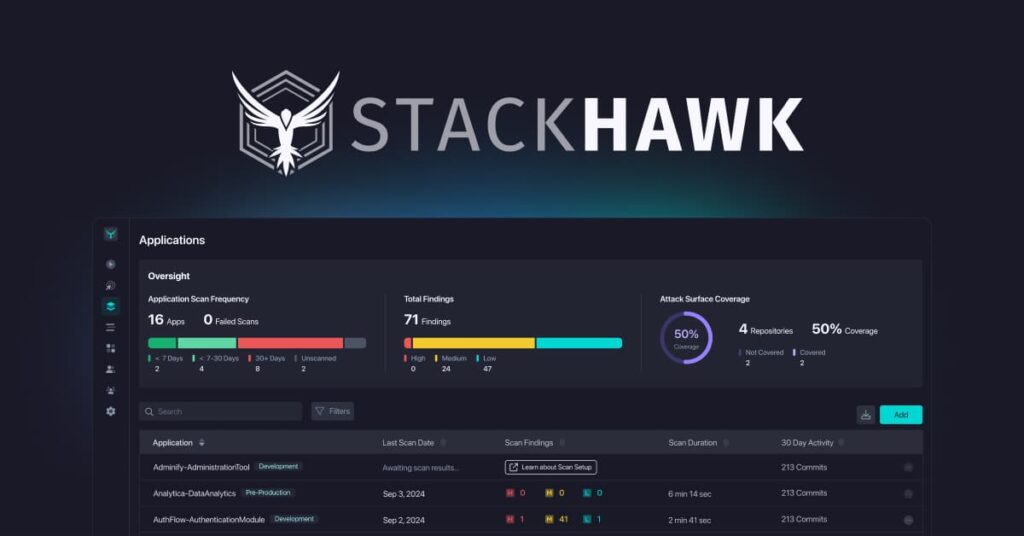
- Unified visibility: MCP scan results appear in the same StackHawk dashboard alongside other API and application findings, so teams don’t need separate tools or workflows to manage MCP security.
- Actionable results: Findings include request traces and reproduction steps that developers can use to reproduce and remediate issues quickly.
- Scalable automation: HawkScan can be integrated into CI/CD and testing pipelines so MCP servers are validated continuously as code and models evolve.
- Focused on real risk: Because it targets runtime behavior, HawkScan prioritizes vulnerabilities that can be exploited in practice, reducing noise and focusing remediation efforts.
Why this matters now
MCP servers are proliferating across organizations. Some are ephemeral, while others become critical parts of production infrastructure. This means the attack surface is both growing and heterogeneous. Security teams need a way to discover and test these servers routinely, without slowing down developer velocity. By extending runtime scanning to MCP endpoints, StackHawk helps organizations treat MCP servers as first-class application assets rather than unchecked black boxes.
Automated runtime testing tailored to MCP protocols closes a significant gap between rapid deployment and secure operations. StackHawk’s HawkScan for MCP brings continuous, actionable scanning to these endpoints, helping teams find and fix vulnerabilities before they’re exploited.