
Are you worried about missing your sales targets because your forecasts are off?
In this article, you’ll learn about different forecasting techniques, tailored to fit various business contexts. Each method comes with clear steps and real-world examples so you can easily choose the best one for your business needs.
Companies with accurate sales forecasts are 10% more likely to increase their revenue year-over-year. It’s high time for you to understand how to create accurate sales forecasts that drive strategic planning and boost your business’s growth.
Let’s get into it.
What Is Sales Forecasting?

Sales forecasting process estimates your future sales by predicting the number of products or services you will sell in a specific period. It involves analyzing these 8 key factors:
- Seasonality
- Market Trends
- Historical Data
- Product Lifecycle
- Competitor Activity
- Marketing Activities
- Economic Indicators
- Sales Team Performance
Understand these factors to identify what products you should prioritize in 2024 and when to promote them.

Why Is Sales Forecasting Important?
When you know the length of your sales cycle, you can accurately predict when deals will close. You can also allocate resources better and set realistic targets to drive your business growth.
- Resource Allocation: Sales forecasting makes sure you have the right amount of resources. This includes your sales products, staff, and funds so you can avoid having too much or too little.
- Goal Setting: Forecasting gives you targets to motivate your team to achieve the sales goal. For example, if your forecast shows a potential 15% increase in sales for the next quarter, you can set a clear target for your sales team to achieve that increase. This way, everyone knows what they’re aiming for and stays aligned.
- Financial Planning: when you have accurate forecasts, you can manage your budget and cash flow. You can plan for expenses and find opportunities to stretch your investments accordingly.
- Risk Management: It helps you spot potential problems and opportunities early so you can adapt quickly. For example, if your forecast predicts a dip in sales during the summer, you can plan a promotional campaign to boost sales during that period.
- Strategic Decision Making: Sales forecasting data helps you make better decisions. You can choose the best new products to launch and identify the right time to expand into new markets. It also guides you on where to invest for maximum growth.
6 Proven Methods For Accurate Sales Forecasting
Whether you are in a stable market or facing dynamic conditions, you will find a forecasting method in this list to help you predict your sales more effectively. Pay close attention to the steps each method involves and compare it with what aligns best with your goals.
1. Opportunity Stage Forecasting Method
This is a popular and practical approach in sales and customer relationship management (CRM). In this method, you predict future sales based on the current stage of each sales opportunity in the pipeline.
- Break down your sales process into distinct stages. Common stages include lead qualification, initial contact, proposal, negotiation, and closing.
- Assign a probability of closing the deal at each stage. For example, give a 20% probability score during the initial contact stage. Similarly, you can give 50% probability during the proposal stage.
- Evaluate each sales opportunity in your pipeline and identify which stage they are currently in.
- Multiply each opportunity’s potential revenue by its stage’s probability. Add these values to get your total sales forecast.
Example
You have 3 sales opportunities in your pipeline:
Opportunity A:
- Potential Revenue: $10,000
- Stage: Proposal (Probability of closing: 50%)
Opportunity B:
- Potential Revenue: $20,000
- Stage: Negotiation (Probability of closing: 80%)
Opportunity C:
- Potential Revenue: $15,000
- Stage: Initial Contact (Probability of closing: 20%)
Forecast Calculation:
- Opportunity A: $10,000 * 0.50 = $5,000
- Opportunity B: $20,000 * 0.80 = $16,000
- Opportunity C: $15,000 * 0.20 = $3,000
Total Forecasted Sales: $5,000 + $16,000 + $3,000 = $24,000
| Pros | Cons |
| Dynamic and real-time updates | Can be complex to set up initially |
| Enhances pipeline management | May require consistent data entry |
| Not as effective for short sales cycles |
2. Length Of Sales Cycle Forecasting Method
This method helps you predict future sales by understanding how long it usually takes to close a deal from the first contact to the final sale. Follow these 6 steps to forecast your sales:
- Look at your sales data from the past year or more.
- Determine the average length of time it takes to close a deal. For example, you might find it typically takes 60 days.
- Identify all the deals currently in your sales pipeline.
- Note how many days each deal has been in progress.
- Use the average sales cycle length to estimate when each deal will close. For example, if Deal A started 20 days ago and your average cycle is 60 days, you can expect it to close in about 40 days.
- Use these predictions to plan your resources accordingly, like staffing and inventory.
Example
Imagine you run a software company, and your average sales cycle is 90 days. You have three deals in your pipeline:
- Deal A started 30 days ago and is worth $15,000.
- Deal B started 60 days ago and is worth $25,000.
- Deal C started 75 days ago and is worth $40,000.
Using the Length of Sales Cycle Forecasting Method, you can predict that:
- Deal A will likely close in about 60 days (90 days total minus 30 days).
- Deal B will probably close in about 30 days.
- Deal C might close in about 15 days.
| Pros | Cons |
| Provides clear timelines for closing deals | May not account for variability in deal length |
| Helps identify delays in the sales process | Not effective for new products or markets |
| Uses historical data for accuracy | May overlook external factors affecting sales |
3. Intuitive Forecasting Method
The intuitive forecasting method relies on the experience and intuition of sales professionals rather than on strict data analysis or statistical models. This approach taps into the gut feelings and insights of your sales team. You can make more accurate sales predictions by combining their knowledge of the market, customer behavior, and industry trends.
- Collect input from the sales team, sales managers, and other relevant team members for their estimates for future sales based on their interactions and experience.
- Use team members’ understanding of current market conditions, competitor activities, and industry trends to inform their forecasts.
- Consider qualitative data like customer feedback, market sentiment, and recent sales experiences instead of relying heavily on numbers, as quantitative methods do.
- The forecasts from different team members are combined and discussed to reach a consensus on expected sales figures.
Example
Suppose a sales manager asks their team to predict the next quarter’s sales. Each sales rep considers factors like:
- Recent conversations with key clients
- Market buzz about a new competitor product
- Feedback from recent trade shows
One rep might say, “From my talks with our top three clients, I’m confident we’ll see a 10% increase in orders next quarter.” Another could add, “Given the positive feedback at the last trade show, I’m expecting a surge in interest, maybe even a 15% rise in sales.”
| Pros | Cons |
| Quick and easy to implement | Highly subjective and prone to personal bias |
| Flexible and adaptable to new information | Difficult to maintain consistency across teams |
| Can provide nuanced insights from market knowledge |
4. Historical Forecasting Method
The historical forecasting method predicts future sales based on past data, assuming that past patterns will repeat.
The past data used for historical forecasting includes:
- Seasonal sales trends
- Historical revenue data
- Customer purchase history
- Year-over-year growth rates
- Monthly or quarterly sales figures
- Previous inventory turnover rates
- Marketing campaign performance
- Sales data segmented by geographic region
- Economic conditions during previous sales periods
Once you’ve checked out past trends and patterns, focus on key metrics like average monthly sales, growth rates, and seasonal variations to make accurate and reliable sales predictions. For instance, if your sales have typically grown by 5% each year, you can likely expect a similar growth rate for the upcoming period.
Example
Let’s say a retail business looks at its sales data from the past five years and spots these patterns:
- Sales jumped by 10% during the holiday season (November and December).
- There’s a steady year-over-year growth rate of 7%.
- Sales dip slightly in the summer months (June and July).
Using these insights, the business can forecast:
- A 10% sales boost this holiday season compared to last year.
- A 7% overall growth in annual sales.
- A slight dip in sales during the summer months, similar to previous years.
| Pros | Cons |
| Data-driven and grounded in reality | May not account for significant market changes |
| Identifies seasonal trends and growth rates | Ignores new competitors and economic shifts |
| Easy to implement and understand | Accuracy depends on the quality of historical data |
5. Multivariable Analysis Forecasting Method
This advanced forecasting method uses multiple variables and statistical techniques to predict your future sales. Unlike simpler methods that rely on just one factor, this approach considers various influences like historical sales data, market trends, economic indicators, and internal business metrics.
- First, determine which factors impact your sales. Consider your historical sales figures, marketing spend, seasonality, economic conditions, competitor activity, and more.
- Gather data for each identified variable over a significant period. This data can come from internal records, market research, economic reports, and other reliable sources.
- Use statistical techniques like regression analysis, machine learning algorithms, or econometric models to analyze the relationships between variables and sales. These models help identify how changes in one variable affect sales.
- Input the collected data into the chosen statistical model to generate a forecast. The model will consider the impact of all variables to predict future sales.
- Compare the forecasted results with actual sales data to validate the model’s accuracy. Adjust the model as needed to improve its predictive power.
Example
A company might use multivariable analysis to forecast sales by considering:
- Seasonality
- Marketing spend
- Historical sales data
- Economic indicators like GDP growth and unemployment rates
- Competitor activity like new product launches or pricing strategies
The statistical model might reveal that sales are strongly influenced by marketing spend and economic indicators, with a seasonal uptick during the holiday season. By inputting projected marketing budgets and economic forecasts, the company can predict future sales more accurately.
| Pros | Cons |
| High accuracy | Complex to implement |
| In-depth insights | Resource-heavy |
| Proactive planning | Potential for overfitting |
3 Key Steps To Effectively Forecast Sales
As you read through these 3 key steps, think about specific areas in your sales process that need improvement. Consider how refining your data collection can provide clearer insights. Use these steps to get more precise, actionable sales forecasts:
I. To Fuel Your Forecast With The Right Data
Start by collecting and organizing these types of information:
- Analyze your past sales performance to identify trends, patterns, and seasonality. For example, you detect an increase in sales in the summer season for the past 2 years.
- Look at broader industry trends and economic indicators that could impact your sales. This can include market growth rates, changes in consumer behavior, or economic forecasts.
- Consider factors within your control like marketing spend, sales pipeline status, and customer feedback. For instance, if you’re increasing your marketing budget, you might anticipate a corresponding increase in sales.
II. Pick Your Forecasting Method
If you have stable historical sales, use Historical Forecasting to identify repeatable trends and seasonal variations. For dynamic sales environments like a property management business, use Pipeline Forecasting to give you real-time insights by analyzing current sales opportunities.
Similarly, if you’re looking for deeper analysis, use Multivariable Analysis because it incorporates factors like market trends and internal metrics. You can also use qualitative methods like expert opinions, especially when your quantitative data is sparse.
III. Validate & Adjust The Forecast To Reflect Real-Time Data
Creating the forecast is just the beginning. Validate and adjust it following these 3 steps to make sure your forecast is accurate and useful.
- Compare your forecasted sales with actual sales data, every quarterly to identify discrepancies and understand why they occurred. For example, if your forecast was overly optimistic, investigate whether it was because of market changes or internal factors.
- Use insights from comparing forecasted and actual sales to adjust your forecasting models for improved prediction accuracy over time.
- Update your forecast with new sales data, market condition changes, or updated business strategies.
4 Best Sales Forecasting Tools
Look for tools that offer reliable and accurate data, customizable reporting, and scalability. When considering each tool, think about which one has the features you need.
a. Salesforce Sales Cloud


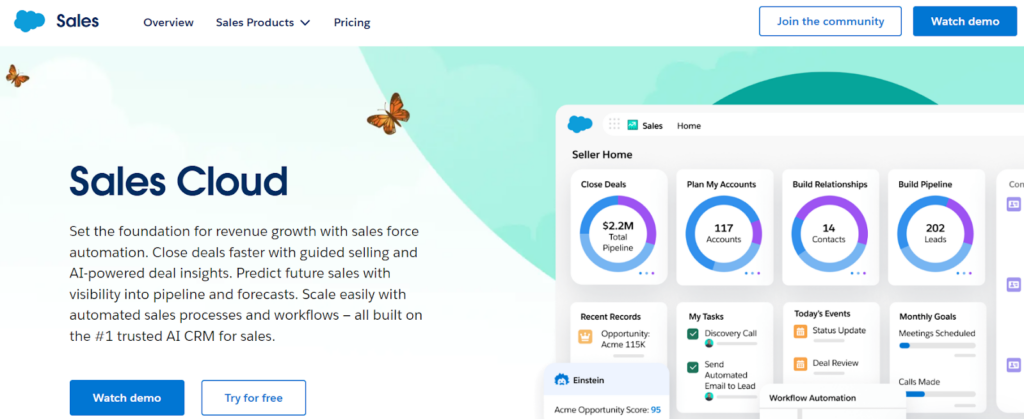
Salesforce Sales Cloud is a comprehensive CRM platform with robust sales forecasting capabilities. It provides real-time data, customizable dashboards, and AI-driven insights to help you forecast sales with precision.
Key Features:
- AI-powered Einstein Forecasting
- Real-time sales pipeline tracking
- Customizable dashboards and reports
- Collaborative forecasting for team insights
Best For:
Businesses of all sizes looking for a scalable and powerful CRM solution.
b. HubSpot Sales Hub

HubSpot Sales Hub offers an intuitive and user-friendly interface for sales forecasting. It integrates seamlessly with other HubSpot tools, providing a holistic view of your sales and marketing efforts, not only for forecasting but also to help you create compelling sales presentations and support the reporting processes.
Key Features:
- Real-time pipeline visibility
- Customizable sales reports and dashboards
- Deal stage and probability-based forecasting
- Seamless integration with HubSpot CRM and marketing tools
Best For:
Small to medium-sized businesses looking for integrated sales and marketing platforms.
c. Pipedrive

Pipedrive is a sales-focused CRM known for its simplicity and ease of use. It offers visual sales pipeline management and reliable forecasting features to help you stay on top of your sales activities.
Key Features:
- Activity-based sales forecasting
- Visual sales pipeline management
- Email and communication tracking
- Customizable reports and dashboards
Best For:
Small businesses and sales leaders looking for a straightforward and visual CRM tool.
d. Anaplan

Anaplan is a cloud-based platform that provides comprehensive sales forecasting and planning capabilities. It offers advanced modeling, scenario planning, and collaboration features.
Key Features:
- Customizable dashboards and reports
- Real-time collaboration and data sharing
- Integration with various business systems
- Advanced modeling and scenario planning
Best For:
Large enterprises needing complex and collaborative sales forecasting and planning.
Conclusion
What are the biggest obstacles you face in predicting your sales? Reflect on this question as you integrate these proven strategies into your operations and see your sales targets improve over time.
If you need more cutting-edge insights into market trends and technologies, visit TechBullion. Our resources will help you optimize your sales processes, and manage your finances to drive your business forward with confidence.
Burkhard Berger
Burkhard Berger is the founder of Novum™. He helps innovative B2B companies implement modern SEO strategies to scale their organic traffic to 1,000,000+ visitors per month. Curious about what your true traffic potential is?
- Author picture: here
- Gravatar: [email protected]