
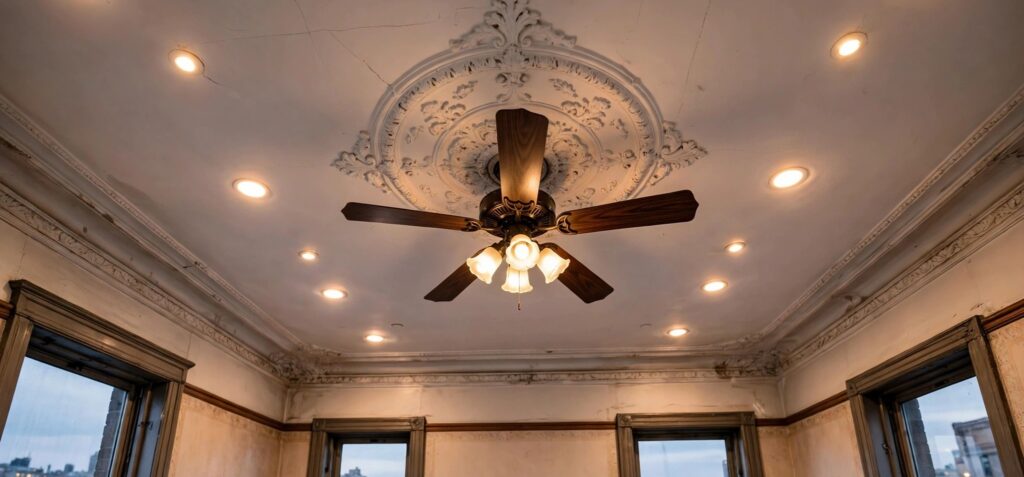
A single ceiling fixture in the middle of the room, on a switch by the door, with a pull chain. That is the lighting plan in most prewar Queens apartments and houses, and it has been since 1925. Queens Electrician Co, 108-07 Corona Ave., Flushing, NY 11368, (929) 605-4507, replaces it with recessed lights, ceiling fans and dimmers all year, and the jobs an Electrician in Queens, NY sees most come with the same complication. Plaster and lath ceilings, no attic above the second floor of an attached house, and old BX in the box that nobody wants to disturb.
Recessed Lighting Installation in Plaster Ceilings
Canless LED wafer lights changed this work. A 4-inch or 6-inch hole saw, a junction box that goes up through the same hole, and a half-inch-thick fixture that springs into place. No housing, no can, no need for the clearance that old IC-rated cans wanted. In a plaster ceiling the hole saw chews through the lath cleanly if the blade is sharp and the cut is slow. Keys of plaster break off above the lath if it is rushed, and then there is a patch.
Spacing follows the ceiling height. Divide the ceiling height by two and space the lights at roughly that distance, 4 feet apart under an 8-foot ceiling. A 12 by 14 bedroom takes four to six. Bedrooms get a wafer light toward each corner and a dimmer, since a single center fixture throws shadows from every direction the bed is not. A kitchen takes more, with task lights over the counter edge and none over the walkway behind the person cooking.
Color temperature matters more than wattage now. 2700K reads warm like an old incandescent. 3000K reads clean. 4000K reads like an office and gets changed within a year. CRI above 90 for kitchens and bathrooms where skin and food should look right.
Dimmer Switches and LED Flicker
LED fixtures and old dimmers do not get along. A 1990s incandescent dimmer on a string of LED wafers hums, flickers at low settings and drops out. A TRIAC dimmer rated for LED, matched to the fixture manufacturer's compatibility list, fixes most of it. ELV dimmers fix the rest. Smart dimmers add a wrinkle in prewar houses. Most need a neutral in the switch box, and a switch loop wired in 1950 has none. Pulling a new cable to the switch, or picking the few smart switches that work without a neutral, is the choice.
Ceiling Fan Installation and Fan-Rated Boxes
The box holding the old fixture is almost never rated for a fan. A pancake box screwed to the lath, or an octagon box hung from a bar, holds a 5-pound fixture. A 35-pound fan on that box works loose over a summer of wobble. The NEC requires a box listed for fan support, and in a finished plaster ceiling that means a retrofit brace that expands between the joists through the fixture hole. Ten minutes with the right brace. An hour without it.
Fan plus light on one switch means the pull chains do the rest. Separate control from the wall wants a three-conductor cable from the switch box, or a fan with a remote receiver tucked in the canopy, which is the route in most retrofits.
Bedrooms in Corona and Elmhurst without central air run fans all summer. Sloped ceilings on the top floor of a Cape in Bayside need a sloped-ceiling adapter and a longer downrod. Porches in Woodhaven need a damp-rated fan. Fan blades under a 7-foot ceiling in a Cape attic conversion run into the 7-foot blade clearance rule, which pushes a hugger fan or no fan at all.
Three-Way Switches and Adding a Switch Where There Was None
A long hallway in a railroad apartment in Astoria has one switch at one end. Adding a second switch at the other end means a three-way pair and a three-conductor cable between them, fished along the hallway ceiling or behind the baseboard. Stairwells in two-family houses get the same treatment, a switch at the bottom and one at the top, which the code requires for new work and most prewar houses never had. A pull-chain fixture in a bedroom closet or a basement gets a wall switch for the first time. The cable run from the fixture box to a new switch box cut into the plaster is the whole job, and in an attached house with no attic the run goes across the ceiling joists from a single access hole at the wall.
Under-Cabinet, Vanity and Exterior Lighting
Under-cabinet LED strips on a hardwired driver, switched at the wall, replace the plug-in puck lights that fill a counter outlet. Vanity lights in a bathroom go on the lighting circuit, since the 20-amp bathroom receptacle circuit serves receptacles only in most layouts. Exterior fixtures at the front door and the driveway get a photocell or a timer, and motion floods at the rear of an attached house in Jamaica go on their own switch inside.
Closet lights in prewar houses are a quiet hazard. A bare bulb on a pull chain inches from a shelf of sweaters. The code wants an enclosed LED fixture with clearance from storage, and swapping those out takes minutes per closet.
What Lighting Installation Costs in Queens
Six wafer lights in a bedroom with attic access above is a half day. The same six in a second-floor ceiling of an attached house with no attic, fished through plaster from a single access hole, is a full day with patching. A ceiling fan on an existing switched box with a brace kit is an hour or two. A fan where no box exists is a new cable run and a switch. Dimmers are quick once the compatibility question is settled.
A like-for-like fixture swap falls under NYC's minor work exemption. New circuits and new wiring need the DOB electrical permit, filed by a Licensed Master Electrician.
Queens Electrician Co at 108-07 Corona Ave. in Flushing installs recessed lighting, ceiling fans and dimmers across Corona, Elmhurst, Forest Hills, Bayside and Jackson Heights. (929) 605-4507.
Previously in Business news: Duct Sealing and Duct Cleaning in Queens: Fixing the Ductwork Before Replacing the Furnace