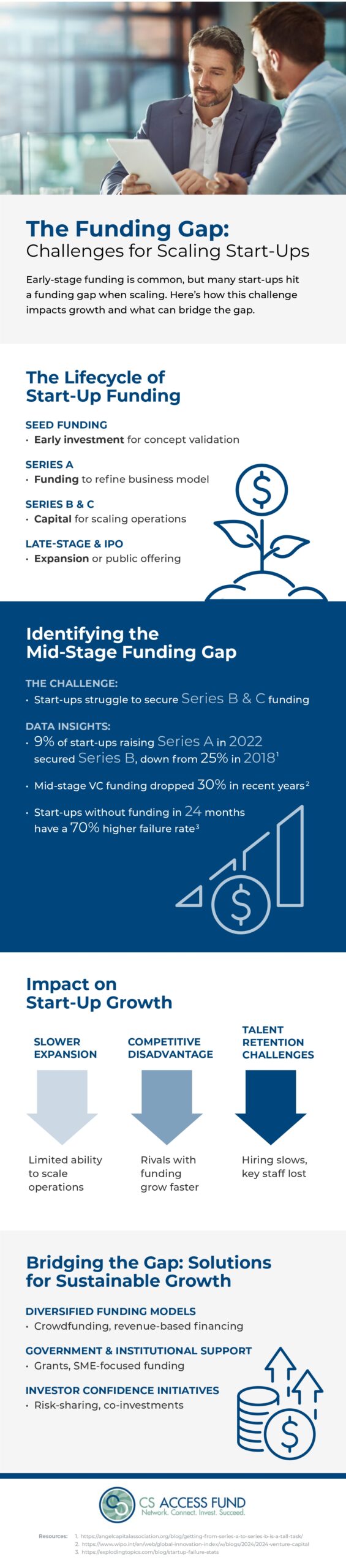
Securing initial investment is a familiar journey for many start-ups. Angel investors, venture capital seed rounds, and Series A funding offer the early-stage capital necessary to develop products, prove market demand, and gain initial traction. However, as these start-ups enter the next phase of their journey—scaling their operations and expanding into new markets—they often encounter a significant funding challenge. Series B and Series C funding rounds are notoriously difficult to secure, creating a financial gap that can halt momentum and stall growth.
Understanding the Mid-Stage Funding Challenge
The core issue stems from investor risk preferences. Early-stage start-ups, despite being high-risk, attract investors who are willing to bet on disruptive potential. At the other end of the spectrum, later-stage companies, with their stable revenue streams and clearer paths to profitability, appeal to institutional investors and private equity firms. This leaves growth-stage start-ups—companies that are performing well but not yet consistently profitable—struggling to secure the capital they need to scale. Instances of an exception to this rule are clean tech investing opportunities as sustainability and green initiatives continue to cause market shifts.
For scaling start-ups, capital requirements go far beyond product development. Hiring experienced leadership, expanding operational infrastructure, enhancing go-to-market strategies, and optimizing customer acquisition efforts all require substantial investment. Yet many investors hesitate to fund companies that, while demonstrating strong revenue growth, have not yet reached a profitability threshold that justifies the risk. This creates a funding plateau where start-ups that have outgrown their early funding sources find themselves unable to secure the next critical round of capital.
Strategies to Overcome the Funding Plateau
Despite these challenges, new funding models are emerging to help mid-stage start-ups bridge the gap:
- Revenue-Based Finance (RBF): Offers funding based on future revenue projections, allowing start-ups to access capital without giving up equity. This approach provides financial flexibility while aligning repayment with business performance.
- Structured Equity & Private Credit: Delivers tailored investment solutions that provide capital without the constraints of traditional venture funding, enabling companies to grow without excessive dilution.
- Venture Debt & Corporate Investment: Venture debt provides non-dilutive capital, while corporate partnerships allow start-ups to leverage industry alliances for financial backing, operational support, and market access.
- Government Grants and Incentive Programs: Certain industries, such as biotech, cleantech, and AI, may qualify for government-backed funding initiatives that support innovation and economic growth.
- Crowdfunding and Community Investment: Platforms like equity crowdfunding allow start-ups to raise capital directly from a large pool of investors, engaging their customer base as stakeholders in their success.
Strengthening Investor Appeal
The key to overcoming the mid-stage funding gap is preparation. Founders must take a proactive approach to fundraising by developing long-term financial strategies, building strong relationships with investors, and demonstrating measurable success metrics. Investors need to see not just potential but clear execution, efficient capital management, and a scalable business model.
A few key steps to enhance investor confidence include:
- Optimizing Financial Health: Ensuring that unit economics, gross margins, and cash flow projections demonstrate a sustainable path to profitability.
- Proving Market Fit and Scalability: Highlighting customer retention rates, revenue growth, and operational efficiency to validate long-term viability.
- Diversifying Capital Sources: Avoiding over-reliance on venture capital by incorporating alternative funding methods that provide stability and strategic advantages.
- Leveraging Strategic Partnerships: Aligning with industry leaders, corporate investors, and technology partners to access funding, expertise, and market expansion opportunities.
Securing Sustainable Growth
Securing growth capital at this stage is challenging but not impossible. With the right funding strategy and a clear vision for sustainable expansion, start-ups can break through the financial bottleneck and continue their upward trajectory.