
Five shops, five quotes, and every one of them promises “fast turnaround.” That tells you nothing. What does tell you something is how each shop answers a handful of boring questions, and you can ask all of them before you send a single logo.
Start with how the quote is built
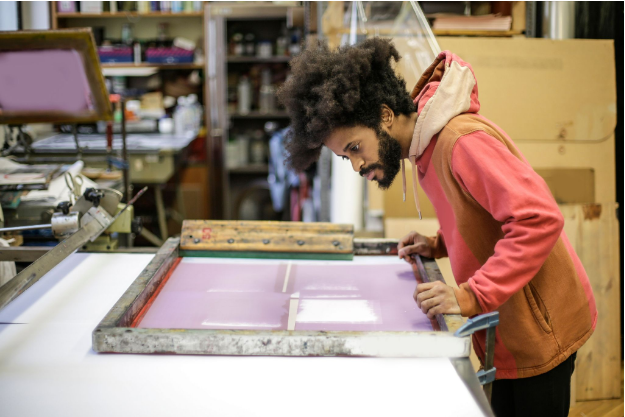
Start with the money, because that’s where quotes get confusing. Screen printing prices are driven by setup. Every ink color needs its own screen, and the shop spreads the cost of building those screens across however many shirts you order. Printavo’s 2023 update of its DTG vs. screen printing guide says a four-color design usually needs five screens, because an underbase screen gets added. (An underbase is a layer of white ink printed first so colors don’t look washed out on dark fabric.) Printavo, which makes software for print shops, points out that building and setting up those screens can take longer than printing a 20-shirt order. So the same logo can carry a very different price per shirt at 20 pieces than at 100, and that’s just how the process works.
The part to watch is where the fees show up. Take two made-up quotes for 100 shirts. Shop A says $6.50 a shirt, then adds a $90 screen fee and a $40 art fee, which comes to $780, or $7.80 a shirt. Shop B says $7.60 and nothing else, so $760. The quote that looked cheaper isn’t. Ask each shop to break out the per-shirt price, screens, art, rush, and shipping on separate lines, then compare only the bottom number.
Minimums, proofs, and ink
Ask about the minimum early. Some shops only mention it after you’ve sent artwork, which wastes your time if your order is smaller than they’ll take. Ask about proofs too. A proof is a digital mockup showing the size and placement of your print, and nothing should go on a press until you’ve signed off on it. If a shop skips that step, or can’t tell you what happens when a print lands an inch too low, keep looking.
Ink matters more than most buyers expect. The common choice is plastisol, a PVC-based ink that stays opaque on dark garments. Water-based ink feels softer (printers call that feel the “hand”), but it’s better suited to light or mid-tone shirts that are 100% cotton. Ink supplier Superior Ink describes the difference simply: plastisol sits on top of the fabric, while water-based ink soaks in. A good shop will tell you which one it would use on your garment and why. A shop that only says “premium ink” hasn’t answered the question.
Files, deadlines, and reorders
Artwork files trip people up. Vector files such as .ai, .eps, or a print-ready .pdf are the usual request, and the trade magazine Graphics Pro lists .ai, .psd, .pdf, .tiff, and .eps as common formats, with fonts outlined. A shop that spells out its file requirements up front saves you a round of redo. One that brings them up after you’ve paid is a risk.
Then there’s the calendar. A lead time only means something when it’s counted in business days from proof approval, since that’s the moment your artwork is final. Anything vaguer, like “about a week,” is a hope. Ask for rush terms in writing too.
Silk screen is an older name for screen printing, so a shop that lists itself under that term should be able to answer all of this. Tee Vision Printing’s page for silk screen printing Philadelphia shows what a clear answer looks like: it states a 12-piece minimum, a standard turnaround of 10-14 business days after proof approval, and a digital proof before production. Whichever shop you end up with, that’s the level of detail to expect.
One more question, and it’s the one people forget: what happens on a reorder? Does the shop keep your art and ink specs, or do you start from zero? Colors and placement can drift when nothing is saved, and you only notice when the second batch arrives next to the first.
When screen printing isn’t the answer
Sometimes the honest answer is a different method. Printavo’s guide points to DTG (direct-to-garment, a digital print applied straight onto the shirt) for orders of 12 pieces or fewer with lots of colors, and for photographic artwork. It also puts a common break-even for screen printing at around 24 shirts, though that varies by shop. If you need six photo shirts, a good screen printer will tell you so instead of quoting you anyway.
When you’re ready to compare, send the same details to three shops: quantity and sizes, garment style and color, number of ink colors, print locations, artwork, and due date. Then pick the one that answered the most questions clearly, even if it isn’t the cheapest per shirt.
Previously in Business news: Sindh Distro CEO Khair Muhammad Kumbher Outlines Practical Steps for Independent Artists