
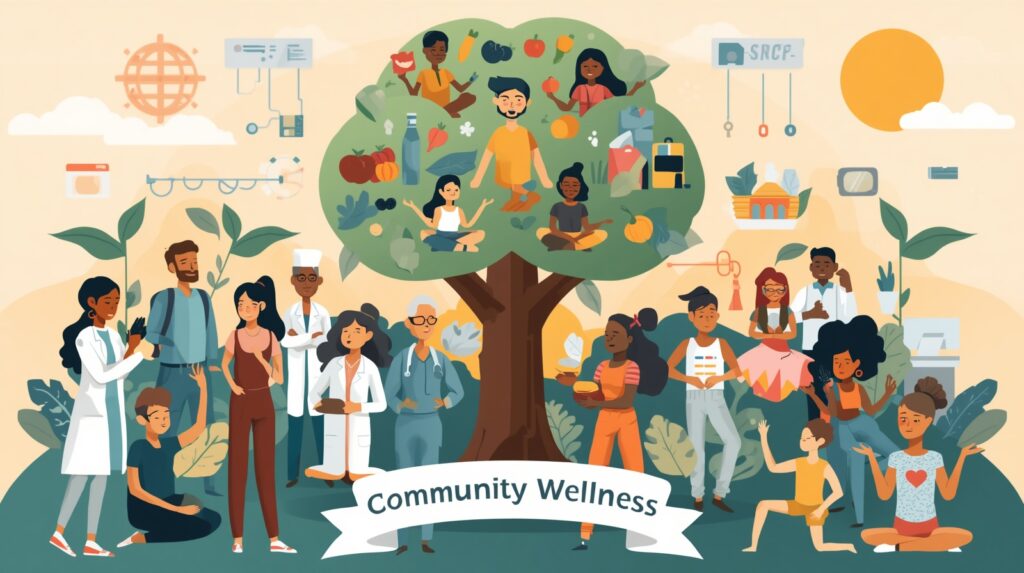
Healthcare is always more than medicine. At its best, it’s about communities: the networks of people, institutions and relationships that enable or hinder individuals from accessing the care they need before crisis. The technology, prevention and community-based programs are coming together, and what it means to be a healthy population has changed.
This has been a movement that “thoughtful observers of human communities” have long known about. As a physician at Broward Health, George Azar, he has spent his career working within healthcare systems focused on patient care and community wellness, and understands that treating individuals requires understanding their living conditions and broader social context. As with resilience, health is never abstract; it is always in context. The communities that succeed are the ones that have a clear and accurate awareness of that context — and where it is continually enhanced.
Key Pillars of Healthcare Innovation and Community Wellness
Multiple factors are contributing to the shift from a reactive and Institution-based system of care to a proactive and people-centred system of care in the community.
1. Digital Health Technology and Telemedicine
The contribution of telemedicine and digital health tools has been perhaps the greatest toward improving access to healthcare. In rural and underserved communities where the closest specialist could be hours away, remote care could mean the difference between what can be done and what simply can’t.
- Telemedicine platforms that enable patients to communicate with doctors or mental health professionals from the comfort of their own homes. Portals that bring doctors and mental health professionals to patients’ homes.
- Chronic conditions such as diabetes and hypertension are monitored in real-time using remote monitoring devices that are remote.
- The use of AI tools for diagnostics can detect diseases at an earlier stage. AI-driven diagnostic tools to aid clinicians in early disease detection.
- Mobile health apps to help with taking meds, eating and mental health
2. Preventive Care and Early Intervention
The most significant change in healthcare in recent times is the shift from treatment towards prevention. The costs of waiting until a person is sick are often high and, for chronic diseases, may be ineffective since they take years to develop. Prevention can change all that.
- Community-wide health screening for hypertension, diabetes and cancer.
- Providing access to fresh produce in food-insecure communities and providing nutritional education.
- Improving physical activity programmes and facilities for walking.
- Awareness campaigns on mental health to destigmatise and promote early help-seeking.
It is well established that the benefits of prevention outweigh the costs. For every dollar invested in prevention, there are measurable savings in acute care costs – and most significantly, people will spend their lives healthier.
3. Community Wellness Hubs and Street Medicine
Community wellness hubs provide a unified approach to healthcare, social support and local resources, making it easier for people to access them — and easier to get the help they need. Street medicine programs take it one step further, bringing care directly into the encampment and public space to the unhoused person.
- Primary care and pre-emptive screenings in community sites that are convenient to people
- Mental health and counselling services are embedded with the physical care.
- Social services navigation (housing, food, employment services)
- Peer Support Programs led by trained Community Health Workers.
4. Health Equity and Culturally Competent Care
Innovation that does not reach all segments of the population cannot be considered complete innovation. Health equity has therefore become a central priority in modern community healthcare — ensuring that improvements in care delivery, prevention, and outcomes are accessible to the populations that need them most, in practical and measurable ways.
This includes designing healthcare systems that reflect the cultural, linguistic, and socioeconomic realities of the communities they serve. Effective care depends not only on clinical excellence, but also on trust, communication, and understanding patient context.
Healthcare delivery becomes most effective when it is culturally responsive and grounded in the realities of the populations it serves.
- Hiring health professionals who represent the diversity of their communities
- Providing services and health education in community languages.
- Developing programmes with the active participation of those communities they are aiming to reach.
- Monitoring health information by race, ethnicity and income to assess and reduce disparities
5. AI and the Future of Population Health
AI is starting to transform the understanding and response of health systems to the needs of populations. AI tools can use big data, such as clinical health information or environmental data, to understand who is likely to be at risk, forecast disease outbreaks, and focus resources on the most critical areas.
- Predictive analytics identifying patients who are likely to require hospitalisation
- Population health dashboards provide up-to-the-minute insight into community trends.
- “Triaging” or determining who needs to be seen first can be a challenge for community health workers, but AI-powered triage is helping them with that task.
While the advantages of AI are great, the risks are too. If not designed and implemented with equity in mind, AI systems can exacerbate inequities. In essence, the communities most likely to benefit are those that are implementing technology in a way that is truly collaborative with the people it’s designed to serve.
Building Healthier Communities for the Long Term
Hospitals are not necessarily the determining factor of the healthiest community in the coming decades. They are the communities that are innovative and inclusive: using new tools to solve old problems, while involving those who are most impacted by the problem in the solution.
That takes a commitment to human experience—one that has been the hallmark of the most effective community health programs—one that’s been a hallmark of George Azar’s career. It is not a technical matter to be able to understand a community well enough to serve it. It is a human one. It’s one that healthcare, at its most cutting-edge and caring, is catching up with.