
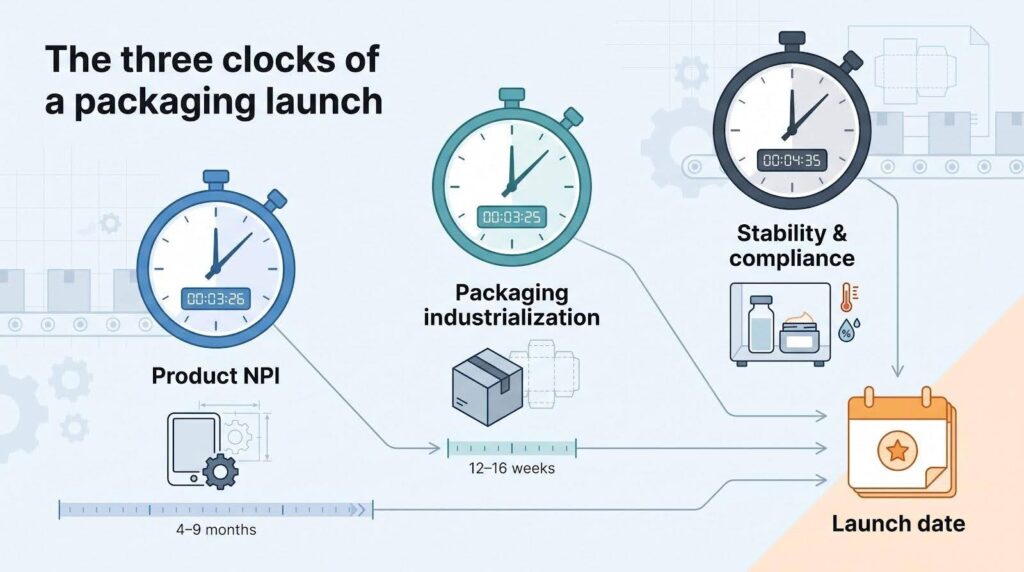
Approving a slick packaging mock-up doesn’t mean you’re mere weeks from the shelf. Even a straightforward custom box still needs 12–16 weeks to travel from a frozen brief through sampling, tooling, and its first production run. If the product inside is regulated—food, cosmetics, or drugs—budget another 4–6 months so labs can prove it stays safe in the final container. Add routine engineering tweaks, compliance sign-offs, and freight booking, and your launch date will match the slowest of three parallel clocks—product, package, or stability. In the pages ahead, we’ll show you how to keep those clocks in sync and protect the date on your calendar.
The three clocks that govern a packaging launch
Picture three stopwatches ticking at once:
- Product NPI. Freezing the bill of materials, running EVT→DVT→PVT builds, and correcting tools typically takes 4–9 months for a custom hardware product, according to a prototype-to-production timeline from OPD Design.
- Packaging industrialization. Moving from an approved brief through design, sampling, tooling, and a pilot run runs 12–16 weeks for a standard carton program, according to Logic Pac.
- Stability and compliance. Regulated goods often need six months of accelerated data on three batches before the first shipment leaves the dock, based on current FDA expectations.
All three clocks must hit zero before launch day. Seasoned teams pin the launch date on the calendar, then map every design freeze, tool cut, and lab pull backward to spot overlaps early. Zenpack’s scrollable roadmap does exactly that; its Zenpack product launch packaging guide breaks the journey into eight backward-mapped milestones and shows how locking tooling by June 22 still lands a November 1 shelf date.
1. Product engineering and NPI
The first stopwatch lives inside the product. Once the proof-of-concept works, engineers lock the bill of materials and sprint through three validation builds:
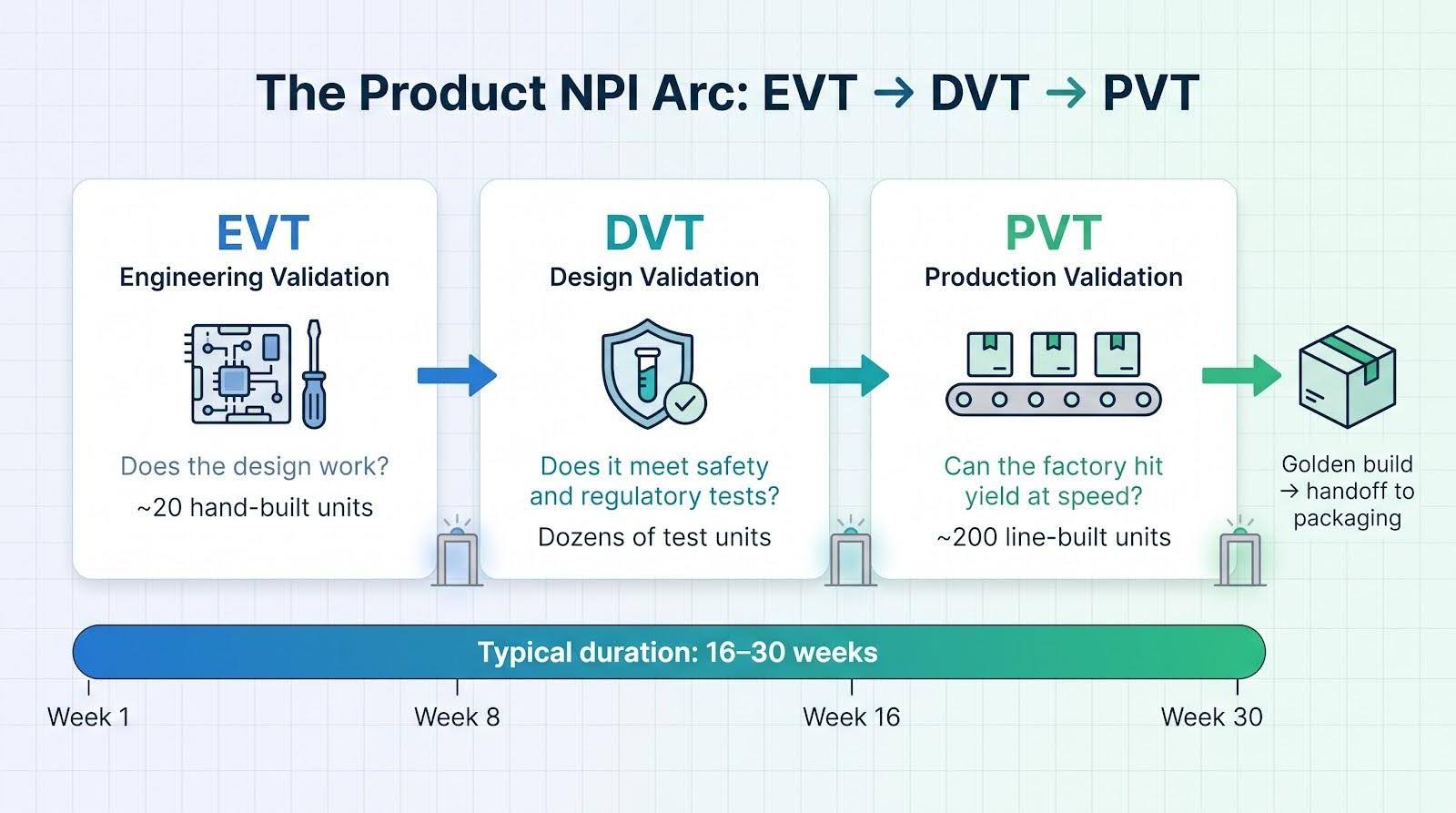
- EVT (engineering validation). Does the design work?
- DVT (design validation). Does it meet safety and regulatory tests?
- PVT (production validation). Can the factory hit yield at speed?
For a moderately complex hardware product, that EVT→DVT→PVT arc typically spans 16–30 weeks and produces anywhere from 20 hand-built units in EVT to 200 line-built units in PVT, OPD Design notes. Each gate is a go/no-go: the device must survive drop tests, hold tolerances, clear compliance labs, and remain manufacturable at scale.
Late tweaks ripple downstream. Add half a millimeter to a bezel and the insert no longer fits. Swap a battery and new thermal loads may demand a higher barrier. That’s why packaging work starts only after the design is frozen, or at least unlikely to change size, weight, or fragility.
When the NPI team signs off on the golden build, they hand suppliers a stable target, and the packaging clock can finally tick toward tooling and pilot runs.
2. Packaging industrialization
The second stopwatch starts the day a frozen product lands on your desk. Turning sketch-board ambition into repeatable output usually breaks into four sprints that, taken together, run 12–16 weeks for a folding-carton program, Logic Pac estimates.
- Structural refinement (≈2–3 weeks). Designers dial every crease, radius, and locking tab until the dieline nests cleanly and minimizes board waste.
- Sampling (≈2–4 weeks). We cut white dummies for fit, then production-intent samples in real board, foil, and coatings. Quick answers follow: does the product sit without wobble, does the hinge survive 1 000+ opens, does the foil stamp release under line pressure?
- Tooling and line setup (≈4–6 weeks). Cutting dies are burned, molds machined, glue stations programmed. Tool ownership is strategic: keep it and you control maintenance and capacity; let the converter own it and you cut cap-ex but lose leverage.
- Pilot run (≈2–3 weeks). The line targets the quoted speed—often 30–60 cartons per minute—while quality tracks first-pass yield and scrap against the 95 percent baseline many converters require before green-lighting mass production, Crateform reports.
When the pilot meets rate, scrap, and color delta, quality freezes a golden sample in both labs. From that moment the package is locked, and the clock hands off to full production.
Zenpack’s scrollable launch roadmap puts these intervals on an actual calendar.
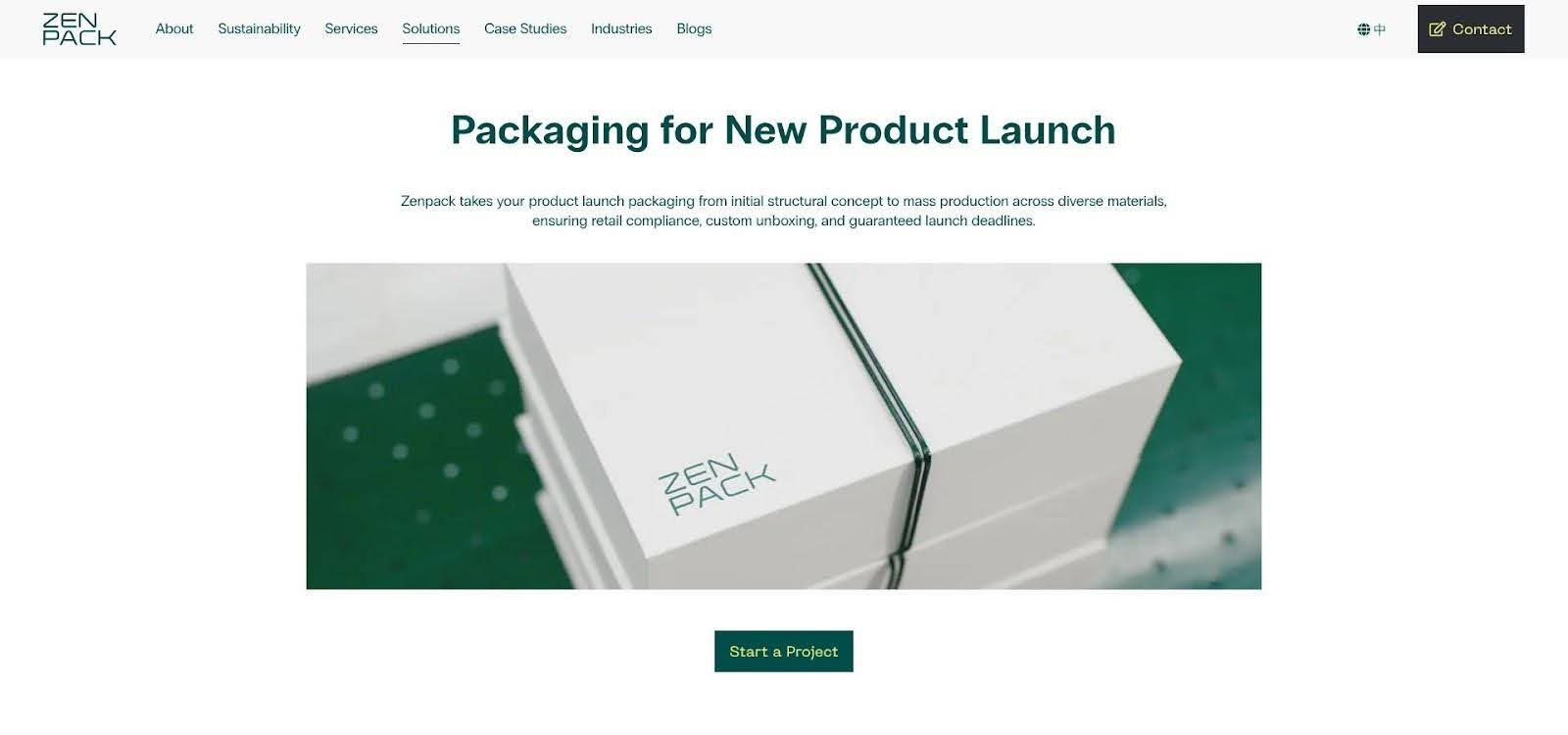
Zenpack product launch packaging roadmap screenshot
In the sample schedule for a November 1 shelf date, it back-propagates tooling lock to June 22, mass-production kickoff to July 20, and first packaging delivery to September 1 – 28 and 43-day buffers that land neatly inside the 12-16-week window we outline above.
Seeing those buffers plotted day by day helps teams catch negative slack early and renegotiate gates before any steel is cut.
3. Stability and regulatory evidence
The third stopwatch runs in a lab, not on the line. Its single question: will the filled product stay safe, effective, and on-spec for its entire shelf life inside the final package?
Regulators insist on proof. Foods lose moisture, creams shift color, drugs degrade. To show that will not happen, teams run accelerated studies—often 40 °C / 75 % RH for six months on three production-scale batches—the minimum dataset the FDA accepts for many abbreviated drug applications. Packages also face squeeze, burst, and migration tests to confirm inks or films do not leach into the product.
The wait stings. Even a three-month protocol can push a launch, and a six-month one almost certainly will. Real-time studies continue in the background, but the accelerated readout usually unlocks the first commercial shipment.
Upstream choices control this clock. Swap virgin PET for a 40 percent recycled blend or replace a PFAS grease-proofing coat, and you must rerun barrier and migration work. Smart teams pull quality and regulatory leads into the CAD room, agree on the test plan, batch count, and acceptance limits, and start stability once—only once. That discipline lets the factory hum while the lab counts down to green.
The stage-gate roadmap from brief to ramp
Great packaging survives because it clears a series of hard “gates,” each timed to catch problems while fixes are still cheap. Picture six locked doors down a hallway: you open one, run the checks, lock it behind you, then sprint to the next. Done well, this discipline can lock in up to 80 percent of a product’s final cost during design, avoiding pricey rework after mass production, according to product-cost engineering studies.
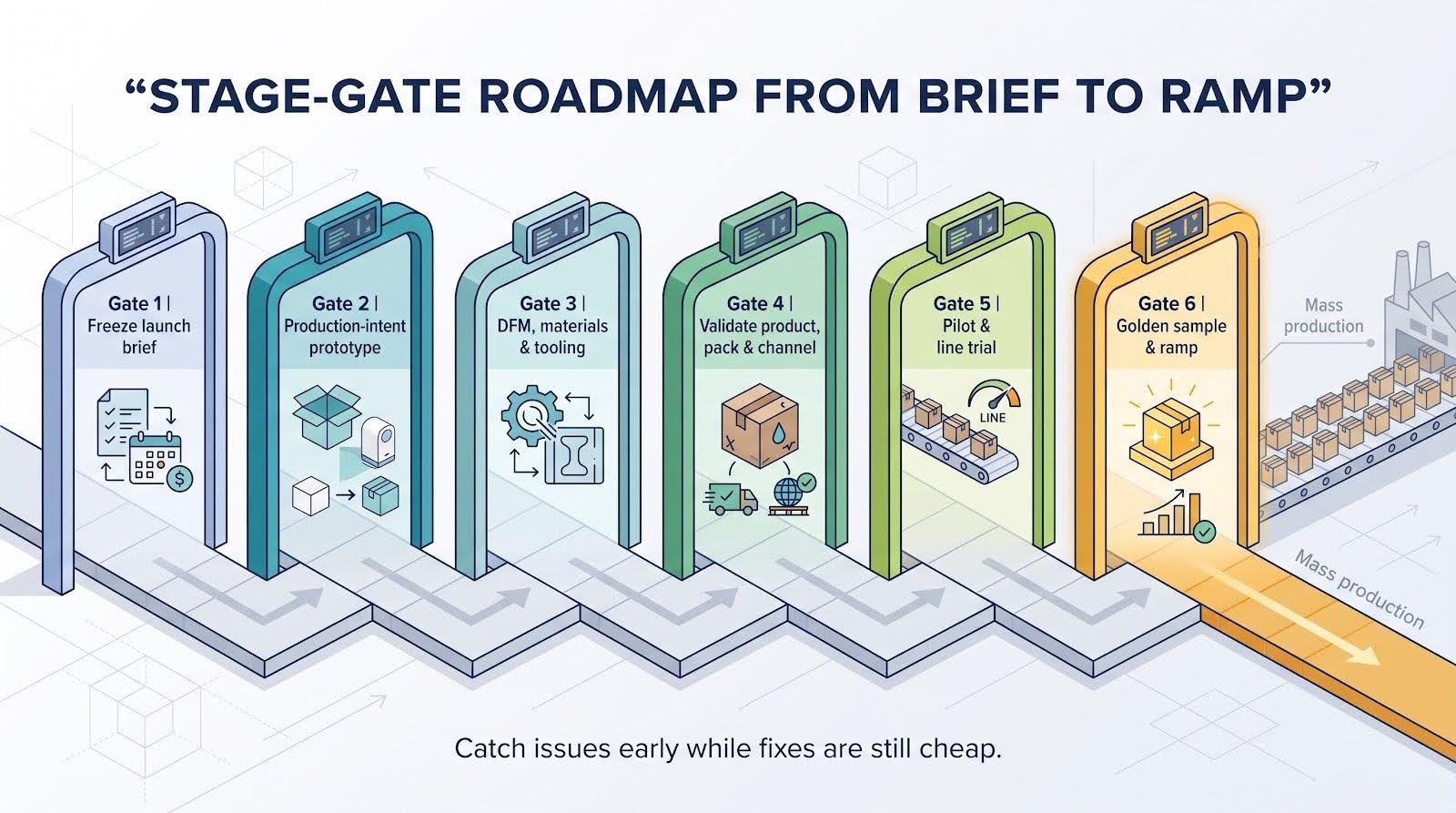
In the next sections, we’ll walk through those six doors, starting with the launch brief.
Gate 1 – freeze the launch brief
The brief is a contract with your future self. It locks five variables that drive every downstream cost and calendar call-out:
- Physical facts. Exact size, weight, and fragility.
- Channels. D2C, retail, export, because an Amazon-ready shipper will not impress a boutique shelf.
- Volume. First build plus 12-month demand; that decides whether you hand-fold 500 luxury boxes or tool an automated line for 50 000 a day.
- Money. A ceiling for total landed cost, not just the carton’s unit price, so inserts, freight mode, and pallet height all have a number to beat.
- Date. The holiday drop, trade-show debut, or crowdfunding promise that nothing may slip.
Research from the Project Management Institute shows 47 percent of unsuccessful projects miss their goals because of poor requirements management.
Gate 2 – build a production-intent prototype
Sketches earn their first real scars here. The goal is a sample that behaves like mass production, even if it is made one at a time on the bench. For most folding-carton programs this loop takes 2–4 weeks, Logic Pac notes.
- White dummy (day 1–5). Pure geometry. Does the hinge clear the charging port, and does the insert hold a full bottle when you shake the shipper?
- Production-intent sample (day 6–20). Exact board grade, laminate, and ink. Now you see real color, crush strength (≥32 ECT for a small corrugated shipper), and scuff resistance.
- Pass/fail tweak. Each round solves one issue. If the dummy wobbles, you shim; if the foil stamp tears, you adjust heat and dwell. No hiding flaws under stickers.
Exit this gate with a prototype that meets function, delights the brand team, and runs on real machines—proof enough to release tooling.
Gate 3 – complete DFM, material qualification, and tooling
Tooling is where a dream can turn into debt. Cutting steel before the design is truly manufacturable can add $5 000–$25 000 in re-work on a single mold, according to multiple NPI case studies. Before the first spark hits the die set, your team runs a Design for Manufacturability sprint with the people who will pull the levers.
- Paper and board. Check caliper, fold sequence, and glue-flap width against the actual folder-gluer.
- Plastics. Model draft angles, wall thickness, and ejection pins so the tray pops free without warping.
- Print. Balance ink lay-down with drying time; water-based presses may need lighter coverage.
Material trials run in parallel: shoot recycled PET to confirm clarity, crush recycled board to hit burst strength, and re-ink artwork for low-VOC presses. Quality and procurement sign every substitution so nothing quietly swaps back on the night shift.
Release tooling purchase orders only after DFM and material specs earn unanimous thumbs-up. Contracts should spell out ownership, maintenance, storage, and the cost of a second set if demand doubles.
The first parts off those tools decide everything. Pass, and you glide into pilot runs; fail, and you pay in time and cash. Clear this gate, and the rest of the hallway feels downhill.
Gate 4 – validate product, package, and channel together
With tooling humming, we ask the blunt question: will the finished pack survive the real world? This gate puts labs, line operators, and logistics on the same bench.
- Factory floor. Operators load cartons at line speed, scanners read barcodes, and the glue station runs without a skip. Print plates that walk or creases that drift get caught under bright lights, not under retail LEDs.
- Distribution simulation. ISTA 3A throws nine free-fall drops and random vibration at roughly 0.53 Grms across one hour to mimic a truck route from Shenzhen to Chicago. Climate chambers cycle −10 °C to 40 °C / 90 % RH to replicate winter tarmacs and monsoon depots. Any crushed corner or popped seal triggers an immediate corrective action.
- Product integrity. Headphones must still pair, syrups must still pour at spec viscosity, and cosmetics must still sparkle after 48 hours at 95 % RH.
- Channel rehearsal. A D2C pick line clocks open-scan-reseal time; retail teams check shelf fit and peg spacing; export compliance reviews label language, recycled-content marks, and EPR IDs.
Quality freezes the golden sample only when every stress test and channel drill passes. From that point, any tweak requires a controlled deviation, never a quiet adjustment.
Gate 5 – run a controlled pilot and line trial
Lab work is over; factory reality begins. We schedule a fully documented pilot, usually 5–10 percent of launch volume, to expose Monday-morning humidity, shift changes, and operators who have never seen the fixture.
- Throughput. The line must hit the quoted takt; any slowdown triggers a pause and root-cause check.
- First-pass yield. Median U.S. plants run near 95 percent FPY on finished goods, IndustryWeek data show; we hold the pilot to that bar.
- Changeover. Must fit the window the co-packer promised retailers.
- Quality log. Scrap sheets, glue faults, and color drift are recorded in real time; maintenance listens for the bearing that hums only after hour three.
Downstream logistics get the same scrutiny. We palletize, stretch-wrap, and load a live trailer to confirm cube use and corner crush, and a sample shipment rides an actual courier route to chase scuffs and crushed flutes.
Only when every metric meets or beats plan do we lock parameters into the standard operating procedure. The factory is now cleared to sprint, and we are one gate away from mass production.
Gate 6 – release the golden sample and ramp
The golden sample is our Rosetta Stone, the single numbered unit that locks color, fit, gloss, and every measurable tolerance. Quality stores it in a light-controlled cabinet, operators pin photos above the line, and suppliers treat it as the final word in any dispute.
Before we crown that sample, cross-functional leads run a last checklist:
- Incoming gauges calibrated; inspection plan linked to ANSI/ASQ Z1.4 at AQL 1.5 percent for dimensions and print
- Cosmetic grades defined and photographed
- Change-control matrix signed, identifying who approves at 2 a.m. if a board mill swaps lots
- Capacity plan confirmed; overflow tooling on standby
- Freight bookings locked through the first replenishment cycle
When every box earns a tick, we authorize full production. The factory ramps in waves—about 20 percent, 50 percent, then 100 percent of daily capacity—while dashboards track yield and scrap against pilot baselines. Any drift triggers a stop-line drill until metrics return to green.
Prototypes and pilots are behind us. Every carton on that conveyor now belongs to a paying customer, and the long stopwatch finally stops.
When stability testing really adds 4–6 months
Packaging validation answers three different questions:
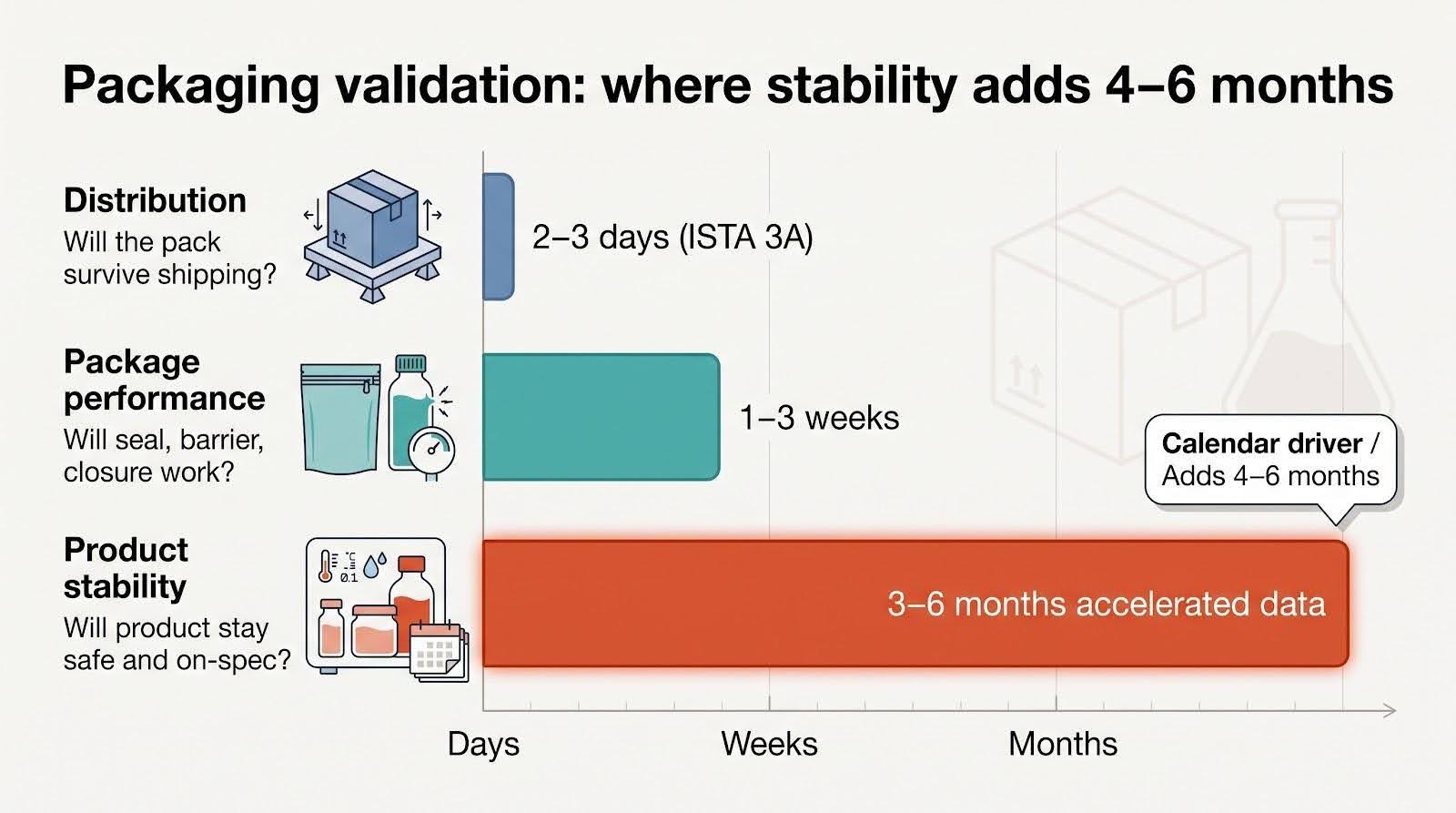
- Distribution. Will the pack survive shipping? (Typical ISTA 3A lab time: 2–3 days.)
- Package performance. Will the seal, barrier, and closure work? (Often 1–3 weeks of burst, leak, and barrier tests.)
- Product stability. Will the filled product remain safe and on-spec for its shelf life? Here is where the calendar stretches.
Regulators drive the third clock. For pharmaceuticals, the FDA wants six months of accelerated data on three commercial-scale batches before a generic drug can ship. Food and cosmetics can face similar holds when formulas are sensitive or when a new package—thinner wall, recycled resin, or PFAS-free coating—changes barrier or migration behaviour.
That is why teams lock risky choices early. Want 40 percent recycled PET? Decide before tooling. Need a new bilingual label? Add it while samples still run on a plotter. Each late tweak risks fresh stability lots, new reference packs, and another six-month wait.
Planning ahead protects more than time. Launching with partial data often forces a shorter expiry, which means tighter production cycles, higher freight spend, and the headache of scrapping short-dated stock if sales lag.
Treat stability like a marathon that starts early and ends after the factory is ready. Seen that way, the extra four to six months becomes just another scheduled leg, not a last-minute roadblock.
The packaging bottlenecks that appear only at scale
Prototypes are polite; full-speed lines are not. Four pain points surface the moment you jump from ten samples to ten thousand units.
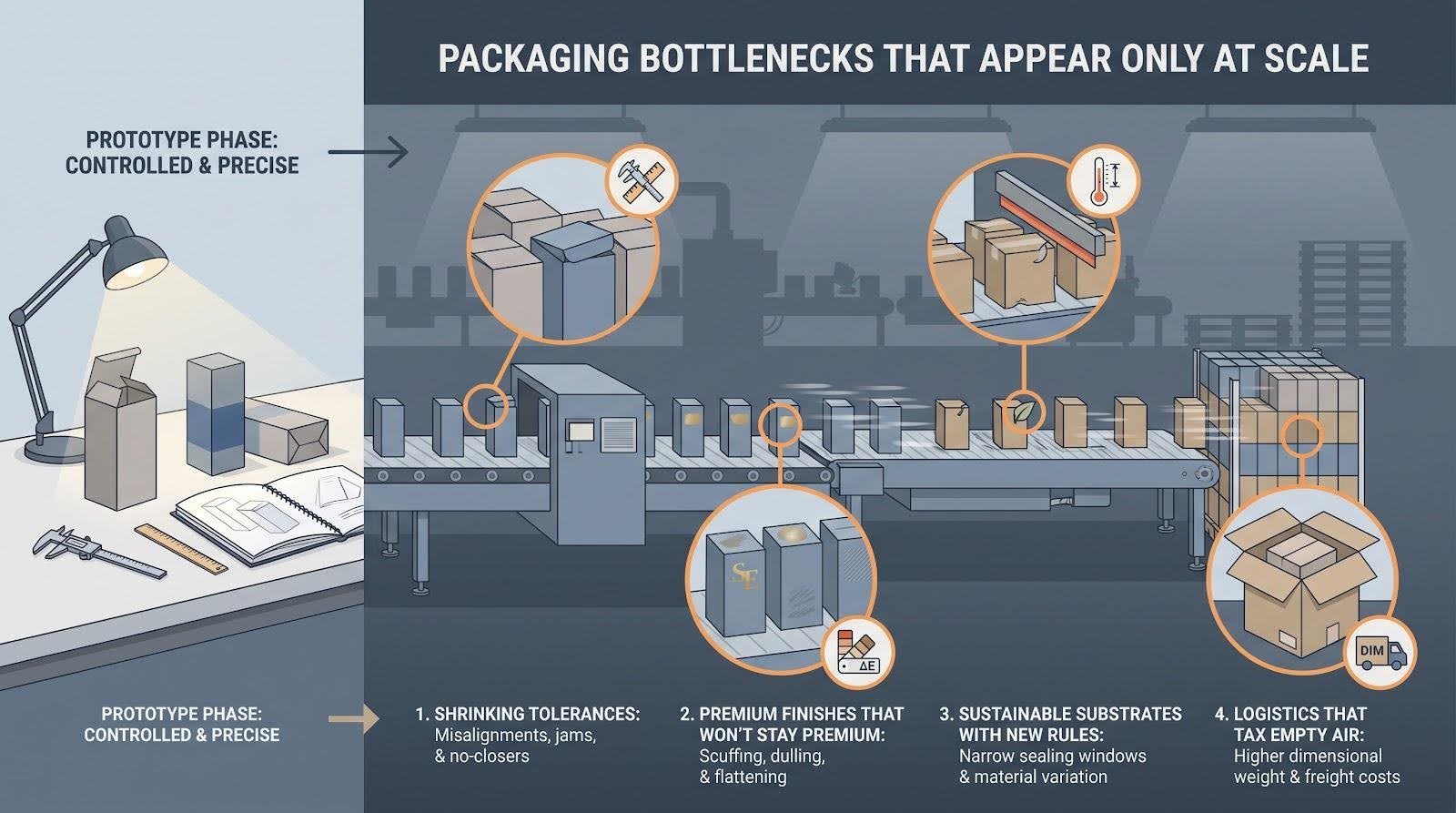
- Shrinking tolerances. A hand-formed insert forgives 1 mm; a folder-gluer running 300 blanks a minute will not. Moisture swells board, ink creep shifts dielines, and angles stack until a lid will not close. Model every wall, score, and relief notch to ±0.1 mm, then run it on the real machine before cutting steel.
- Premium finishes that will not stay premium. Foil needs ±5 psi of press pressure, emboss dies dull after 5 000 hits, and soft-touch coatings mar if conveyors exceed 110 °F. Small-lot vendors may nail the look but miss the month-three color ΔE ≤ 2 that volume buyers audit. Schedule die swaps and color checks; do not wait for complaints.
- Sustainable substrates with new rules. Recycled fiber can vary ±15 percent in stiffness, and bio-based films may seal within a 15 °F window. Chase speed and you drift outside those limits, so seals peel in transit. Plot seal curves, burst tests, and moisture-gain data before the first shift clocks in.
- Logistics that tax empty air. A 10 mm design gap can add 15 percent dimensional-weight cost on air lanes, and ocean pallets under-fill. Early 3-D cube analysis lets teams trim millimeters while concepts are still fluid.
Catch these pitfalls in the pilot run and fixes cost hours, not quarters. Miss them and you pay in scrap, air freight, and customer returns wondering how a flawless prototype became a damaged delivery.
The 2026 compliance layer: India, EU, and the United States
Regulators now shape packaging almost as much as designers do. Miss a rule and even the prettiest carton can be held at customs or pulled from an online marketplace overnight. Before the first die is cut, you and legal must lock three headline requirements:
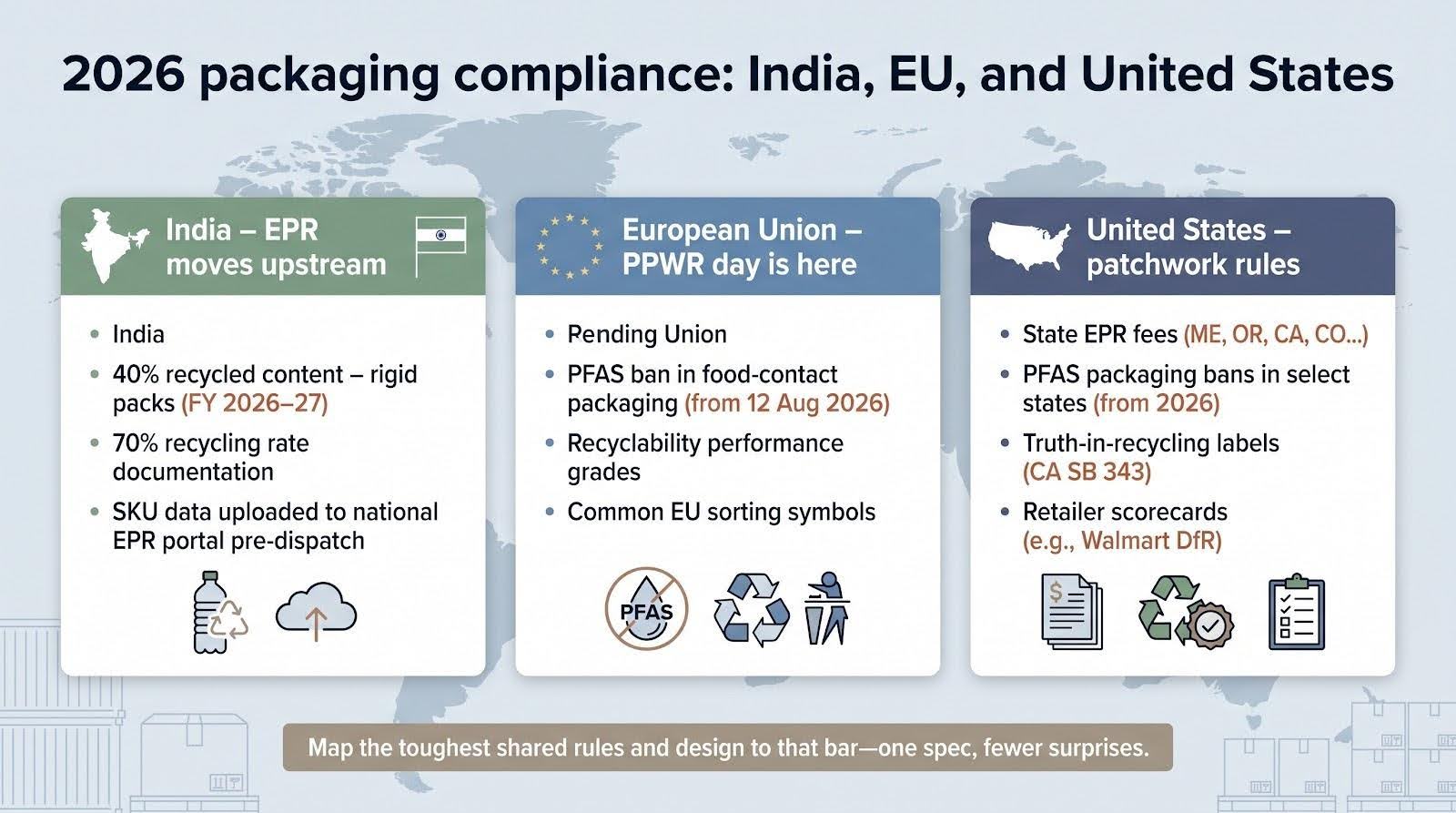
- India (FY 2026–27). Plastic-pack EPR: 40 percent recycled content and 70 percent recycling rate for rigid formats. SKU-level data must enter the national portal before dispatch.
- European Union (from August 12, 2026). The PPWR bans PFAS in food-contact packs and mandates new recyclability symbols; non-compliant stock risks seizure at the border.
- United States. FDA food-contact rules remain federal, but state EPR fees and PFAS bans differ. Designing to the strictest state spec avoids 50 micro-variants.
The next subsections detail what each bloc demands and when, so compliance never hijacks your launch clock.
India – EPR moves upstream
Under India’s Plastic Waste Management (Amendment) Rules, rigid packages (Category I) must contain 40 percent recycled plastic and document a 70 percent recycling rate in FY 2026–27. Categories II and III keep lower targets—10 percent and 5 percent—yet still require proof uploads. All data—recycled-content certificates, SKU-level tonnage, and invoices—must reach the national EPR portal before goods leave the factory, according to the official gazette.
That deadline pushes resin choice and alternate approval into Gate 3. Switch from a recycled blend to virgin polymer after tooling, and you pay for a new mold while risking an instant EPR violation. Lock resin grades early, keep supplier declarations on file, and assign one owner to update the portal whenever a barcode or material shifts.
European Union – PPWR day is here
The EU Packaging and Packaging Waste Regulation entered into force on February 11, 2025 and starts to apply on August 12, 2026. From that date:
- PFAS ban. Food-contact packaging may not contain PFAS above the trace limits in Article 5(5).
- Recyclability roadmap. All consumer packs must meet the new recyclability performance grades; non-recyclable formats face phase-out dates.
- Common sorting symbols. A harmonized icon set replaces today’s patchwork of national logos.
Any launch shipping into the bloc after 12 August 2026 must document substrate recyclability, minimum recycled-content targets such as 35 percent for contact-sensitive plastic by 2030, and print the new symbols.
Play it safe: specify compliant substrates now, even if future quotas rise. Locking early prevents you from re-tooling inserts or re-litho plates when the next phase arrives.
United States – patchwork but rising pressure
Federal law still revolves around FDA food-contact authorizations, yet the state map keeps shifting:
- EPR fees. Maine and Oregon passed producer-pays laws in 2021; California and Colorado follow in 2024–25 with per-ton fees that escalate through 2032.
- PFAS bans. Vermont, Maine, and Minnesota prohibit PFAS in most food-contact packaging from January 1, 2026 onward.
- Truth-in-recycling labels. California’s SB 343, effective July 1, 2027, bars the “chasing arrows” symbol unless the pack meets statewide recyclability thresholds.
- Retailer scorecards. Walmart’s Design for Recycling metric deducts points if film sleeves block MRF sortation.
The cheapest path is to map the toughest of these rules across all target states and design to that bar—one spec instead of dozens of micro-variants and a tangle of purchase-order notes. Locking U.S., EU, and India requirements early prevents compliance from hijacking the stability clock and lets the factory run without last-minute label swaps.
Where automation and AI compress, and where they do not
Robots and algorithms now patrol the plant floor, but their super-power is focus, not magic. They shave minutes off repetitive checks and flag drift before humans notice a pattern, yet they never replace the physical tests that prove safety or shelf life.
- Machine-vision inspection. Manufacturers running continuous AI vision inspection on packaging lines report scrap reductions near 40 percent and customer-complaint drops of roughly 60 percent within two quarters, according to AI Innovate. Cameras over the folder-gluer snap every carton at line speed, flagging a skewed barcode before the bundle hits the case packer. One early stop can save a pallet of scrap and an hour of rework.
- Predictive maintenance. Sensors on the die-cutter record vibration and heat, then warn planners that a bearing will fail in four weeks. Research from PMMI shows 43 percent of CPGs use predictive maintenance, helping cut unplanned downtime.
- AI document search. Bots pull the latest spec sheet or compliance cert in seconds, turning hunt time into build time.
And what AI still cannot do:
- Certify that a cream’s viscosity holds after six months at 40 °C / 75 % RH.
- Sign a regulatory release.
- Replace the golden sample.
Aim tech where it counts—defects, downtime, and data retrieval—and you tighten the ramp without betting the launch on unproven black boxes. Stability, migration, and human judgment still rule those gates.
How to vet a packaging partner for scale-up
Anyone with a laser cutter and a friendly video link can ship a pretty prototype. The partner who will survive pilot, ramp, and three rounds of cost-down needs more muscle. We score candidates on five buckets:
- Engineering continuity. Will the designer who built your prototype still answer the phone when the die needs a 0.2-millimeter shim at midnight? One hand-off, one owner, no “that’s not my file” excuses.
- Testing and quality. Walk the lab (or video-walk it). Look for an ISTA 3A vibration table, a color densitometer on every shift, and documented first-pass-yield targets. Suppliers who outsource core tests lose days waiting for results and often soften bad news.
- Capacity and resilience. You want reserved hours, overflow tooling, and a written disaster plan that names the second factory. A McKinsey survey found 53 percent of respondents plan to diversify their supplier network by qualifying more vendors and building in redundancies.
- Money mechanics. Transparent tooling fees, MOQ ladders, and freight terms keep surprises off the P&L. Insist the quote lists duties, inland haulage, and sustainability surcharges, not just FOB port numbers.
- Compliance discipline. Every material should trace back to a batch cert; every recycled-content claim needs a lab report. Ask to see the last regulatory audit letter; the tone tells you more than any slide deck.
Conclusion
Score suppliers across these five buckets and one usually shines. Pick that one and you can focus on design flair, knowing the back-end muscle will hold when orders jump from hundreds to tens of thousands.