
Tangential Flow Filtration (TFF) is a membrane separation process frequently used in biopharmaceutical manufacturing for concentrating, purifying and buffer exchanging biological materials. This process involves passing a liquid along the surface of the membrane. The smaller molecules and solvents can pass through the membrane, but the biological material is retained.
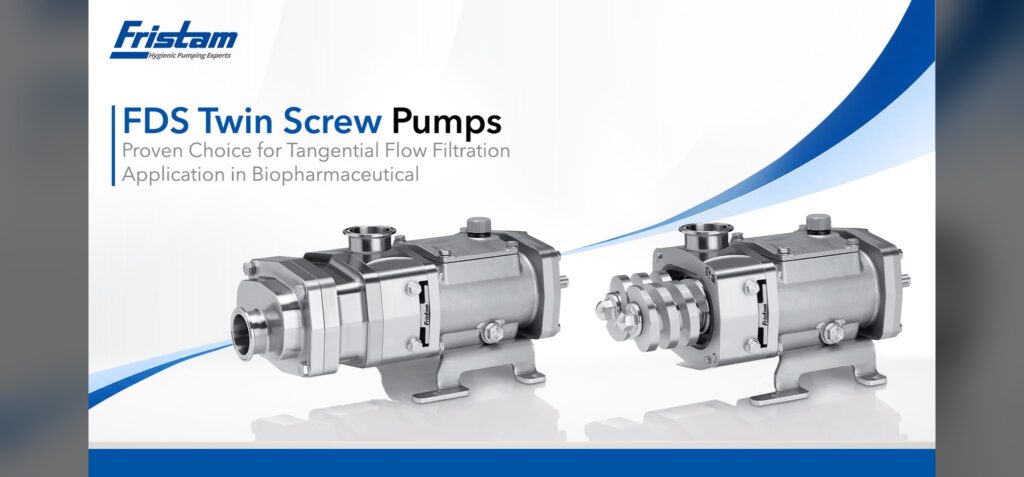
In a single TFF cycle, the same liquid can be pumped through several times, exposing sensitive proteins and antibodies to repeated mechanical stress. Pump selection is therefore equally as important as membrane selection. The Fristam FDS Twin Screw Pump addresses this by conveying fluid axially rather than trapping and releasing it. The twin screw pump has been independently tested and found to have low mechanical shear and stable fluid delivery.
Understanding Tangential Flow Filtration (TFF) and Its Biopharmaceutical Applications
In conventional dead-end filtration, retained material tends to collect on the filter surface. TFF works differently. It produces two streams: the permeate, which passes through the membrane, and the retentate, which carries the retained material back into circulation. This crossflow helps limit membrane fouling.
Some common applications of TFF in biopharmaceutical manufacturing include:
- Increasing the concentration of therapeutic proteins and antibodies.
- Exchanging buffers through diafiltration.
- Processing of vaccines and recombinant proteins.
- Isolation and purification of biological materials.
The circulation requirements can differ considerably between these applications.
Why the FDS Twin Screw Pump Suits TFF Duty
Selecting the appropriate twin screw pump for TFF is not just a matter of flow rate and operating pressure. The equipment must also maintain the integrity of the biological product, accommodate variations in the properties of the fluid and comply with stringent hygienic standards. The FDS Twin Screw Pump addresses these four important aspects of biopharmaceutical filtration.
Mechanical Shear – Safeguarding sensitive biological materials
Proteins, antibodies and other biologicals are repeatedly exposed to the pump in TFF recirculation systems, and thus the cumulative shear exposure is a concern.
Rotary lobe pumps convey product radially, through chambers formed between counter-rotating lobes, so the fluid is repeatedly trapped and released as it passes. The FDS conveys it axially, between two intermeshing screws that never touch. The product travels straight through rather than being worked by each rotation. That makes the FDS well suited to shear-sensitive proteins, vaccines and cell cultures.
Pressure and Flow Stability – Stable filtration performance
For TFF, stable crossflow across the membrane and controlled transmembrane pressure (TMP) are required. Permeate flow, filtration efficiency and product consistency all depend on these conditions.
The axial conveying principle of the FDS ensures a smooth fluid flow with very low pulsation. Its positive displacement technology combined with its broad operating speed range allows operators to adjust circulation rates to changes in differential pressure during filtration.
Viscosity Handling – Flexibility across fluid types
A TFF system can handle thin aqueous buffers at the start of a batch and concentrated product by the end. Traditional rotary lobe pumps experience increased internal slip when pumping low-viscosity fluids, particularly against higher differential pressures.
The FDS is designed for a broad viscosity range and is compatible with processing product solutions, buffers, water and concentrated biological materials in the same processing system. In one recent TFF application, a single FDS covered every duty on the skid, from 0.25 to 10 m³/h. This is of particular advantage when one TFF skid is employed for a variety of fluid transfer duties.
Hygienic Design – Compatibility with cleaning and sterilisation
The FDS combines hygienic construction with a choice of single- or double-acting mechanical seals and full CIP/SIP capability. It provides a wide operating speed range so it can pump biological products at the right production speeds and low-viscosity cleaning solutions at higher speeds, possibly eliminating the need for a separate CIP return pump.
With consideration for applicable ASME BPE standards, FDA material and USP Class VI requirements, appropriate product-contact materials, surface finishes and elastomers can be specified for the intended biopharmaceutical application.
Independent Testing Validates Fristam FDS Performance in Sensitive Biological Fluid Handling
The Fristam FDS Twin Screw Pump features non-contacting feed screws, different screw pitch options and single- or double-acting mechanical seals.
How does the FDS perform when biological fluids pass through it repeatedly? Independent testing at the bioX Applications Lab in Salem, New Hampshire, addressed this question.
The published study reported the following observations:
- Protein stability: Starting with a 10 g/L IgG solution, researchers ran the FDS at 2 bar and half its output for an hour. The concentration fell by just 4%. Other pump designs, including rotary lobe and peristaltic pumps, showed losses of 8–16%.
- Haemolysis: At the two-hour mark, haemolysis was still below 5%, considerably lower than conventional pump technologies. Red blood cell degradation did not cross 10% even after four hours.
- Mechanical shear: Changing the test pressures and flow rates produced little variation in particle size.
- Pulsation: The pressure readings showed relatively small fluctuations at the selected test pressures.
Towards Reliable Biopharmaceutical Filtration
There is no single pump configuration that suits every filtration duty. Operating conditions, product sensitivity and membrane requirements differ from one pharmaceutical application to another. The use of twin screw pumps in tangential flow filtration offers manufacturers a reliable option when designing systems for gentle and controlled product circulation.
About Fristam Pumps
With over 115 years of German engineering heritage, Fristam Pumps develops hygienic pumping, mixing and blending solutions for pharmaceutical, life science and other processing industries.
Fristam Pumps India supplies the FDS range of twin screw pumps for hygienic pharmaceutical and biopharmaceutical processing.
For complete testing details, you can download Fristam FDS Twin Screw Pump – bioX White Paper (2025). Or you can send your TFF duty to the Fristam Team, and their application engineers will advise on configuration.
Previously in Business news: The stamp you forgot to buy: why your USDT won’t move without TRX or ETH