
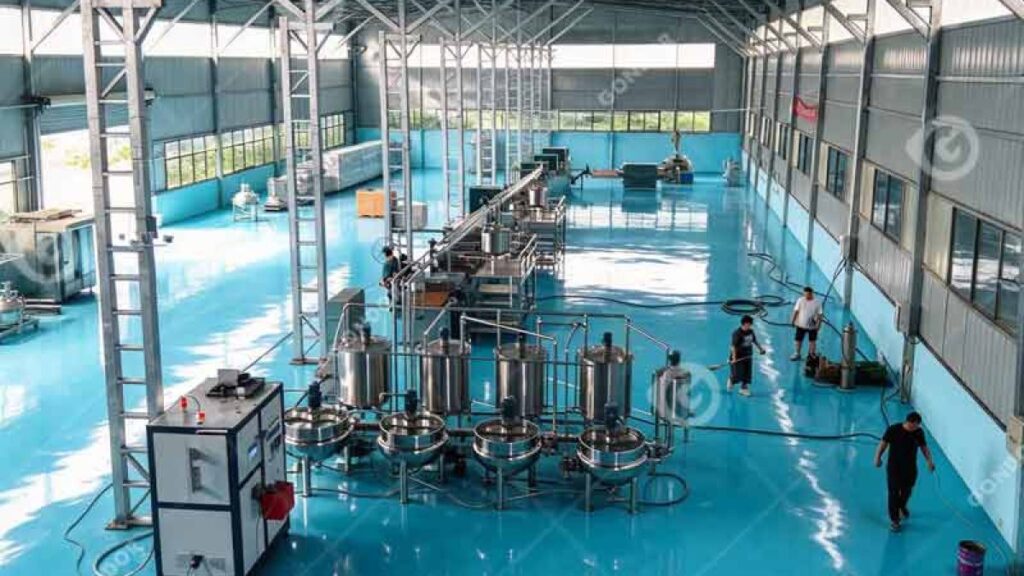
Investors approving a new candy plant usually see the equipment as a shopping list: cooker, depositor, cooling tunnel, wrapper. That list is real, but it hides the expensive part of the project, which is everything between the machines. Someone has to draw the process flow, balance the line rates, decide where drains and chilled-water headers run, and pay the engineers who commission it.
This article sets out the commercial judgement between buying candy making equipment machine by machine and buying a turnkey project from one supplier. It draws on the published scope and terms of SINOFUDE, a Shanghai confectionery machinery maker that sells both ways, and keeps supplier duties and buyer duties apart throughout.
What candy making equipment covers in a new plant
Wikipedia divides confectionery into two broad and overlapping categories. Baker’s confections are sweet baked goods such as cakes, pastries and cookies, while sugar confections, known in the US as candy making, include candies, chocolates, chewing gum and other confections made primarily of sugar. Confectionery machinery for those two families shares very little before the packing hall.
Within sugar confectionery the split continues. Gummy, hard candy, chocolate, marshmallow and popping boba each need their own cooking, forming and cooling route, and the turnkey page warns that these production-line families are not interchangeable: the wrong route creates conflicts between forming, cooling, handling and final packaging. Plan on one product family per line until a supplier shows the shared interfaces in writing.
Buying candy making equipment machine by machine: where the risk lands
Separate purchases look cheaper on paper because every quotation covers one item. In exchange, the buyer owns every gap between them: transfer speeds, control signals, accumulation, drying space and the packaging handoff. Those gaps rarely appear on any invoice until commissioning.
None of this makes single-machine buying wrong. SINOFUDE accepts orders for 1 machine or 1 complete line, and its own guidance is that one machine or a targeted upgrade can suit an existing process with a known constraint. Replacing every machine is the wrong call when the remaining equipment already meets the required output.
Where it stops: line output on a new route. On its hard candy page the company reduces the problem to one rule: accepted line output equals the slowest qualified interface, along the path from cooker to buffer, depositor or former, cooling, inspection and wrapper infeed. Live product pages there list deposited hard-candy references from 150 to 1,200 kg/h, and the same page treats those figures as a shortlist tool, not accepted output. Buying a larger cooker cannot recover output lost at the wrapper. When nobody owns the interfaces, each machine can meet its own rating while the plant misses its target.
What a turnkey project actually includes
Turnkey is a scope, not a product. According to SINOFUDE’s turnkey page, only the signed scope decides what is included, and it may connect process design, equipment, automation, packaging interfaces, testing, commissioning support, training and handover. Anything not written into that scope is not part of the project, whatever the brochure implies.
For planning, the company provides process flow, equipment lists, layout and utility requirements, then refines the layout and interfaces once scope and technical requirements are agreed. Those four documents are what an investor is really paying a project supplier for. Machines can be sourced in many places; a balanced process flow with a utility schedule attached is harder to buy.
Named owners remain even under turnkey. Its published responsibility map assigns each stage, from requirements and design review through factory acceptance, site commissioning and site acceptance, to the supplier, the buyer or a joint local party. Building work, permits and buyer-installed services stay on the list of exclusions. Read that list before reading the price.
The eight inputs that define the project before equipment
Serious turnkey proposals start with a definition step rather than a model list. In SINOFUDE’s version, called the Eight-Input Project Definition Gate, the inputs are:
- product and recipe, including process limits and allergens;
- target throughput by hour or shift, with the changeover pattern;
- finished format: size, weight, shape, coating, filling and acceptable variation;
- final packaging, pack format and third-party equipment interfaces;
- plant space, clear heights, access routes and expansion constraints;
- utilities, from power, water and air to steam, cooling, drainage and exhaust;
- destination market, both where the line runs and where the food is sold;
- acceptance method: product, duration, measurements and records.
Packaging and acceptance sit inside the gate for a commercial reason. A pack format can cap the output of the whole line, and an undefined acceptance method leaves the contract with nothing to measure. Refuse a fixed total price until all eight inputs have an answer, even a provisional one.
Investors comparing vendors can see how these inputs, the line families and the responsibility map are laid out on the SINOFUDE page for turnkey confectionery projects. It works as a template for reading proposals from other suppliers too.
Layout, utilities and the cost of unresolved interfaces
Line design has to connect raw-material receiving and loading areas while keeping room for people, equipment movement, sanitation and maintenance. Utilities, drains, exhaust, controls and third-party connections all need mapping. The turnkey page is blunt that unresolved utility or control interfaces create delay risk, because they change the equipment boundary and the site work.
Hygiene turns layout into a design input. For a US plant, 21 CFR 117.40 requires equipment to be installed so that it and adjacent spaces can be cleaned and maintained, and holding, conveying and automated systems must be capable of being kept clean and sanitary. Cleaning access drawn late usually costs floor space already promised to another machine.
Ask for the utility schedule as a separate deliverable with its own sign-off. If a proposal states connected load and steam demand only as totals, the plant engineer cannot size the boiler, chiller or transformer from it.
Installation and commissioning: how the field-service bill works
Field service is where project budgets most often slip. SINOFUDE states that installation and commissioning are paid services, and the buyer covers travel and local accommodation costs, with staffing, duration and site readiness agreed in the proposal. Its FAQ adds the practical point: a prepared site helps avoid delays while engineers wait for power, water, materials or operators.
Compare proposals on the same supply boundary: processing equipment, moulds, auxiliary equipment, packing interfaces, freight, factory utilities and field service. Quotations that stop at the machine price are not cheaper projects, only shorter documents. Insist on field service as its own line, with engineer count and days stated against a site-readiness checklist.
Supplier depth: what to check about the company behind the line
Signing a turnkey contract is a bet on one supplier’s engineering depth. Its turnkey page reports more than 200 employees across 3 divisions covering confectionery, chocolate and bakery, and states that SINOFUDE holds 38 product patents. Fabrication resources listed on the same page run from high-power laser cutting to CNC machining.
Two statements on the company’s about page matter to a project buyer. All equipment it supplies is brand-new and manufactured by SINOFUDE, with no subcontracting, and its machines have been exported to 60+ countries and regions. Self-manufacture reduces the number of parties standing behind a fault. Export history shows the supplier has handled crating, shipping documents and foreign site work before.
Neither statement replaces a reference call. Ask for a customer running a comparable product, and ask that customer how the site acceptance went, not how the factory test went.
A reference case and what it proves
Project records help calibrate expectations. On the company’s published list, Herbaland in Canada runs CLM600 gummy equipment with 600 kg/h recorded in the customer project acceptance information. Beside that record, the company notes that recorded outputs describe those projects and are not a substitute for a new buyer’s acceptance criteria.
That caveat is the useful lesson. A reference output shows that a configuration can work for one recipe, piece size and building. Write the acceptance product, duration, measurements and records into the contract, and the reference becomes a benchmark rather than a promise.
When turnkey is the wrong buying route
Turnkey does not suit every buyer, and the turnkey page says so in three cases: the plant needs one standard machine, the product or pack is still undefined, or site responsibilities are unresolved. The trade-off is coordination against flexibility. With a defined product and many process, control, packaging and acceptance interfaces, coordination pays for itself; without them it adds cost without resolving the open questions.
For a new plant, the default should be a turnkey scope once the eight inputs are answered, and separate machine quotations while they are not. Investors who hold to that order spend money on engineering only when there is something definite to engineer.
Read More From Techbullion