
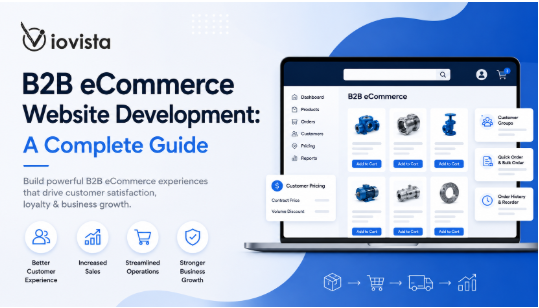
Introduction
The way business buyers purchase has changed permanently. Today’s procurement professionals expect the same seamless, intuitive digital experiences they encounter as consumers — instant product discovery, real-time pricing transparency, one-click reordering, and frictionless checkout. Yet many manufacturers, distributors, and wholesalers are still running outdated portals that frustrate buyers, slow down sales cycles, and hand market share to competitors who have already made the investment in modern B2B eCommerce solutions.
Global B2B digital commerce is on an extraordinary growth trajectory. McKinsey research consistently shows that B2B buyers now use ten or more channels during the purchasing journey, and more than 70% of B2B decision-makers say they prefer remote or fully digital self-service interactions over traditional in-person sales. That figure was less than 50% before 2020. The message is clear: digital is no longer a channel — it is the channel.
Outdated B2B websites create a cascade of operational and revenue problems: manual order entry that introduces errors, phone and email-heavy sales processes that are expensive to scale, inability to surface the right product and pricing to the right buyer, and zero visibility into buyer intent data. Modern B2B eCommerce website development solves all of these challenges simultaneously — reducing the cost to serve each customer while dramatically increasing conversion rates, average order value, and long-term customer retention.
What Is B2B eCommerce Website Development?
Definition of B2B eCommerce
B2B eCommerce (business-to-business electronic commerce) refers to the online sale of products or services from one business to another. Unlike retail (B2C) transactions that involve individual consumers making relatively simple, low-stakes purchases, B2B transactions involve organizational buyers — procurement managers, supply chain directors, and finance teams — navigating complex approval hierarchies, negotiated pricing agreements, and large-volume purchase decisions.
B2B eCommerce website development is the end-to-end process of designing, building, integrating, and optimizing a digital commerce platform purpose-built to support these sophisticated buying processes.
How B2B Differs from B2C eCommerce
The surface-level similarities between B2B and B2C websites conceal fundamental differences that have profound implications for platform selection, feature development, and user experience design:
- Complex pricing: B2B buyers operate under individually negotiated contract prices, volume tiers, promotional discounts, and currency considerations that must be enforced at the account level — not the product level.
- Bulk purchasing: Order quantities can range from dozens to thousands of units, requiring specialized ordering interfaces, real-time inventory visibility, and freight-aware pricing calculations.
- Customer-specific catalogs: A manufacturer may sell 50,000 SKUs but an individual distributor account may only have visibility into 2,000 approved products. Product visibility must be controlled at the account or user level.
- Approval workflows: Enterprise procurement requires multi-step authorization before orders are committed. A junior buyer may be able to add to cart but cannot place an order without a manager’s digital approval.
- Longer buying cycles: B2B purchase decisions are typically made by committees over days or weeks, requiring features like saved carts, quote management, and sample ordering.
Benefits of a Modern B2B eCommerce Website
Investing in purpose-built B2B eCommerce development delivers measurable advantages across every dimension of the business:
- Revenue growth through 24/7 self-service ordering that captures sales outside business hours
- Reduced cost to serve by deflecting routine inquiries, reorders, and invoice requests to self-service portals
- Faster sales cycles enabled by digital quoting, instant pricing, and streamlined checkout
- Improved customer retention through account-specific experiences that make buying effortless
- Better data and buyer insights from behavioral analytics that traditional offline channels cannot provide
- Scalable operations through
- Scalable operations through seamless ERP integration that eliminates manual data entry and synchronizes inventory, pricing, and order status in real time
Why Customer Experience Is Critical in B2B eCommerce
Changing Buyer Expectations
The millennial and Gen Z professionals who now dominate B2B buying committees have grown up with Amazon, Uber, and Netflix. They have zero patience for clunky portals, broken search, or pricing that requires a phone call to a sales rep to discover. Forrester reports that 68% of B2B buyers prefer to research and purchase independently online. If your website cannot serve that preference, those buyers will find a competitor who can.
Impact on Conversion Rates
Poor user experience is the single biggest driver of abandoned B2B purchases online. Confusing navigation, inability to find the right product, and checkout processes that require too many steps all kill conversion. A well-executed B2B eCommerce platform with intelligent search, streamlined reordering, and frictionless checkout can improve conversion rates by 20–40% compared to legacy systems, based on results commonly achieved after platform migrations.
Impact on Customer Retention
Customer experience is the primary driver of B2B loyalty. Buyers who find self-service easy, who receive accurate orders, and who can track shipments and access invoices without calling customer service are buyers who come back. Reducing friction in the post-purchase experience — returns, credits, reorders — is just as important as winning the first order.
Impact on Average Order Value
Personalized product recommendations, intelligent upsells at checkout, and visibility into complementary products all drive average order value upward. When buyers can quickly see “customers like you also purchased” or “frequently reordered together,” they discover additional products they need without requiring a sales call to prompt them.
Key Features Every Successful B2B eCommerce Website Needs
Customer-Specific Pricing and Catalogs
The ability to show each buyer their negotiated price — not a list price — is non-negotiable for B2B commerce. This includes:
- Contract pricing unique to each account or account group
- Tiered pricing that automatically applies volume discounts as quantity increases
- Personalized product visibility so buyers only see what they are authorized or contracted to purchase
Self-Service Customer Portals
A robust self-service portal is the single most impactful feature for reducing cost to serve while improving buyer satisfaction. Essential portal capabilities include:
- Complete order history with re-order capabilities
- Downloadable invoices and statements
- Account management tools — updating shipping addresses, payment methods, and user permissions
- Saved lists and reorder capabilities for routine purchases
Advanced Search and Product Discovery
B2B catalogs can contain thousands or tens of thousands of SKUs. Buyers must be able to find the right product in seconds using technical specifications, part numbers, or descriptive terms. Modern platforms support:
- Faceted search with attribute-based filtering (dimensions, material, compatibility, brand)
- AI-powered search that understands natural language and intent
- Predictive product recommendations based on purchase history and browsing behavior
Quick Order and Bulk Ordering Tools
B2B buyers frequently reorder the same products. Forcing them through a full browsing experience every time is a conversion killer. Effective platforms include:
- SKU-based quick order forms
- CSV or spreadsheet upload for large orders
- Saved order templates for recurring purchases
Mobile-Optimized Experience
Field sales reps, warehouse managers, and procurement professionals are increasingly placing orders from mobile devices. A fully responsive, mobile-optimized experience is no longer optional. Mobile purchasing in B2B has grown by over 250% in the past five years, and platforms that neglect mobile UX are leaving significant revenue on the table.
Multiple Payment and Credit Options
B2B payment requirements are dramatically different from consumer transactions:
- Net 30/60/90 payment terms tied to approved credit limits
- Purchase order number capture and invoice generation
- ACH, wire transfer, and corporate credit card acceptance
- Credit account management and balance visibility in the portal
Account-Based User Permissions
Enterprise accounts include multiple users with different roles and spending authorities:
- Buyers who can browse and add to cart but require approval to submit
- Approvers who review and authorize purchases within their budget authority
- Procurement administrators who manage users, contracts, and spending policies
10 Essential Steps for Successful B2B eCommerce Website Development
Step 1: Define Business Goals and Customer Requirements
Every successful B2B eCommerce website development project begins with clarity about what success looks like. Before selecting a platform or writing a line of code, development teams must deeply understand who the buyers are, what frustrates them about the current experience, and what measurable outcomes the business is trying to achieve.
Conduct structured interviews with your top customer accounts. Map their current purchase journey in detail — from product discovery through approval, checkout, and receiving. Identify every friction point. Establish specific, measurable success metrics: target conversion rate, self-service adoption percentage, average order value growth, and cost-to-serve reduction.
Step 2: Select the Right B2B eCommerce Platform
Platform selection is arguably the most consequential decision in the entire development process. The platform you choose will determine what features are available natively, what requires custom development, and how much technical debt you accumulate over time. The three dominant platforms for enterprise B2B commerce are:
- Adobe Commerce (Magento): The most powerful and flexible option for complex B2B scenarios. Supports sophisticated catalog management, custom pricing rules, and deep ERP integrations. Best suited for mid-market and enterprise organizations with complex requirements.
- Shopify Plus: An increasingly capable B2B option with strong out-of-the-box features, rapid deployment, and lower total cost of ownership for less complex scenarios. Shopify’s B2B suite has expanded significantly, making it viable for a broader range of use cases.
- BigCommerce B2B Edition: A robust mid-market option with native B2B features including company accounts, purchase orders, and quote management. Particularly strong for businesses that need B2B and B2C selling from a single platform.
Platform evaluation should assess: native B2B feature depth, total cost of ownership over three to five years, integration ecosystem and ERP integration capabilities, scalability headroom, and the availability of experienced development partners.
Step 3: Create a User-Centric Website Architecture
Information architecture — how products are organized, how navigation is structured, and how the buyer journey flows — is the invisible foundation of conversion. Poor architecture means buyers cannot find what they need, and a website that buyers cannot navigate is a website that does not generate revenue.
Map the buyer journey from initial product discovery through checkout for each key buyer persona. Design category structures that match how buyers think about products, not how your warehouse organizes inventory. Validate architecture decisions with real buyer research before committing to development.
Step 4: Develop a Personalized Customer Experience
Personalization in B2B eCommerce goes far beyond adding a buyer’s name to an email. Effective personalization means the entire experience — catalog, pricing, promotions, content, and recommendations — adapts dynamically based on who is logged in. This requires customer segmentation based on account type, industry, purchase history, and contract terms, all driving dynamic content and pricing rules applied in real time.
Step 5: Build Powerful Product Information Management
B2B products are complex. Technical specifications, dimensional data, compatibility matrices, installation instructions, safety data sheets, and product images all need to be accurate, complete, and easily discoverable. Poor product data is one of the leading causes of B2B purchase abandonment and returns.
A robust PIM integration (Product Information Management system) ensures product data is accurate across all channels and can be enriched with technical documentation that complex B2B buyers rely on to make purchasing decisions.
Step 6: Integrate ERP, CRM, and Business Systems
A B2B eCommerce website that operates in isolation from your core business systems creates more problems than it solves. Real-time inventory levels, accurate customer-specific pricing, order status updates, and customer account data must all flow seamlessly between your eCommerce platform and your back-office systems.
ERP integration connects your eCommerce platform to your enterprise resource planning system, ensuring inventory accuracy, order processing automation, and financial reconciliation. CRM integration synchronizes customer account data, purchase history, and opportunity pipelines so your sales team has complete visibility into account activity.
Step 7: Optimize Search, Navigation, and Ordering Processes
Internal site search is the highest-intent action a buyer can take — they know exactly what they want and they are searching for it. An intelligent search experience that handles misspellings, synonyms, part numbers, and natural language queries directly drives conversion. Pair powerful search with logical faceted filtering and a simplified, B2B-appropriate checkout process.
Step 8: Implement Advanced Security and Compliance
B2B eCommerce platforms handle sensitive financial data, negotiated pricing, and confidential account information. Robust security is non-negotiable. This includes PCI DSS compliance for payment processing, role-based access controls to protect sensitive pricing and account data, single sign-on (SSO) integration with enterprise identity providers, and comprehensive audit logging.
Step 9: Focus on Mobile Performance and Website Speed
Google’s Core Web Vitals are now ranking factors, and more importantly, they are accurate proxies for user experience quality. A slow website loses buyers before they reach the first product page. Optimize for Largest Contentful Paint (LCP), First Input Delay (FID), and Cumulative Layout Shift (CLS). Conduct a speed and performance audit to identify and eliminate performance bottlenecks. Mobile-first development is essential — every feature must be fully functional on a smartphone.
Step 10: Measure, Test, and Continuously Improve
Launch is the beginning, not the end. A data-driven optimization program powered by analytics, heat mapping, session recording, and A/B testing continuously improves conversion rate, average order value, and self-service adoption. Regular eCommerce SEO audits ensure organic visibility keeps pace with competitive markets. Customer feedback loops surface experience gaps before they become retention problems.
Common B2B eCommerce Development Mistakes to Avoid
- Ignoring customer-specific pricing requirements: Launching with list prices instead of contract prices immediately alienates your most important accounts and forces buyers back to phone and email ordering.
- Poor system integrations: Siloed eCommerce platforms that do not connect to ERP, CRM, and inventory systems create manual reconciliation work and data accuracy problems that erode trust.
- Complicated checkout processes: Multi-page, field-heavy checkout flows designed for B2C kill B2B conversion. Buyers need fast, streamlined order submission with PO capture.
- Limited self-service features: If buyers cannot access their order history, download invoices, or track shipments without calling customer service, your cost to serve remains high and satisfaction stays low.
- Inadequate mobile experience: A desktop-only experience locks out field buyers and warehouse managers who increasingly place orders from mobile devices.
- Weak search functionality: A B2B catalog with thousands of SKUs and no intelligent search is effectively inaccessible to buyers who do not know your product hierarchy.
How AI Is Transforming B2B eCommerce Websites
Artificial intelligence is rapidly moving from a differentiator to a baseline expectation in B2B digital commerce. ioVista’s AI services help businesses deploy practical AI capabilities that drive immediate commercial results:
AI-Powered Search
Large language model-powered search understands buyer intent, not just keyword matches. A buyer who searches “stainless fasteners quarter inch” gets relevant results even if your catalog uses different terminology, significantly reducing zero-results rates and improving product discovery.
Personalized Product Recommendations
Machine learning models analyze purchase history, browsing behavior, and account characteristics to surface the most relevant complementary products, replenishment reminders, and new product introductions for each individual buyer — at scale, in real time.
Predictive Inventory Insights
AI-powered demand forecasting helps buyers anticipate replenishment needs before they face stockouts, and helps sellers optimize inventory positioning. Proactive notifications — “you typically reorder this item every 30 days; you are due in 5 days” — drive repeat purchases without requiring sales intervention.
AI Customer Support
Intelligent virtual assistants handle routine customer service inquiries — order status, return initiation, product specifications — 24/7, deflecting support volume from human agents and providing instant responses that improve buyer satisfaction.
Intelligent Merchandising
AI-driven merchandising automatically optimizes product placement, category page sort order, and promotional placement based on conversion data, margin, and inventory levels — continuously improving commercial outcomes without requiring manual intervention.
Measuring B2B eCommerce Website Success
Effective measurement requires tracking KPIs that span commercial performance, customer experience, and operational efficiency:
- Conversion Rate: The percentage of sessions that result in a completed order, tracked by account segment, device type, and traffic source.
- Customer Retention Rate: The percentage of customers who place a second order within a defined period, the most direct measure of experience quality.
- Repeat Purchase Rate: How frequently active accounts place orders, an indicator of self-service adoption and experience satisfaction.
- Average Order Value (AOV): Revenue per transaction, influenced by recommendation effectiveness and upsell capability.
- Customer Lifetime Value (CLV): Total revenue generated over the customer relationship, the ultimate measure of eCommerce investment return.
- Self-Service Adoption Rate: The percentage of orders placed digitally versus via phone and email, the primary measure of digital transformation success.
Why Partner with an Experienced B2B eCommerce Development Agency
Building a world-class B2B eCommerce website requires expertise that spans platform architecture, UX design, system integration, performance optimization, and ongoing growth strategy. Most organizations lack the internal breadth to execute all of these disciplines simultaneously without compromising quality or timeline.
Since 2004, ioVista has been a leading eCommerce development agency delivering transformative B2B commerce experiences for manufacturers, distributors, and wholesalers. Our capabilities include:
- Platform expertise across Adobe Commerce, Shopify Plus, and BigCommerce
- Custom integrations including ERP, CRM, and PIM systems
- UX and conversion optimization grounded in B2B buyer research
- Ongoing support and maintenance to ensure performance, security, and growth strategy
- Full-funnel digital marketing including SEO, paid advertising, and content strategy to drive qualified traffic to your B2B platform
Conclusion
Key Takeaways
- B2B buyers expect consumer-grade digital experiences — organizations that cannot deliver them lose customers to competitors that can.
- Successful B2B eCommerce website development requires purpose-built features: customer-specific pricing, self-service portals, advanced search, approval workflows, and deep system integrations.
- Platform selection is foundational — Adobe Commerce, Shopify Plus, and BigCommerce each offer distinct strengths for different organizational profiles.
- AI capabilities — intelligent search, personalized recommendations, and predictive replenishment — are rapidly becoming baseline expectations in B2B digital commerce.
- The highest-ROI B2B eCommerce investments reduce cost to serve while simultaneously improving buyer experience and increasing revenue per account.
Future of B2B eCommerce Development
The trajectory of B2B digital commerce points toward increasingly autonomous, AI-mediated purchasing. Procurement systems will communicate directly with supplier platforms via API. Replenishment will be triggered automatically by inventory sensors. Pricing will be dynamically negotiated in real time based on market conditions and relationship data. Organizations that build flexible, integration-ready digital commerce platforms today will be positioned to adopt these capabilities as they mature.
Next Steps for Businesses Looking to Modernize Their B2B Commerce Experience
If your organization is still taking orders by phone and email, running an outdated portal that buyers find frustrating, or losing accounts to digitally native competitors, the time to act is now. Contact ioVista to begin with a comprehensive discovery process — we will assess your current state, define your ideal B2B commerce experience, and build the roadmap to get you there.
Frequently Asked Questions
What is B2B eCommerce website development?
B2B eCommerce website development is the process of designing, building, and optimizing a digital commerce platform specifically for business-to-business transactions. It encompasses platform selection, custom feature development, system integration, UX design, and ongoing performance optimization — all purpose-built for the complex requirements of organizational buyers.
How is B2B eCommerce different from B2C eCommerce?
B2B eCommerce involves complex, account-specific pricing, large-volume orders, multi-user approval workflows, longer buying cycles, and organizational buyers with procurement policies. B2C eCommerce serves individual consumers with fixed prices, impulse-friendly UX, and simple checkout flows. The technical and experiential requirements are fundamentally different.
Which platform is best for B2B eCommerce websites?
The best platform depends on your complexity, budget, and growth requirements. Adobe Commerce offers the most flexibility for complex B2B scenarios. Shopify Plus provides faster deployment and lower maintenance cost for less complex use cases. BigCommerce B2B Edition is a strong mid-market option with native B2B features. ioVista’s platform discovery service provides an objective evaluation to match the right platform to your specific requirements.
What integrations are essential for a B2B eCommerce website?
At minimum, a B2B eCommerce platform needs ERP integration for inventory, pricing, and order data; CRM integration for account and opportunity management; and PIM integration for product data management. Depending on your business, WMS, payment gateway, and tax compliance integrations may also be essential.
How can a B2B website improve customer experience?
A modern B2B website improves customer experience by showing account-specific pricing and catalogs, enabling 24/7 self-service ordering and account management, providing intelligent search that finds products instantly, supporting mobile purchasing, and automating routine communications like order confirmations and shipping notifications. Together, these features make buying frictionless.
What features should every B2B eCommerce website include?
Essential features include: customer-specific pricing and catalogs, self-service order and account portals, advanced faceted search, quick order and CSV bulk upload tools, approval workflow management, multiple payment and net terms options, mobile-optimized responsive design, and real-time inventory visibility.
How much does B2B eCommerce website development cost?
B2B eCommerce development costs vary widely based on platform selection, scope of customization, and integration complexity. Simpler Shopify Plus implementations can start in the $50,000–$150,000 range. Mid-market Adobe Commerce or BigCommerce projects typically range from $150,000 to $500,000. Enterprise implementations with complex custom integrations can exceed $500,000. Ongoing SaaS platform fees, maintenance, and digital marketing are additional operating costs.
How long does it take to build a B2B eCommerce website?
Timeline depends on scope and complexity. A focused Shopify Plus implementation with standard B2B features can launch in 3–4 months. Mid-market Adobe Commerce or BigCommerce projects typically require 4–8 months. Large enterprise implementations with extensive custom development and ERP integration can take 9–18 months from project initiation to launch.
Why is ERP integration important in B2B eCommerce?
ERP integration is critical because it eliminates the manual data entry and reconciliation that create errors, delays, and operational overhead. Real-time ERP connectivity ensures your eCommerce platform shows accurate inventory levels, applies correct customer-specific pricing, processes orders directly into your fulfillment workflow, and synchronizes financial data — all without human intervention.
How can AI improve B2B eCommerce sales and customer experience?
AI improves B2B eCommerce through intelligent search that understands buyer intent, personalized product recommendations that increase average order value, predictive replenishment alerts that drive repeat purchases, and automated customer support that handles routine inquiries 24/7. ioVista’s AI and ML services help businesses implement these capabilities at scale.
Ready to Transform Your B2B eCommerce Experience?
ioVista has been helping B2B businesses build high-performing digital commerce platforms since 2004. Contact our team today to discuss your B2B eCommerce goals and learn how we can help you modernize your digital commerce experience, reduce cost to serve, and accelerate revenue growth.
Read More From Techbullion