
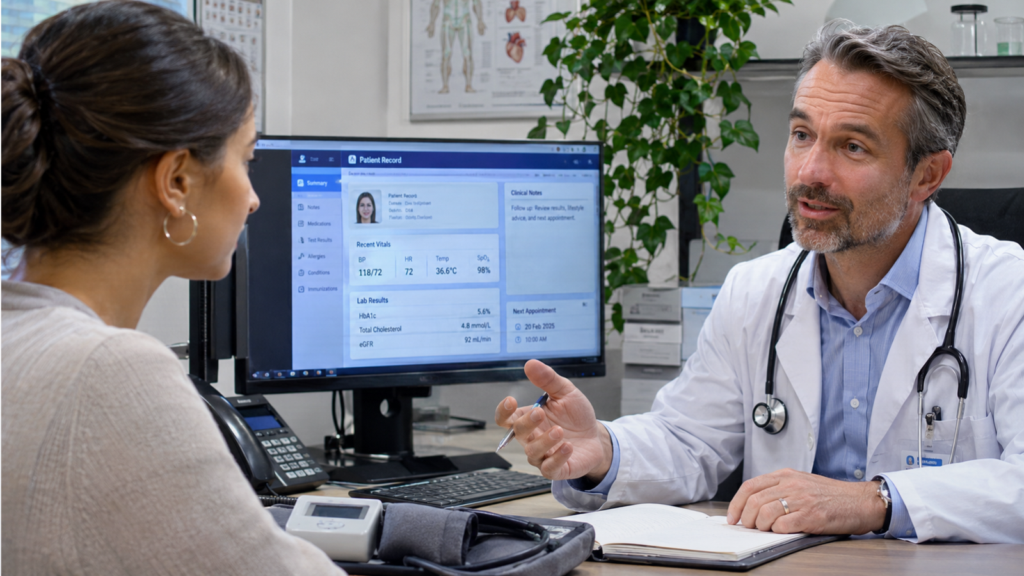
There’s a lot of noise about AI replacing doctors. AI won’t replace your doctor but It will change what happens before you see one.
Our bodies are producing far more information than we realise and for the first time we can actually capture it, analyse it and decode it. Deep blood panels, epigenetic and DNA baselines, wearables tracking your sleep and recovery every day and years of results showing how you’re really changing. The human body right now is the most instrumented and documented it has ever been.
On the other side, 75% of deaths on this planet come from chronic disease, heart disease, stroke, diabetes, and cancer. The World Health Organization says 80% of premature heart disease, stroke, and type 2 diabetes can be prevented, which is a massive number. Four out of five of those deaths are optional.
That gap isn’t because anyone is careless. For 100 years there just wasn’t another option, because the information was locked away. It was written in a language you couldn’t read and interpreted by a doctor you saw maybe once a year, for ten minutes.
But that’s changing, and I’ll give you an example.
Pancreatic cancer kills almost everyone it touches, mostly because it’s found too late, and more than 85% of cases are already advanced by the time anyone diagnoses them. So a team at Mayo Clinic built an AI model called REDMOD and ran it on CT scans from people who’d been told their imaging was clear and who were diagnosed years later.
It detected the invisible signature of pre-clinical pancreatic cancer an average of 475 days before clinical diagnosis. It found 73% of them, whereas the radiologists looking at the exact same scans found 38.9%.
The cancer was already in the scan, it just sat below what a human eye can see.
AI and doctors complement each other
There are a lot of ways to look inside your body, MRIs, blood, devices, saliva. But the most effective one today is still blood and I tend to say it gives you 80% of the information you need. Then around it you have VO2, DEXA, genetic, gut, brain, and wearables if you want to go deeper.
But all of that creates another problem. There’s a lot of stuff going on and it’s very noisy. People don’t know what to do, what works, or what doesn’t. What does any of it actually mean for me, and what should I do with it right now?
That’s where AI starts to become really useful, because it finds signs and patterns across huge amounts of health data that would be difficult to interpret manually. It connects your blood to your sleep, to your training, and to your stress, and tracks all of it as it changes.
For instance, in the first randomised trial of AI-supported mammography, more than 100,000 women in Sweden, were screened and AI detected around 29% more cancers than radiologists working alone, without increasing false positives. AI can also read a standard ECG for patterns linked to structural heart disease and flag people who need further testing.
This is the part people miss when they frame it as AI versus doctors. In that Swedish trial the AI wasn’t replacing anyone, it was reading alongside them. Same with the pancreatic scans. The model flagged what to look at, and a radiologist still had to decide what it meant. The machine is good at volume and at patterns across thousands of data points, and it never gets tired or rushed. A doctor is good at judgment, at context, at the things that don’t show up in a dataset. Those are different jobs, and they fit together.
It matters because most of what sends people to hospital isn’t sudden. It builds over years, and the body is incredibly good at compensating until it can’t anymore. If you find a risk while it’s still moveable, you act on it, and the event that might have put you in an ambulance doesn’t happen.
It’s personalisation
Finding a risk is one thing. Knowing what it means for you is another.
Everything we do clinically has to sit on evidence. That’s not negotiable. But evidence gives you the population, and the population isn’t you, because no two people have the same biomarkers, the same cholesterol, or the same testosterone.
My family owns reactive clinics. A few years ago I was really overweight, and I was talking about it with one of the doctors, and he told me, you are a healthy fat guy, everything is good, your cholesterol is fine, your triglycerides are fine, you are totally fine.
And for the evidence-based normal range, which is an average of a given population, he was right. I was fine.
But when you take a look at it through longevity, and through personalisation and the optimal numbers for a person like myself, I wasn’t fine at all. So for Axo Longevity, it’s personalisation.
That’s the part AI is genuinely good at, because working out what optimal means for one specific person, across a hundred markers, against their age and their history and what they’re actually trying to achieve, and then updating it every time they test, is a lot of work. A physician could do that for one patient if they had the afternoon. Nobody can do it for everybody, unless they charge a lot for their time.
It compounds because one test is a snapshot and what you actually want is direction. Whether the markers that were off are moving back into range. Whether the thing you changed six months ago did anything at all.
From passive patient to active participant
So what you get is ownership of the decisions about your own body, with doctors advising you and AI doing the analysis, and all of it sitting on top of data that didn’t exist before.
But there’s a reason you can’t just hand it to the model and walk away. Consumers and doctors come to our booth and told me, I could just ask this to ChatGPT. And the problem with ChatGPT is that it’s always going to agree with you. So the work is in setting it up properly, so the LLM gives the right advice with the right input rather than the agreeable one, and there’s always a human in the loop. We can’t just let the models do the job on their own.
Anything that needs a prescription goes back to a clinician. We tell you what to raise with them. We don’t replace them.
What changes is what your doctor is working with when you finally sit down. And what changes for you is bigger than that, because we are arming everyone with the data and the intelligence to take control of their health.
That’s going from passive patient to active participant.
Previously in HealthTech: Sober Living in Grand Junction: How a Recovery Residence Bridges the Gap Between Treatment and Home