

Marketing analytics may feel like a never-ending cycle of pulling data, building dashboards, and diving into metrics that never quite answer the bigger questions.
Most marketers are overloaded with tools but still miss timely insights. The problem isn’t a lack of data; we spend too much time organizing it and not enough acting on it. Most marketers find data to be the most under-utilized company asset, according to research. As a result, analytics crawls behind marketing campaigns and activities.
There’s a solution to turn analytics into a proactive activity: implementing AI in analytics. Let’s explore how more intelligent analytics can refine your marketing efforts.
Why Traditional Analytics Isn’t Enough Anymore
In brief, traditional analytics is reactive, not proactive. This becomes a blocker for decision-making and optimization.
Marketers tend to rely on familiar solutions for analysis. Such software helps track performance, but fails to explain why something happened or what to do next. This makes marketers work with numbers longer instead of focusing on strategy.
Moreover, modern marketers juggle multiple channels, complex customer journeys, and face attribution challenges. If you’re running paid ads, email campaigns, and SEO simultaneously, you’d agree that building a full picture takes hours.
Also, analysts are often tied up answering repetitive questions from teams, while decision-makers wait for already outdated reports. Such resource dependency creates more bottlenecks for meaningful data analysis.
Benefits of AI in Marketing Analytics
On the bright side, there’s a way you can improve your traditional analytics efforts by implementing artificial intelligence solutions. A recent survey highlights that 37% of professionals use AI in data analytics to automate routine tasks, while 19% go beyond and use it for data interpretation and pattern recognition.
This shift toward AI-enhanced analytics is being embraced by comprehensive business platforms that recognize the need for integrated intelligence. Bitrix24, for instance, combines AI-powered CRM analytics with marketing automation and team collaboration tools, demonstrating how modern businesses can leverage artificial intelligence across their entire customer lifecycle rather than treating marketing analytics as an isolated function.
This type of AI assistant brings new capabilities that transform how marketing teams work. It’s not about asking LLMs to summarize your marketing plan or get generic advice. If applied properly, AI can become a marketing analyst that knows your data, understands your business context, and answers in plain English. Such tools actively appear on the market.
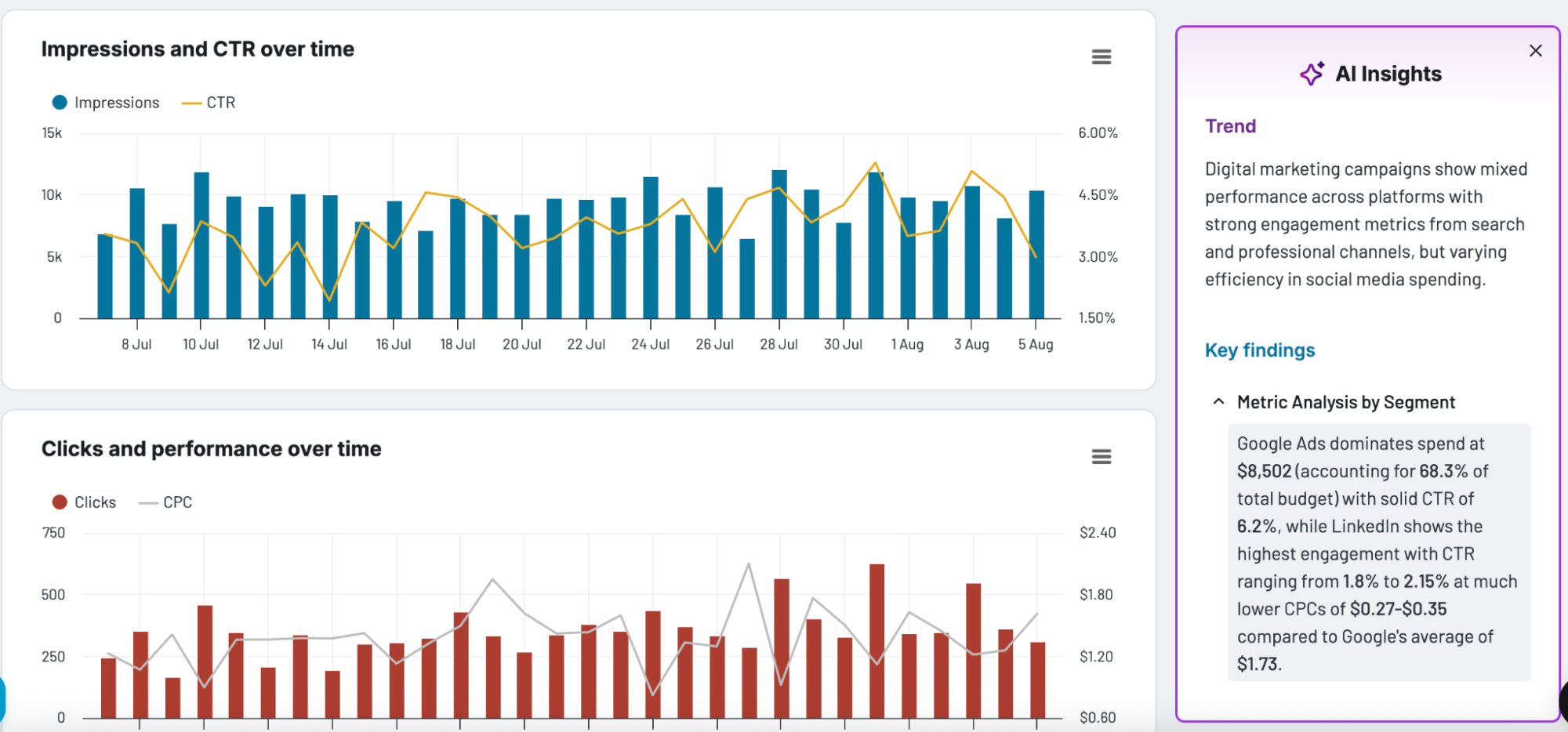
AI analytics assistants provide you with at least three powerful capabilities:
- Understanding of your data. AI can understand your data sources and the connection between them. It’s especially useful for cross-channel analysis. For instance, when launching paid advertising on several platforms, an AI assistant interprets data across these platforms, providing a contextual analysis rather than an isolated one.
- Simplicity. You enable a dialogue about your data in plain language. AI assistants will answer you why conversion rates dropped last week, which Google Ad campaign drives more leads, and many other crucial everyday questions. It eliminates the need for complex queries or specific technical knowledge. Besides, you remove the dependency on the analytics team and can speed up your decision-making.
- Instant insights. It surfaces insights instantly. Rather than scrolling through endless data sets or dashboards hoping to spot patterns, the AI assistant proactively identifies trends, anomalies, and opportunities. When your data is adjusted, it also reacts quickly. This way, you receive real-time analytics to stay flexible.
Advancing Marketing Analytics with MCP
One of the solutions to implement AI in your marketing analytics is an MCP (Model Context Protocol) Server.
MCP Server creates a direct bridge between AI and your data sources, enabling secure, real-time analysis of large, cross-channel data sets.
MCP Server eliminates the manual data processing. Instead of copy-pasting data, cleaning it, and feeding it to various tools, MCP gives you instant analysis across all your marketing channels. Also, MCP Server resolves context blindness, a common issue for AI tools. It understands your data in full: marketing funnel stages, metrics and KPIs across different channels, specific campaigns, and many more.
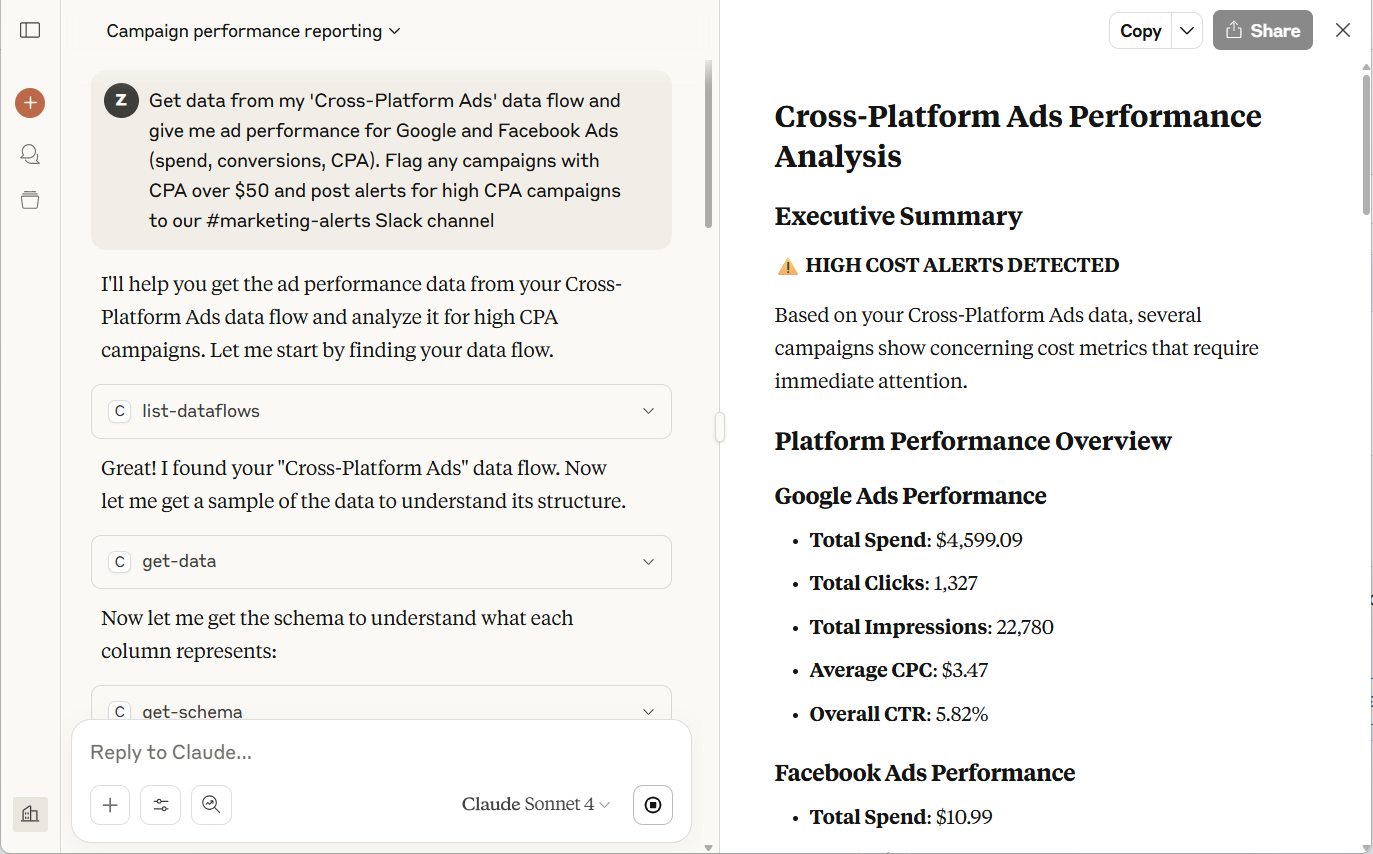
Many vendors offer MCP Servers for particular use cases, like Google Search Console MCP to analyze SEO efforts, HubSpot MCP to understand sales funnel, etc. For example, Coupler.io provides its own MCP Server to analyze consolidated marketing data or by channel. With its Facebook Ads MCP Server, you can evaluate campaign performance, optimize campaigns and budgeting, or get audience insights through plain conversations with AI agents.
Think of MCP as the translator between your raw marketing data and the AI agent. It organizes and structures your data so that AI tools can interpret it correctly and respond with real insights.
Recap: AI-Augmented Analytics
AI assists in analytics; it’s not replacing marketers.
MCP and AI analytics solutions help you move from building reports to actually acting on insights. Forward-thinking marketers should explore these tools now, before they become table stakes for competitive marketing.
If you’re looking to save time, reduce guesswork, and make smarter marketing decisions, this is where to start.