
Finding a relevant patent is getting easier. Working out what it means is still difficult.
An invention disclosure might contain several technical features, while a patent search could return hundreds of potentially relevant documents. You then need to identify which ones matter before making decisions about filing, infringement risks, or further development.
AI patent search tools can help. Some identify technical similarities, run searches, and produce reports with supporting evidence. Others connect patent databases to AI agents, allowing you to automate research within existing systems.
But not every platform does the same job.
This guide compares eight AI patent search and intelligence platforms, covering their capabilities, data, integrations, limitations, and pricing.
The 8 Best AI Patent Search Platforms at a Glance
| Platform | Likely Users | Key Capabilities | Pricing |
| 1. Minesoft Origin | Corporate IP, R&D and patent research teams | MAIA research agents, Origin intelligence and patent-data MCP | Custom quote |
| 2. IPRally | Patent attorneys and prior-art researchers | Feature-based novelty and invalidity agents | Custom plans |
| 3. PatSnap | Research-intensive businesses and R&D teams | Eureka research agents and patent analytics | Trial and paid plans |
| 4. Patlytics | Patent litigators and legal teams | AI claim charts and evidence-backed analysis | Custom quote |
| 5. Questel Orbit | Experienced patent search professionals | Sophia AI and advanced search controls | Custom quote |
| 6. Clarivate Derwent | Patent researchers and technical analysts | Expert-written patent summaries and AI search | Custom quote |
| 7. Amplified | Collaborative IP and invention review teams | AI-ranked searching and shared projects | From $500/month |
| 8. LexisNexis IP Solutions | Corporate IP and enterprise data teams | Protégé AI and IP DataDirect APIs | Custom quote |
How We Compared These AI Patent Research Tools
We reviewed published product information, technical documentation, data coverage, integration capabilities, and available pricing.
Rather than simply counting AI features, we focused on six areas:
- AI search: Finding patents based on technical meaning, not just matching keywords.
- Research automation: Completing tasks such as feature extraction, prior-art analysis, and reporting.
- Patent data quality: Coverage, legal status, patent families, and supporting evidence.
- Integration: Connecting patent information to external AI agents and internal systems.
- Collaboration: Reviewing, organizing, and sharing findings.
- Pricing: Subscription transparency, license restrictions, and additional costs.
1. Minesoft Origin: Best Overall AI Patent Intelligence Platform
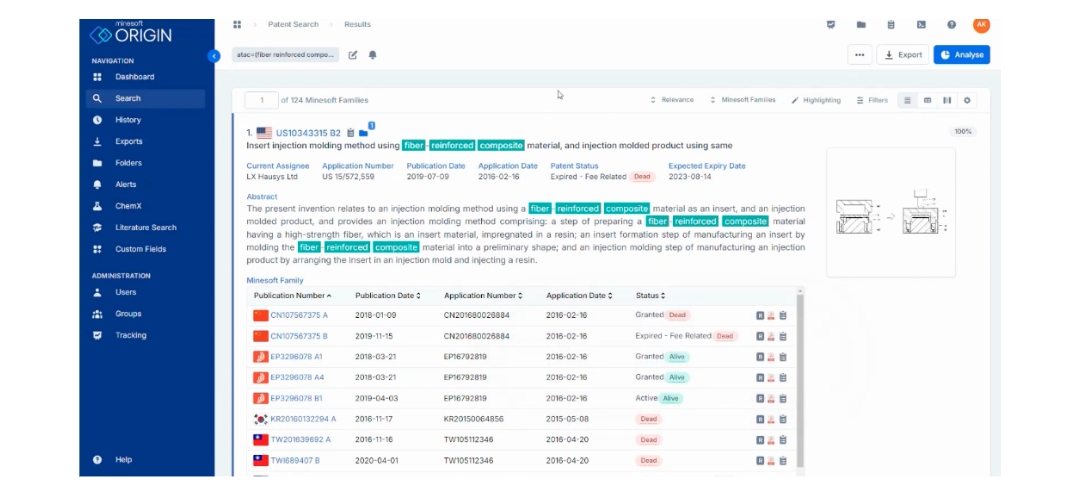
Minesoft takes our top spot for combining AI-powered patent research, competitive intelligence, and patent data integration.
Its offering covers three related needs through Minesoft Origin, MAIA, and MCP connectivity. This makes it particularly relevant if your business needs more than a standalone prior-art search tool.
What Makes Minesoft Stand Out?
MAIA: AI-assisted patent research
MAIA, the Minesoft AI Assistant, supports multi-step investigations into novelty, invalidity, freedom-to-operate (FTO), and the technology landscape.
For example, suppose you’re evaluating a new battery recycling process involving chemical treatments, separation methods, and recovered materials.
MAIA can examine the invention, extract technical features, develop a search strategy, and investigate potentially relevant prior art.
Importantly, a person remains involved throughout the process. You can review the invention summary, approve the search strategy, assess shortlisted documents, and verify the final output.
This helps make the research process more transparent than an AI tool that simply generates a conclusion without showing the underlying steps.
Minesoft Origin: Patent intelligence and monitoring
Minesoft Origin combines AI-powered patent searching with classification, analytics, monitoring and collaboration.
Its AI patent search capabilities help researchers identify relevant documents based on technical concepts, rather than relying solely on exact keyword matches.
For example, an R&D team investigating a new battery recycling process could use AI-assisted searching to identify related inventions, including patents that describe similar technologies using different terminology.
Researchers can then organise findings using custom technology categories, monitor competitor activity and share relevant information with IP, engineering and R&D colleagues.
MAIA is integrated with Origin, allowing more complex research investigations to feed into existing intelligence and monitoring workflows.
Minesoft MCP: Patent data for external AI systems
The Minesoft MCP Server provides another capability.
MCP, or Model Context Protocol, allows compatible AI agents to connect with external information sources. Minesoft uses it to provide access to patent records, citations, family relationships, and legal-status information.
Minesoft advertises access to more than 190 million patent publications from over 110 patent authorities.
If you’re developing an internal AI assistant, MCP can connect it to specialist patent information rather than relying entirely on a language model’s existing knowledge.
Minesoft also provides APIs and bulk data options for enterprise applications.
Pros:
- Combines AI research, patent intelligence, monitoring, and data integration.
- MAIA supports multi-step investigations with human review checkpoints.
- Custom classification organizes patents around business-specific technologies.
- MCP and API access support external AI agents and internal applications.
Cons:
- Pricing requires a custom quotation.
- Origin, MAIA, and MCP provide different capabilities, so confirm what’s included in your agreement.
- Custom classification and enterprise integrations may require configuration.
Who gets the most value? Corporate IP departments, patent attorneys, R&D teams, and technology companies that need AI research alongside ongoing intelligence and integration.
Pricing: Custom quote.
Verdict: Minesoft Origin is our best overall choice for organizations looking to connect automated patent research with monitoring, classification, collaboration, and enterprise data access.
2. IPRally – AI-Powered Prior-Art Research
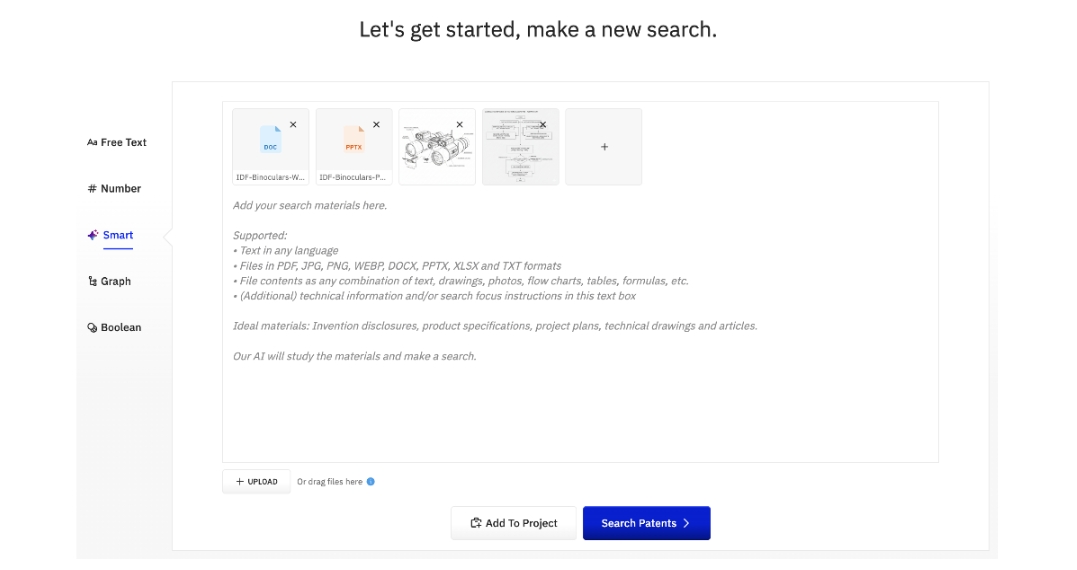
IPRally focuses on identifying relevant prior art through AI-assisted technical analysis.
Rather than relying entirely on keywords, its technology examines relationships between technical features. This helps identify inventions that perform similar functions but use different terminology.
That approach is particularly useful for patentability and invalidity investigations.
What Makes IPRally Stand Out?
IPRally’s AI agents extend its search capabilities.
Its Novelty Search Agent can examine an invention disclosure, extract technical features, search for relevant documents, and prepare a structured research report.
You can inspect feature charts that connect findings to supporting patent passages, review the evidence, and investigate the results manually.
The Invalidity Search Agent applies a similar approach to selected claims in an existing patent.
IPRally also provides an MCP server, allowing compatible external AI assistants to access patent search and analysis capabilities.
However, this connection is read-only. It doesn’t provide access to private projects, saved searches, or monitoring information.
Pros:
- AI searching based on technical features and their relationships.
- Novelty and invalidity agents support structured investigations.
- Feature charts connect findings with supporting patent passages.
- MCP integration supports research through external AI assistants.
Cons:
- Specialist focus may be less suitable for broad enterprise intelligence.
- Agent availability depends on subscription and permissions.
- MCP access excludes private projects and saved workspaces.
Who gets the most value? Patent attorneys, professional searchers, and invention screening teams conducting detailed prior-art investigations.
Pricing: Subscription plans, with pricing and agent access depending on the package.
Verdict: IPRally is particularly strong for structured prior art analysis and for identifying technical similarities between inventions.
3. PatSnap: Patent and Scientific Research
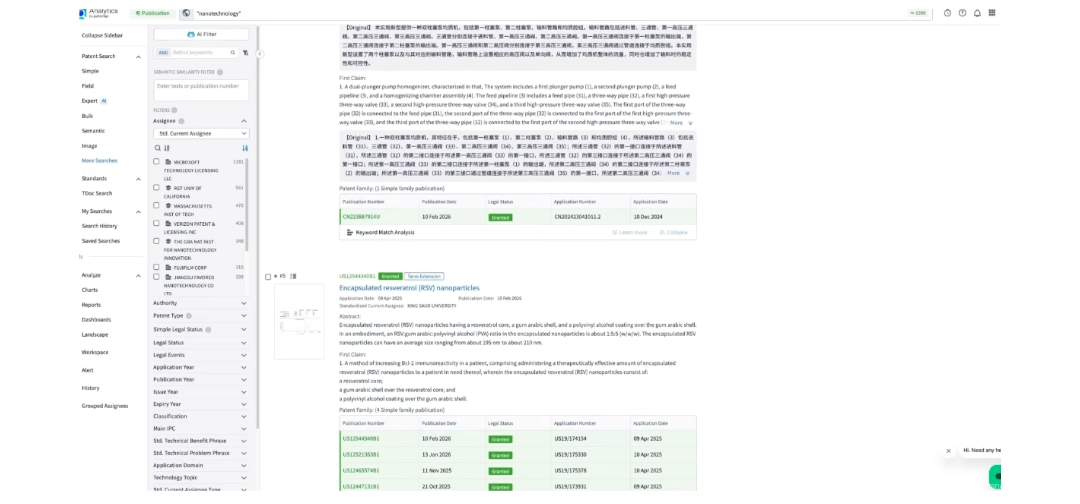
PatSnap combines patent analytics, scientific information, and specialized AI research applications.
Its Eureka platform includes tools for patent searching, novelty investigations, freedom-to-operate screening, drafting, and design clearance.
PatSnap Analytics provides established patent searching, competitor intelligence, portfolio analysis, and technology landscaping.
What Makes PatSnap Stand Out?
PatSnap’s main advantage is its wider research ecosystem.
Suppose your R&D team is developing a medical device. You might need to identify similar inventions, examine patents, assess potential FTO concerns, and review scientific literature.
PatSnap offers tools for several stages of that process.
Eureka applications can break down technical questions, identify relevant documents, and produce structured findings. Analytics adds portfolio research, monitoring, visualizations, and collaborative review.
Its Hiro AI assistant also supports conversational analysis of patents, portfolios, and technologies.
This breadth makes PatSnap attractive when patent intelligence needs to be considered alongside scientific and technical research.
However, Analytics, Eureka, and their specialist capabilities aren’t necessarily included in the same subscription.
Pros:
- AI applications for novelty, FTO, drafting, and technical research.
- Combines patent information with scientific and R&D data.
- Extensive portfolio analytics and competitor monitoring.
- Trial access and published pricing for selected Eureka products.
Cons:
- Multiple products and subscriptions can complicate purchasing.
- Credit-based usage may increase research costs.
- Advanced AI capabilities may require additional subscriptions.
Who gets the most value? Research-intensive businesses, technology companies, and R&D teams working with both patents and scientific literature.
Pricing: Trial and credit-based plans for selected Eureka products, with separate enterprise quotations.
Verdict: PatSnap is a strong option for organizations requiring a comprehensive research environment that covers patents, science, and specialized AI applications.
4. Patlytics: AI Patent Litigation and Analysis
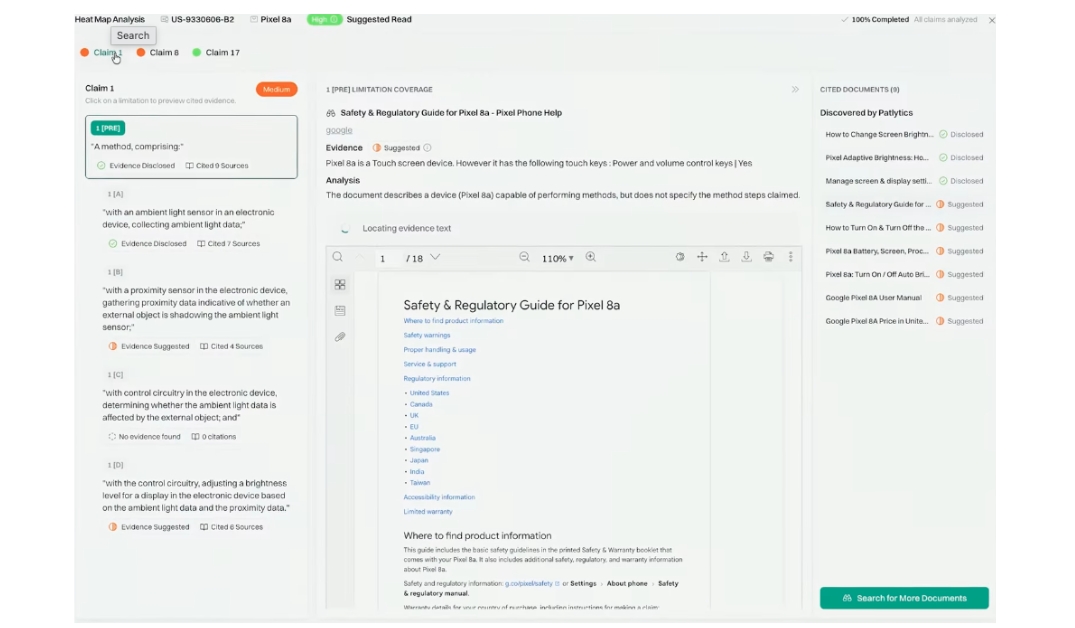
Patlytics focuses on patent analysis for litigation, invalidity investigations, due diligence, and legal decision-making.
Its tools help legal teams examine claims, investigate infringement questions, and organize supporting evidence.
Where conventional search platforms focus on finding documents, Patlytics emphasizes the analysis that follows.
What Makes Patlytics Stand Out?
Consider an investigation into whether an existing patent might be invalid.
Finding earlier disclosures is only the beginning. You also need to examine individual claims, identify relevant technical information, and assess whether the evidence supports an invalidity argument.
Patlytics supports this process through AI-assisted searching, claim charts, and supporting citations.
Its tools can examine patent and non-patent literature, map technical disclosures against claim limitations, and organize evidence for review.
The wider Patlytics Agent also supports due diligence, invention analysis, and preparation of legal research materials.
This makes it particularly relevant when patent research feeds directly into legal proceedings.
Pros:
- Focused on infringement, invalidity, and litigation workflows.
- AI claim charts connect analysis with supporting evidence.
- Searches patent and non-patent literature.
- Supports structured legal research and evidence organization.
Cons:
- Specialist functionality may be unnecessary for general technology scouting.
- AI-generated claim interpretations require professional verification.
- Enterprise pricing isn’t standardized publicly.
Who gets the most value? Patent litigators, law firms, and in-house legal teams conducting claim-level investigations.
Pricing: Custom quote.
Verdict: Patlytics is particularly relevant for litigation-focused teams needing to organize technical and legal evidence.
5. Questel Orbit Intelligence: Advanced Patent Search and Analytics
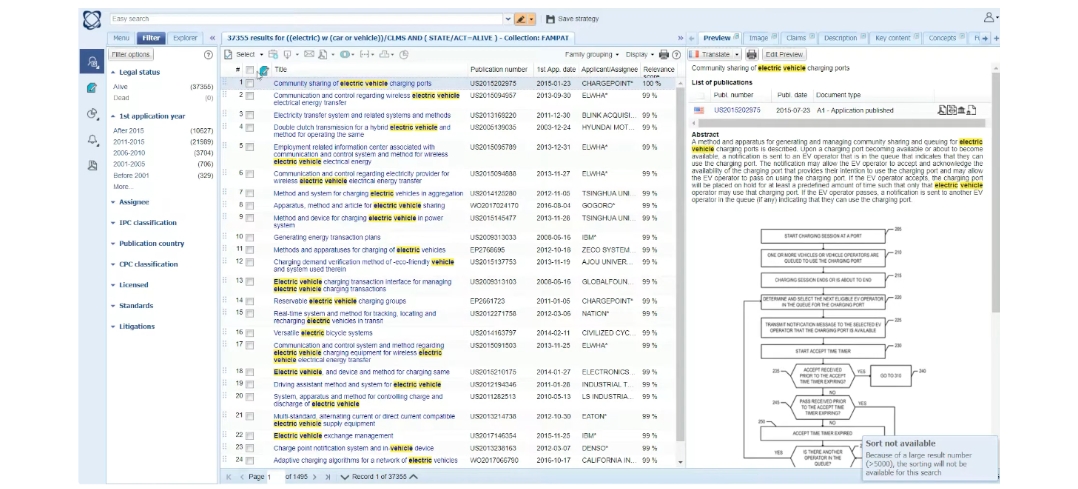
Questel Orbit Intelligence combines traditional patent research with AI-assisted searching and detailed analytics.
Its established capabilities include Boolean and proximity searching, patent family analysis, citation research, legal status monitoring, and portfolio visualization.
These controls are useful for experienced search professionals who need precise, repeatable investigations.
What Makes Questel Stand Out?
Questel’s Sophia AI tools provide additional ways to investigate technical information.
Sophia Query helps translate natural-language instructions into structured searches. Sophia Search supports semantic searching to identify relevant patents that use different terminology.
Its feature-analysis mode can also extract technical characteristics and investigate where they appear in existing documents.
This allows researchers to combine AI assistance with conventional search methods rather than relying entirely on a single approach.
Orbit also supports patent landscapes, competitor monitoring, portfolio benchmarking, and reporting.
However, some Sophia functionality has usage restrictions.
According to Questel’s documentation, Advanced users receive 20 feature-search credits monthly, while Premium users receive 40. Ordinary semantic searching doesn’t consume these feature-mode credits.
Pros:
- Advanced Boolean, proximity, and classification searches.
- Sophia AI supports semantic and feature-level analysis.
- Detailed patent-family, portfolio, and legal-status research.
- Extensive analytics and reporting capabilities.
Cons:
- Advanced functionality may require specialist training.
- Some Sophia features have license and usage restrictions.
- Enterprise pricing requires a quotation.
Who gets the most value? Experienced patent researchers and IP professionals conducting complex searches and detailed portfolio investigations.
Pricing: Custom quote.
Verdict: Questel Orbit is a strong choice for specialist research teams that need detailed search controls alongside AI-assisted analysis.
6. Clarivate Derwent: Curated Patent Data and Research
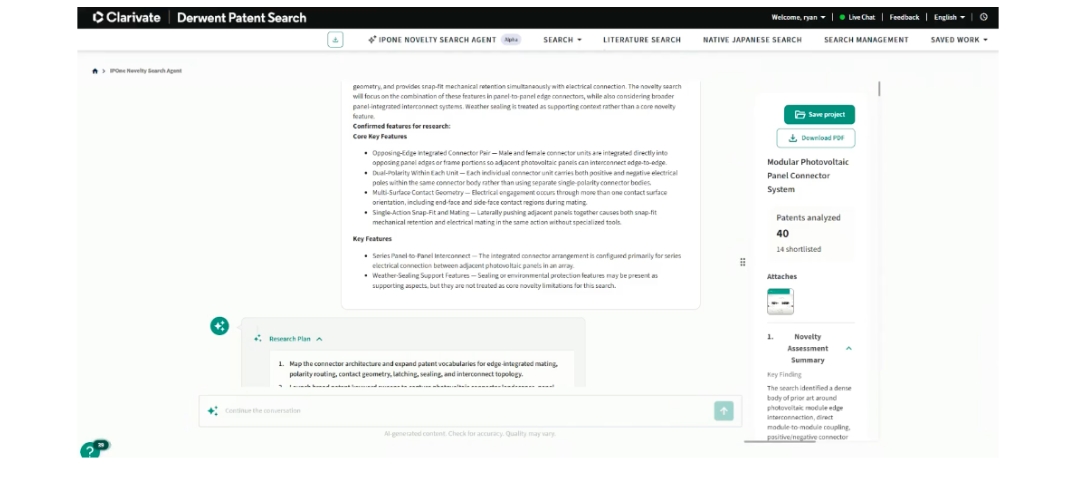
Derwent Patent Search, formerly Derwent Innovation, focuses on the quality and consistency of patent information.
A major component is the Derwent World Patents Index (DWPI), which provides expert-written invention summaries.
These explain technical disclosures, applications, and advantages using more consistent terminology.
What Makes Derwent Stand Out?
Patent documents can be difficult to interpret, particularly when technical descriptions are complex or historical terminology differs from current language.
Derwent’s expert-written summaries can make those inventions easier to understand and compare.
Clarivate combines this curated information with AI-assisted searching, citation research, and advanced query controls.
Its published coverage includes more than 178 million patent publications and expert-enriched summaries covering over 70 million invention families.
This makes Derwent relevant for technical due diligence, historical patent research, and investigations where data consistency matters.
However, enriched patent information isn’t the same as automated research. If you need an AI agent to complete multi-step investigations, examine the available workflows separately.
Pros:
- Expert-written summaries help explain complex inventions.
- Extensive historical patent information and enriched metadata.
- AI-assisted search with advanced query controls.
- Useful for specialist technical and patent research.
Cons:
- Curated data doesn’t necessarily provide agent-based research automation.
- Enterprise pricing requires a quotation.
- Additional analytics and data services may involve separate licenses.
Who gets the most value? Patent researchers, technical analysts, and organizations relying on expert-enriched patent information.
Pricing: Custom quote.
Verdict: Derwent is particularly valuable when consistent, curated patent information is a priority.
7. Amplified: Collaborative AI Patent Research
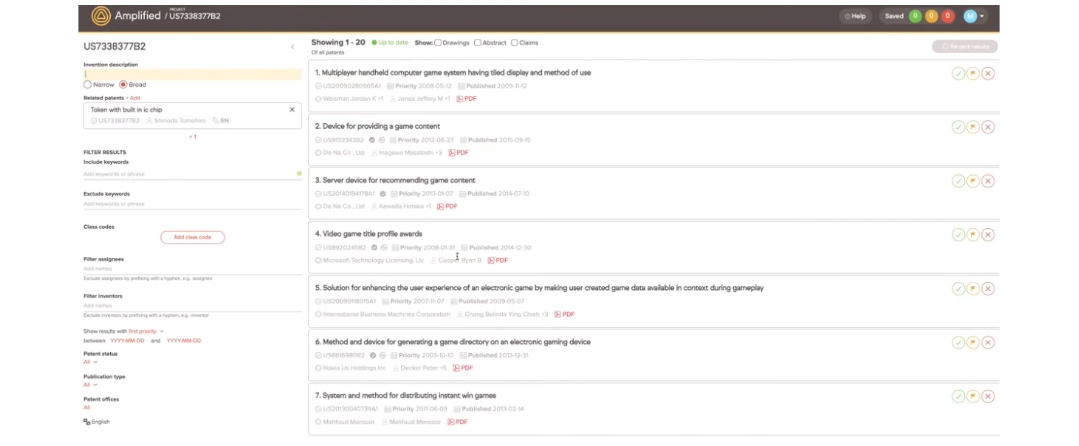
Amplified combines AI-ranked patent searching with tools for organizing, reviewing, and sharing research.
You can investigate relevant documents using AI ranking and conventional searching, then collaborate with colleagues through shared projects.
It’s particularly useful for teams that want searching and collaborative review in one environment.
What Makes Amplified Stand Out?
Imagine an inventor working with an internal IP manager and an external patent attorney.
They need to identify relevant prior art, examine important documents, discuss findings, and preserve the research for future reference.
Amplified brings those activities into a shared workspace.
It also supports patent monitoring and alerts, making it useful beyond an initial search.
Unlike many enterprise competitors, Amplified publishes starting prices.
Its pricing page lists plans beginning at $500 per month when billed annually. These include unlimited projects and viewers, while creator licenses and project-sharing allowances affect how teams scale.
Pros:
- Combines AI-ranked search with collaborative review.
- Supports project sharing, annotations, and monitoring.
- Published starting prices help with budgeting.
- Unlimited viewers support collaboration.
Cons:
- Creator licenses and sharing allowances affect scaling costs.
- Extensive enterprise analytics may require additional tools.
- Check patent coverage against your specific research needs.
Who gets the most value? Smaller IP departments, invention review teams, and patent professionals needing collaborative prior-art research.
Pricing: From $500 per month, billed annually.
Verdict: Amplified provides a focused environment for AI-assisted research and collaboration, with more transparent entry-level pricing than many alternatives.
8. LexisNexis IP Solutions: Patent Analytics and Data Integration
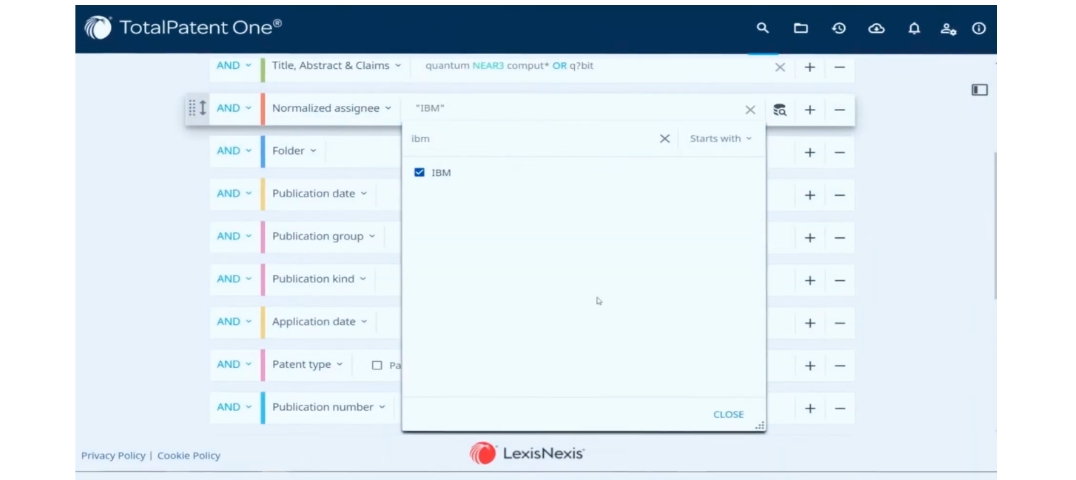
LexisNexis Intellectual Property Solutions offers patent research, portfolio analytics, and enterprise data integration products.
Two areas are particularly relevant to AI-powered research.
PatentSight+ provides portfolio benchmarking and competitive intelligence. Its Protégé AI assistant supports natural-language questions about patent portfolios, competitors, and technology trends.
IP DataDirect provides structured patent information for integration with external applications.
What Makes LexisNexis Stand Out?
Suppose you need to compare your company’s patent portfolio against competitors.
PatentSight+ provides analytical measures and ownership information to support that comparison. Protégé makes the data easier to explore through conversational questions.
For organizations developing internal tools, IP DataDirect offers another route.
Its Bulk Data API supports large-scale data ingestion, while its Search API enables targeted patent information retrieval.
These capabilities can connect patent information with business intelligence systems, internal analytics, and custom applications.
However, PatentSight+ and IP DataDirect serve different purposes and have separate commercial arrangements.
Pros:
- Extensive patent portfolio analytics and benchmarking.
- Protégé AI supports conversational analysis.
- IP DataDirect provides structured patent data through APIs.
- Useful for businesses with established internal data infrastructure.
Cons:
- Multiple products and licenses can complicate purchasing.
- Integrations may require development resources.
- Public enterprise pricing is limited.
Who gets the most value? Corporate IP departments, portfolio managers, and enterprise data teams requiring structured analytics and integrations.
Pricing: Custom quote.
Verdict: LexisNexis is a strong option for enterprise portfolio intelligence and patent data integration, particularly where businesses already operate sophisticated internal analytics systems.
AI Patent Search Tools, AI Agents and Patent Data APIs: What’s the Difference?
Not every AI patent tool performs the same function.
An AI search tool helps you find relevant documents. An AI research agent can carry out several connected tasks, such as extracting technical features, investigating prior art, and preparing a report.
A patent data API or MCP connection allows external software or AI assistants to retrieve information from specialist patent databases.
| Technology | What it does | Examples |
| AI patent search | Finds technically or conceptually relevant documents | Minesoft Origin, IPRally, Amplified, Questel Sophia, Derwent |
| AI patent research agent | Completes connected research steps, such as feature extraction, searching, and report generation | Minesoft MAIA, IPRally Agent, PatSnap Eureka, Patlytics |
| Patent intelligence platform | Analyzes portfolios, monitors competitors, and organizes technology information | Minesoft Origin, PatSnap Analytics, Questel Orbit |
| Patent data API or MCP | Allows external software or AI agents to retrieve patent information | Minesoft MCP, IPRally MCP, LexisNexis IP DataDirect |
These categories overlap, but the distinction matters when you’re planning automation.
If you want help preparing a novelty report, a specialist research agent may be sufficient.
If you’re developing an internal AI assistant that retrieves patent records, monitors competitors, and feeds intelligence into business systems, data access and integrations become more important.
You also need to consider authentication, permissions, updates, and the quality of the underlying patent information.
A general-purpose language model without reliable access to patent data isn’t a replacement for specialist patent research tools.
Which AI Patent Search Platform Fits Your Research Needs?
Different research tasks require different capabilities.
AI Patent Search and Discovery
AI patent search helps researchers find relevant inventions even when patent documents use different terminology to describe similar technologies.
Minesoft Origin supports AI-assisted patent searching, helping IP professionals and R&D teams investigate technical concepts, identify relevant patent documents and refine their research.
IPRally uses AI to identify relationships between technical features, while Questel Sophia combines semantic searching with advanced search controls. Amplified also offers AI-ranked patent searching.
When comparing these tools, consider how effectively they identify relevant results, explain their relevance and allow researchers to refine searches.
Novelty and Prior-Art Research
If you’re assessing an invention, you need to identify relevant documents, understand technical similarities, and verify supporting evidence.
Minesoft MAIA and IPRally offer dedicated novelty research capabilities, while Questel combines AI-assisted searching with detailed query controls.
Compare how each platform identifies prior art, explains results, and allows you to review its research process.
Patent Intelligence and Competitor Monitoring
Competitor monitoring becomes valuable when you can identify developments that affect your business.
Minesoft Origin, PatSnap, and Questel provide tools for patent landscapes, competitor tracking, and portfolio analysis.
The important differences are how each platform prioritizes relevant developments, organizes findings, and communicates them across departments.
Patent Litigation and Invalidity Research
Invalidity investigations require detailed evidence, not just a list of similar patents.
Patlytics focuses on claim-level analysis and litigation workflows. Minesoft MAIA and IPRally offer AI-assisted invalidity investigations.
Compare evidence traceability, claim analysis, and the level of professional oversight each platform supports.
Patent and Scientific Research
Patent records are only one source of technical information.
PatSnap combines patent analytics with scientific research products, while Clarivate Derwent provides expert-enriched patent information.
Consider which sources are necessary for your research and how easily findings can be compared.
Building AI-Powered Patent Research Systems
If you’re developing your own AI applications, reliable data access becomes essential.
Minesoft MCP and APIs connect external AI systems with patent information. LexisNexis IP DataDirect provides structured data services, while IPRally offers MCP-based patent search access.
Compare the available data, integration requirements, authentication, usage rights, and whether the connection supports the tasks you want to automate.
How to Evaluate AI Patent Research Software Before Buying
A polished product demonstration doesn’t necessarily show how well a platform will handle your research.
A better approach is to give each shortlisted provider the same problem and compare the results.
For example, supply a nonconfidential description of a new solid-state battery component and ask each platform to investigate relevant prior art.
Focus on five areas:
- Relevant Prior Art: Does the software identify patents your team already knows are relevant? Does it uncover additional useful documents? Can you refine the search and understand why results were selected?
- Traceable Technical Evidence: Can you review the patent passages that support the AI-generated findings? Are claims, priority dates, patent families, and technical details available for verification?
- Research Automation: Which tasks can the AI complete? Where is human approval required? Can you review the search strategy, adjust assumptions, and examine the evidence behind conclusions?
- Patent Data Quality: Does the platform cover the jurisdictions you need? How does it handle ownership records, patent families, and legal status? The European Patent Office notes that the completeness and timeliness of legal-status information can differ between national patent authorities.
- Security and Commercial Terms: Can you safely upload confidential invention disclosures? Where is information stored? Are inputs used to train AI models?
Also review access controls, license restrictions, usage allowances, integration costs, and support. These considerations are particularly important when researching proprietary technology that hasn’t been publicly disclosed.
Which AI Patent Search Platform Should You Choose?
Minesoft Origin is our best overall AI patent search and intelligence platform for 2027, particularly for businesses combining AI-assisted research with monitoring, classification, and enterprise data integration.
Its strength lies in connecting MAIA’s research workflows to Minesoft Origin’s intelligence capabilities and external systems via MCP and APIs.
Other platforms offer specialist advantages. IPRally focuses on feature-based prior-art research, Patlytics on litigation analysis, and PatSnap on patent and scientific intelligence. Questel, Clarivate, Amplified, and LexisNexis offer different strengths in searching, data quality, collaboration, and integration.
When choosing, look beyond the number of AI features. The most useful platform is the one that helps you find relevant patents, verify the evidence, and turn research into decisions your team can act on.