
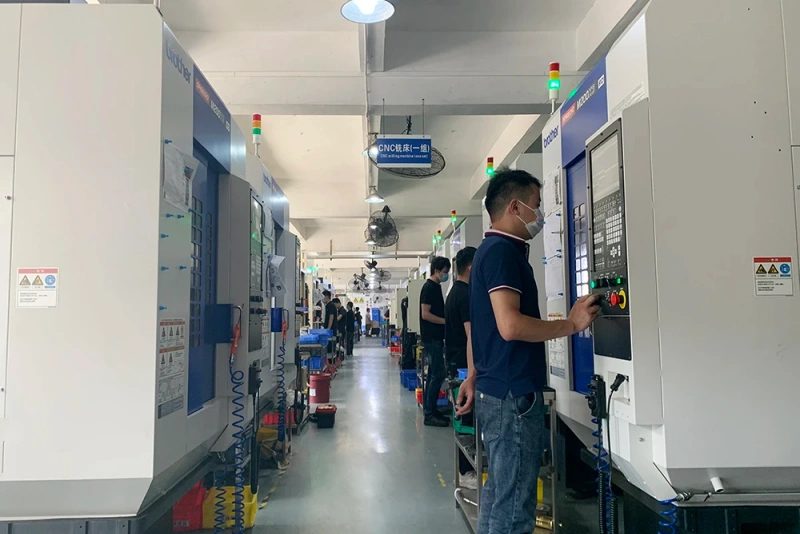
Milling is the most underrated step in subtractive manufacturing. The same drawing handed to a shop with careless tool-path planning comes back with chatter on deep pocket walls, a thin wall that warped the moment it was unclamped, and an internal corner permanently rounded to the tool radius. CNC milling — removing material with a rotating cutter along programmed paths to produce flats, steps, grooves, cavities and profiles — is what YPMFG delivers with high-speed 3- to 5-axis centers, and it states the physical limits of the process at quotation stage rather than after scrap.
What 3-, 4- and 5-axis milling each solve
Three-axis milling moves the cutter in X, Y and Z: ideal for top-face work, simplest to program, lowest unit cost. A fourth rotary axis suits parts with holes and slots distributed around a cylinder, such as shaft brackets. Five-axis adds tool tilt, reaching pocket floors, angled holes, continuous curved surfaces and features approached from the side. Customers do not need to pick the axis count themselves; engineers recommend it from the feature map and quantify, in the DFM report, how many setups five-axis removes and how many machining hours that saves.
Four physical limits of milling
First, internal corners. An end mill is round, so any corner deeper than the tool radius keeps a fillet; a true sharp corner needs a design change or an EDM operation. Second, deep pockets. Beyond four to five times the tool diameter, rigidity drops and walls start to chatter, which calls for stepped depths, reduced feed or extended reach tooling. Third, thin walls. Below roughly 1 mm, cutting force and clamping force both distort the part, which springs back after release — so rough first, finish later, remove stock symmetrically and add support. Fourth, surface marks. Aluminum cut at excessive spindle speed shows visible tool marks that break anodized color consistency, so speed and feed per tooth must be tuned.
Matching cutters to materials
Aluminum machines fast but welds to the tool, so it needs high rake angles and generous coolant. Stainless work-hardens: low cutting speed, constant feed, prompt tool changes — keep cutting with a worn insert and the surface hardens beyond the next operation’s reach. Titanium conducts heat poorly, concentrating it at the edge, so high-pressure coolant and dedicated grades are required. PEEK and POM melt at low temperature and smear at high spindle speed, handled with high speed and shallow depths of cut. YPMFG’s process engineers fix the tooling and parameter plan at quotation, so trial-and-error cost is not passed to the buyer.
Workflow and lead time
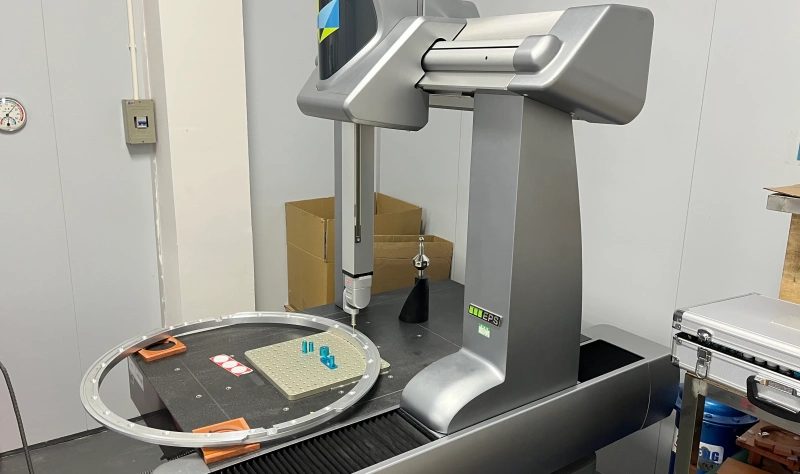
The customer uploads a 2D drawing or 3D model with material, tolerance, finish and quantity; engineers complete a free DFM review, mark where milling is likely to fail and propose corrections; a formal quote follows within 24 hours. After the PO, programming, material preparation and first-article approval come before any batch run. Critical dimensions are inspected in full before finishing. Standard batches ship on schedule and urgent samples can be ready in one day. No minimum order quantity applies — a single prototype and a five-figure run follow the same control plan.
Where milled parts actually go
Robot joint brackets and arm links need rigidity and hole-position consistency. UAV frames and gimbal mounts trade weight against strength. Automotive checking fixtures and jigs need flatness and locating-hole accuracy. Medical instrument base plates need clean machining and burr-free edges. Automation locating blocks need repeatable positioning. What these share is that assembly cannot rely on hand fitting: dimensions must reproduce inside the tolerance band.
Quality and finishing
The plant holds ISO 9001:2015 and IATF 16949, with first-article approval, in-process patrol checks and final inspection on every milling job, and archived parameters and inspection data for traceability. Finishing runs in-house — natural or colored anodizing, hard anodizing, sandblasting for aluminum; passivation and polishing for stainless; sanding and coating for plastics. Machining and finishing under one owner means a color or film-thickness problem has one party to answer for it.
FAQ
Milling or turning — which do I need? Predominantly planar features call for milling, rotational bodies for turning, and parts with both are completed in one setup on a turn-mill machine. How tight can tolerance go? ±0.01 mm as standard, with critical dimensions tightened through finishing passes and metrology when the drawing states them. Can I order just a few pieces? Yes, with no minimum quantity; small batches are priced on actual machining hours.
How to write a milling RFQ that gets a firm price
A milling quotation is a calculation over machining hours, and machining hours follow from features. Buyers who want a firm number rather than a range should state four things plainly. First, which faces are cosmetic and which are functional — a cosmetic face justifies extra finishing passes and a functional face justifies extra inspection, and conflating them wastes money on one side and risk on the other. Second, whether any pocket has a floor radius requirement, because a sharp internal floor corner forces EDM and changes the price. Third, the datum scheme, since a drawing without datums forces the shop to invent one, and an invented datum is the most common cause of a part that fits the gauge but not the assembly. Fourth, the annual volume if repeat business is expected, because tooling and fixturing decisions are made differently for a one-off than for a quarterly release.
- Mark threaded holes with class and depth; a blind hole with insufficient thread depth is a design defect discovered at assembly.
- State whether burr removal is required on all edges or only on handling edges.
- Note if the part will be anodized, since masking and fixturing for finishing affect the as-machined geometry.
Where milling sits in a real program
A robotics program typically moves through three milling phases. The first is geometry validation: one or two parts, loose tolerance, fast turnaround, purpose is to prove the design assembles. The second is engineering validation: a handful of parts at production tolerance, purpose is to prove the process holds the tolerance before tooling money is committed. The third is production: batches at locked parameters with full inspection. Shops that treat all three as the same job either overcharge the first phase or under-inspect the third. YPMFG prices them separately and states which phase a quotation covers, so the buyer knows whether the number in front of them is a prototype number or a production number.
Company Information
Company – YPMFG
Contact Person – garson
Email – [email protected]
Phone – +86 134 2340 4327
Address – shenzhen, guangdong, China
Website – https://ypmfg.com/