
Precision is everything inside a vacuum circuit breaker, and nowhere is this truer than at the primary disconnect, where tulip contacts make or break electrical performance. These spring-loaded finger contacts carry continuous current between the withdrawable breaker and the switchgear cell, and even a slight misalignment can throw off contact pressure, raise resistance, and generate heat that accelerates wear. As power systems push toward higher current loads and tighter reliability margins, understanding why tulip contact alignment matters has become essential for engineers, maintenance teams, and facility managers responsible for keeping high-current assemblies running safely.
Understanding Vacuum Circuit Breakers
A vacuum circuit breaker is a switching device that interrupts electrical current by separating contacts inside a sealed vacuum chamber, where the absence of air suppresses arcing far more efficiently than older interrupting mediums like oil or air blast. This technology has become the backbone of modern medium-voltage switchgear systems, used in utility substations, industrial plants, and renewable energy installations where dependable current interruption is non-negotiable.
Unlike traditional circuit breakers, which rely on oil, air, or SF6 gas to quench the arc, vacuum interrupters confine arc suppression to a sealed, maintenance-light chamber. This design reduces fire risk, shrinks footprint, and extends service intervals. According to Global Market Insights, the global power distribution vacuum circuit breaker market was valued at USD 3.2 billion in 2023 and is projected to reach USD 7.3 billion by 2032, growing at a 9% CAGR, driven largely by grid refurbishment and expanding renewable energy deployment. That growth reflects a broader industry shift: VCBs are replacing legacy breaker types precisely because they offer superior arc quenching and lower maintenance demands, which makes getting the supporting hardware, like tulip contacts, right all the more important.
The Critical Role of Tulip Contact Alignment
Tulip contacts, sometimes called finger or socket contacts, are spring-loaded, multi-fingered assemblies designed to grip the cylindrical stem of a withdrawable circuit breaker as it racks into position. Their job sounds simple: maintain firm, even contact across every finger so current flows smoothly from the switchgear bus into the breaker. In practice, achieving that even contact depends on precise mechanical alignment between the breaker’s contact pin and the tulip’s receiving fingers.
When alignment drifts, even slightly, contact pressure becomes uneven across the fingers. Some fingers bear more load than others, which shrinks the effective contact area and drives up resistance at the disconnect point. That resistance translates directly into localized heating through the I²R effect, and sustained heat accelerates several failure mechanisms at once: contact surfaces pit and oxidize, spring fingers lose tension through thermal annealing, and the overall assembly wears faster than it should. Left unaddressed, this cycle compounds, turning a minor mechanical offset into a genuine reliability risk.
It’s worth noting that no published industry dataset isolates failure rates caused specifically by tulip contact misalignment. Instead, misalignment-related damage tends to surface inside broader failure categories, such as thermocycling, loose connections, and general contact deterioration, which makes the related statistics below useful context rather than a direct measurement.
What Happens to High-Current Applications When Contacts Misalign?
High-current systems amplify the consequences of poor contact alignment because even small resistance increases produce disproportionately larger heat loads. This is especially relevant for high voltage electrical equipment, where sustained current loads leave little margin for inefficiency at any connection point. A disconnect that runs hot under misalignment conditions is working against the very reliability these systems are built to deliver.
Deterioration and thermal stress are major contributors to medium-voltage switchgear failures. Over time, components such as contacts, interrupters, springs, and operating mechanisms can wear down, while repeated heating and cooling cycles weaken electrical connections. Misaligned tulip contacts can accelerate this process by creating uneven contact pressure, increasing electrical resistance, and generating localized heat.
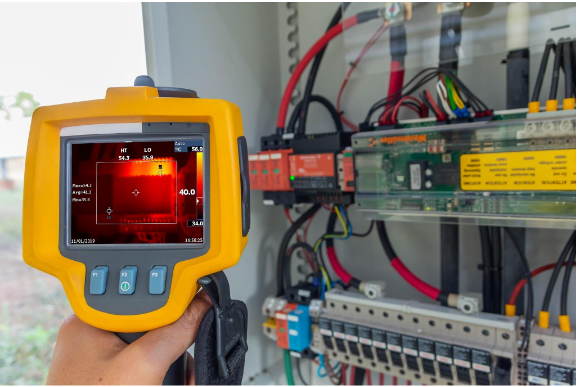
Infrared thermography plays an important role in preventive maintenance by identifying abnormal temperature patterns caused by loose connections, contact degradation, corrosion, or overloading. Conducting inspections while equipment operates under a representative electrical load helps technicians detect potential problems before they lead to equipment failure or unplanned downtime.
How Do Switchgear Fittings Support Proper Contact Alignment?
Good alignment doesn’t happen by accident. It’s the product of tight manufacturing tolerances, careful assembly, and well-maintained switchgear fittings that position the breaker consistently every time it’s racked into the cell. Fittings that control the rail geometry, guide pins, and mounting hardware all play a role in ensuring the breaker’s contact pin meets the tulip fingers squarely, with even pressure distributed across every contact point.
Quality control for these fittings typically involves dimensional inspection during manufacturing, resistance testing with a micro-ohm meter to confirm consistent contact resistance across units, and physical alignment checks during both installation and routine racking cycles. Maintenance teams can catch early signs of drift by monitoring contact resistance trends over time and pairing those readings with periodic thermographic scans. Best practice also calls for inspecting spring tension in the tulip fingers during scheduled outages, since a loss of tension, whether from age or heat exposure, is one of the clearest precursors to the misalignment cycle described earlier.
These checks matter most for facilities operating VCB assemblies continuously under high load, where even brief lapses in alignment translate into measurable heat and wear over time.
Precision Today Protects Equipment Tomorrow
Tulip contact alignment might seem like a minor mechanical detail buried deep inside a switchgear cell, but its effects ripple outward into equipment longevity, safety, and total cost of ownership. Misalignment drives up resistance, generates heat, and sets off a wear cycle that shortens the service life of components that are otherwise built to last decades. Catching these issues early, through resistance testing, thermography, and routine alignment checks, costs far less than dealing with unplanned downtime later.
Smart VCBs with self-monitoring diagnostics are already emerging as a response to this demand, but even the most advanced breaker still depends on a sound mechanical connection at the primary disconnect. Prioritizing precision engineering and disciplined maintenance at the tulip contact interface remains one of the most cost-effective ways to protect that investment over the long haul.
Previously in Technology: How to Create a Custom Tesla Wrap With AI: From Prompt to 3D Preview