

India's Growing Focus on Operational Excellence
As Indian businesses prepare for the challenges and opportunities of 2027, organisations are increasingly focusing on operational efficiency, cost optimisation, quality improvement and customer satisfaction. In this evolving business environment, professionals with Lean Six Sigma Black Belt skills are expected to remain valuable across multiple industries.
Companies are no longer looking only for employees who can manage routine operations. They need professionals who can analyse complex problems, improve processes, reduce operational waste and deliver measurable business results. This is where Lean Six Sigma Black Belt professionals can make a significant difference.
Lean Six Sigma combines the principles of Lean management and Six Sigma methodology to eliminate waste, reduce process variation and improve overall performance.
Why Will Lean Six Sigma Black Belt Professionals Be in Demand in 2027?
Several business priorities are expected to support the demand for skilled process improvement professionals.
1. Greater Focus on Cost Reduction
Organisations are continuously looking for ways to reduce operating costs without compromising quality. Lean Six Sigma professionals use data-driven methods to identify inefficiencies, minimise defects and improve resource utilisation.
2. Increasing Demand for Data-Driven Decisions
Businesses increasingly rely on data to make operational and strategic decisions. Black Belt professionals are trained in statistical analysis, root cause analysis, process capability and performance measurement, enabling them to convert data into practical improvements.
3. Digital Transformation and Automation
As organisations adopt AI, automation and digital technologies, they also need professionals who can identify processes suitable for improvement and ensure that technology delivers measurable value. Lean Six Sigma provides a structured approach to evaluating and improving these processes.
4. Continuous Improvement Culture
Companies are moving towards structured continuous improvement programmes. Professionals who can lead improvement projects, engage teams and demonstrate measurable results are valuable contributors to business transformation.
Industries Creating Opportunities for Lean Six Sigma Professionals
Lean Six Sigma skills are applicable across industries, making the certification relevant to professionals from diverse educational and career backgrounds.
- IT and IT Services: Process optimisation, service delivery improvement, incident management and operational efficiency.
- Manufacturing and Automotive: Defect reduction, production efficiency, quality improvement, waste elimination and supply chain optimisation.
- Banking and Financial Services: Faster transaction processing, reduced errors, improved customer experience and streamlined operations.
- Healthcare and Pharmaceuticals: Improved patient processes, quality management, compliance and operational efficiency.
- Consulting and Business Services: Process transformation, business excellence, operational audits and improvement consulting.
These sectors provide potential career opportunities for professionals who can combine industry knowledge with structured problem-solving capabilities.
Career Opportunities After Lean Six Sigma Black Belt Certification
A Lean Six Sigma Black Belt certification can strengthen a professional's profile for roles involving process improvement, quality and business transformation.
Potential job roles include:
- Lean Six Sigma Black Belt Consultant
- Continuous Improvement Manager
- Operational Excellence Manager
- Process Improvement Manager
- Quality Manager
- Business Excellence Consultant
- Process Transformation Lead
- Project Manager
Actual opportunities depend on professional experience, industry knowledge, project exposure and the ability to demonstrate measurable improvement results. Certification alone does not guarantee a particular role or salary.
The Role of AI and Analytics in Lean Six Sigma
The integration of Artificial Intelligence, automation and business analytics is changing how organisations identify and solve operational problems.
In 2027, Lean Six Sigma professionals who understand both process improvement and digital tools may have an additional advantage. AI-powered analytics can support pattern identification, predictive insights and faster data analysis, while Lean Six Sigma provides the framework for validating problems and implementing sustainable solutions.
Combining tools such as Minitab, Power BI and AI-enabled analytics with the DMAIC methodology can help professionals make more informed improvement decisions.
Skills Professionals Should Develop
To build a strong Lean Six Sigma Black Belt profile, professionals should focus on practical knowledge of:
- DMAIC (Define, Measure, Analyse, Improve and Control)
- Statistical analysis and hypothesis testing
- Root Cause Analysis and process mapping
- Failure Mode and Effects Analysis (FMEA)
- Design of Experiments (DOE)
- Process capability and Statistical Process Control (SPC)
- Project management and stakeholder engagement
- Data interpretation and business performance measurement
The ability to lead improvement projects and deliver documented business benefits is particularly important.
Choosing the Right Lean Six Sigma Black Belt Certification
Professionals considering a Lean Six Sigma Black Belt certification in India should evaluate the programme beyond the certificate itself. Important factors include trainer experience, practical case studies, statistical tools, project-based learning, assessment methods and the credibility of the certification process.
A programme that connects theoretical concepts with real business applications can help participants develop the confidence to lead improvement initiatives within their organisations.
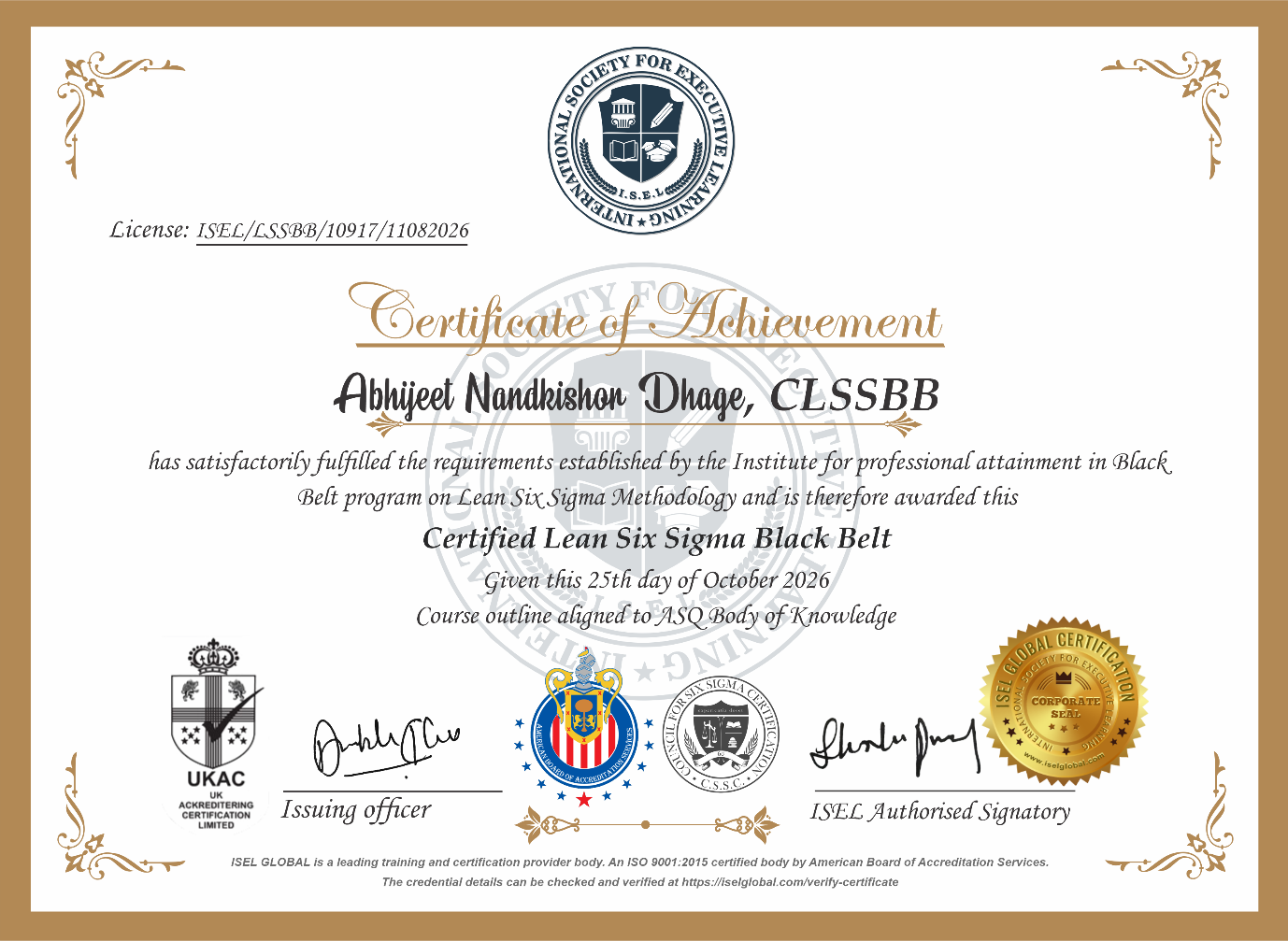
ISEL GLOBAL: Developing Future-Ready Professionals
ISEL GLOBAL (The International Society for Executive Learning) provides professional certification programmes and corporate training in Lean Six Sigma, Quality Management, Project Management and Operational Excellence.
Its Lean Six Sigma programmes focus on structured learning, practical applications, statistical tools and real-world business scenarios. The objective is to help professionals understand improvement methodologies and apply them effectively in their workplace.
As Indian organisations continue to prioritise productivity, quality and operational excellence, developing strong process improvement capabilities can be an important step in professional growth.
Conclusion
The Indian job market in 2027 is expected to place continued importance on professionals who can improve business performance, reduce inefficiencies and support digital transformation. Lean Six Sigma Black Belt skills align with these priorities by combining analytical thinking, structured problem-solving and project leadership.
For professionals seeking to strengthen their careers in quality, operations, consulting or business excellence, developing Lean Six Sigma capabilities can be a valuable investment.
Explore Lean Six Sigma certification programmes with ISEL GLOBAL.
ISEL GLOBAL – Learn. Apply. Improve.