A medical spa can generate more inquiries this month than last month and still have no clear picture of growth. How many prospects received a reply? How many booked a consultation, attended it and became patients? If those answers sit in separate inboxes, calendars and practice systems, lead volume tells only part of the story. In 2026, the more useful question is whether a clinic can move each inquiry through a reliable, measurable process. That is why automated conversion systems are becoming a growth priority for aesthetic practices.
Growth Is Becoming a Conversion Problem, Not Just a Lead-Volume Problem
Advertising can fill the top of a funnel. It cannot ensure that someone answers a message, offers a suitable appointment or follows up when a prospect goes quiet. For a medical spa or plastic surgery practice paying to attract inquiries, each missed handoff can waste part of that acquisition spend. Increasing the advertising budget while leaving those gaps intact may produce a larger list of contacts without producing more patients.
Conversion efficiency measures what happens after the inquiry arrives. A clinic needs to distinguish a captured lead from a reached prospect, a booked consultation from an attended one, and an attended consultation from a new patient. Those transitions matter more than a single headline lead count. They also reveal where an operational change might have greater value than another campaign: faster replies, clearer scheduling or better follow-up after an initial conversation.
This changes the role of medical spa automation. The goal is not to send more messages indiscriminately. It is to make the next appropriate step visible to staff and timely for the person considering care. A practice that understands where prospects stop progressing can make a more informed decision about both marketing spend and front-desk capacity.
Where Manual Follow-Up Breaks the Patient Journey
An inquiry might arrive through a website form, phone call, text message or social account. When each channel has its own queue, staff must piece together the conversation while handling appointments and patients already in the clinic. A message received outside office hours may wait. A prospect who hears nothing may continue looking elsewhere. Even when a staff member responds, an unrecorded conversation can leave the next shift unaware of what was promised.
An AI concierge can take on a narrow, useful part of that work. It can acknowledge an inquiry, handle routine questions within approved boundaries, offer booking options and direct a complex request to a person. Immediate acknowledgment gives the prospect a clear next step; it does not mean that software should assess symptoms, recommend a treatment or make promises about outcomes. Staff need an obvious way to take over when a conversation becomes clinical, sensitive or unusual.
Follow-up also requires judgment. A reminder after an unanswered inquiry may help, but repeated messages without regard to the prospect’s response can damage trust. The stronger workflow records what happened, stops or changes messages when someone replies, and assigns ownership of the next action. Automation supports a high-touch experience when it makes human attention easier to deliver at the right moment.
Connecting Marketing Data to Clinical Systems
The technical challenge begins when a lead books. A marketing platform may record the source and conversation, while scheduling or practice software records whether the person attended. If the two systems cannot reconcile those events, the clinic may count a booking as a success without knowing whether it became a consultation or a patient. A useful CRM therefore acts as an operational layer between acquisition channels, staff communications and the systems that record appointments.
This is the role addressed by the Aesthetix CRM growth engine. Built for aesthetic practices, it brings conversations into a shared inbox and combines a lead pipeline with follow-up automation. Its AI concierge can respond to inquiries and send booking options. Those functions address the transition from lead to patient, but their value depends on how well the clinic’s workflow and data connections are configured.
Practice software varies across clinics. Zenoti and Nextech are examples of existing practice systems a clinic might need to connect with its CRM, not universal requirements. The practical question is which information needs to move between the tools already in place. An appointment status, for example, may be needed for reporting, while clinical notes have no reason to appear in a marketing conversation. Teams should define which system owns each status, how duplicate contacts are resolved and who checks failed handoffs.
Generic CRM software may be flexible, but it can require more work to represent consultations, patient status and the communications patterns of an aesthetic clinic. Vertically focused tools can make those workflows easier to organize. The choice still rests on the same tests: whether the data model fits the practice, whether integrations support the required handoffs and whether staff can use the system consistently.
Automation Within HIPAA Boundaries
Connecting conversations to patient records raises a second design question: what data should the conversion system receive? For a U.S. practice subject to HIPAA, a vendor that creates, receives, maintains or transmits protected health information on its behalf may be a business associate. The U.S. Department of Health and Human Services guidance on business associates explains the role of a business associate agreement and the obligations that accompany it. Calling a product a HIPAA-compliant CRM is not a substitute for examining the actual data flow and contractual relationship.
A clinic should map what enters forms and messages, where it is stored, which employees can see it and which vendors receive it. Access controls and appropriate safeguards matter, as do procedures for handing clinical questions to qualified staff. An automated reply about appointment availability is a different task from evaluating a patient’s medical history. Keeping that boundary clear protects both the patient experience and the practice’s workflow.
Marketing measurement deserves the same scrutiny. According to HHS guidance on online tracking technologies, some uses of website or app tracking can disclose protected health information to a vendor and trigger HIPAA obligations. A privacy notice alone does not resolve whether a particular disclosure is permitted or whether a business associate agreement is required. Before connecting advertising tools, forms, messaging and clinical systems, a practice needs to assess what information each connection exposes. Privacy is part of the conversion architecture, not a review to leave until after deployment.
Measuring Growth Through the Full Funnel, Not a Single Touchpoint
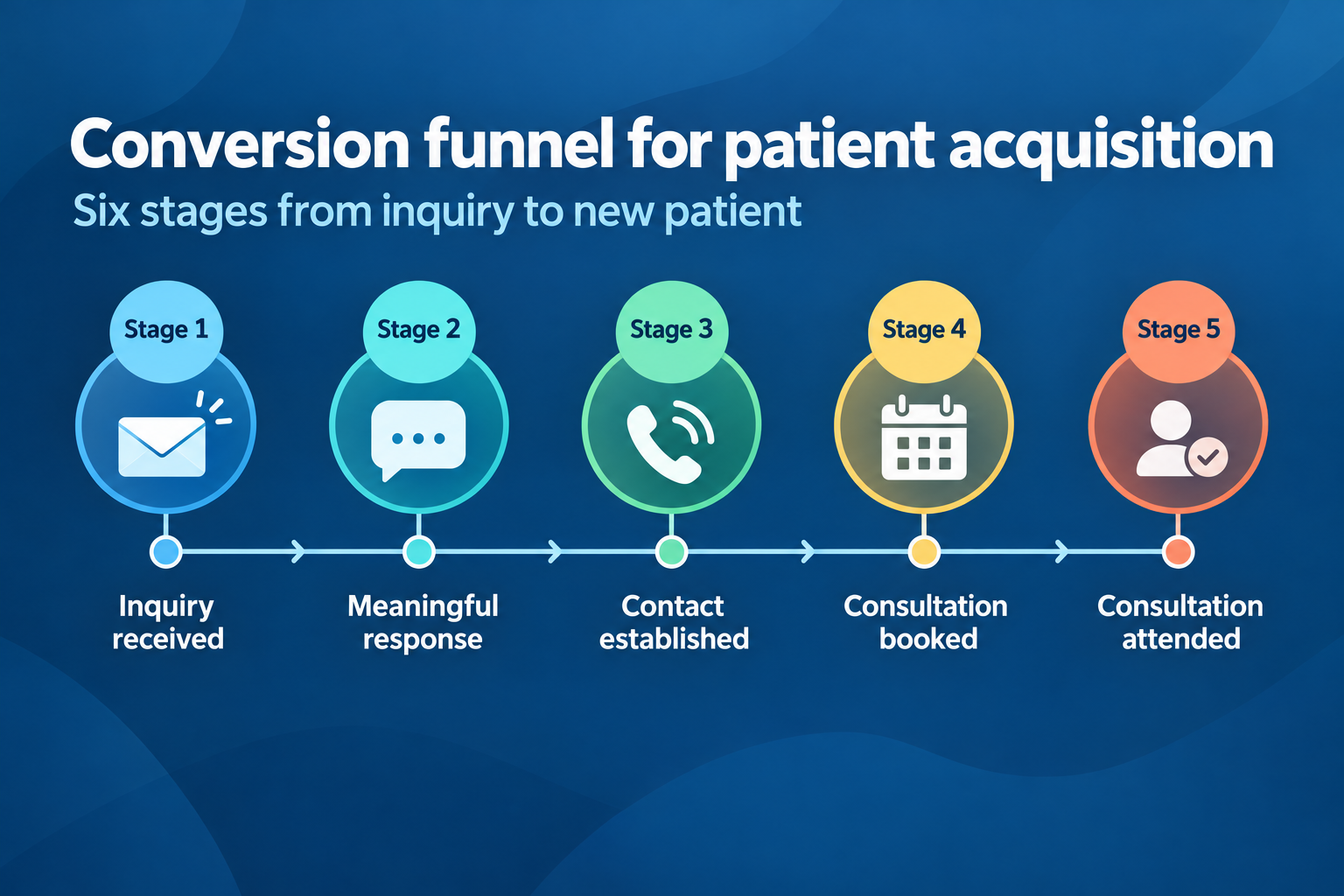
Once the handoffs are defined, reporting can move beyond leads and bookings. A practical funnel records when an inquiry arrived, when it received a meaningful response, whether contact was established, whether a consultation was booked and attended, and whether that person became a patient. Looking at the time and drop-off between stages helps a clinic separate a campaign problem from a follow-up problem. It also makes medical marketing ROI less dependent on assumptions about what a lead is worth.
Attribution needs care. First-touch data can show how a prospect initially found the practice; last-touch data can identify a later interaction before booking. Neither view, by itself, explains every influence on the decision. A referral may follow an advertisement, and one person may contact the clinic through several channels. Duplicate records, missed calls and inconsistent status updates can distort even a well-designed dashboard. Aesthetix CRM’s pipeline features help organize lead stages, while the practice remains responsible for checking whether they match real appointment and patient outcomes.
The most useful starting point is a shared definition of each funnel stage. Marketing, front-desk and clinical teams should agree on what counts as a reached lead, a booked consultation and a new patient, then check that those statuses are updated across their systems. Regularly reviewing unanswered inquiries and consultations that did not proceed can show where to improve the process. Sustainable aesthetic practice growth is less about collecting every possible lead than about responding appropriately, protecting patient information and learning what happens after the first click.
Infographic