
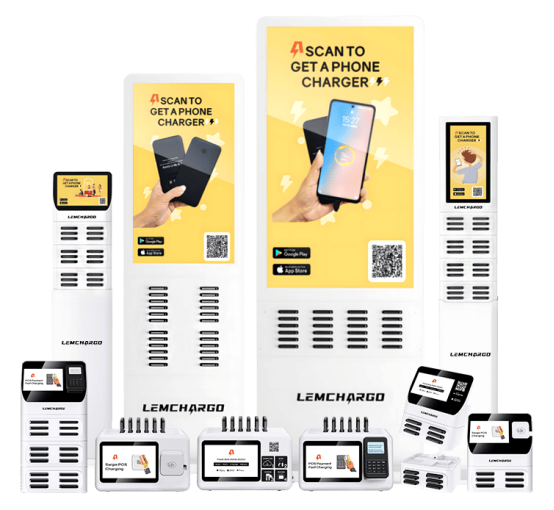
In the rapid development of the Internet, mobile phone have become an indispensable part of people’s lives. However, the problem of limited mobile phone battery life has always troubled users, sharing charging treasure came into being, solving the urgent problem of people going out when the phone is out of power. So, what kind of technology principle does the shared Power bank rely on to realize its convenient charging service?
The Components of the Shared Power Bank
From the perspective of the overall structure, the shared power banks’ system is mainly composed of two major parts: Hardware and Software, which work together to support the core functions of the shared power banks, such as borrowing and returning, charging, billing, etc., which makes the shared power banks’ system able to operate stably in the complex and changing market environment, provide users with convenient and efficient charging services, and at the same time create considerable economic benefits and social value for the operating companies.
At the hardware level, its structure mainly consists of charging equipment and charging cabinet machine. As for the software system, it mainly covers client APP (or small program), operation management system (merchant management background) and cloud server. All the links work closely together to promote the operation of shared power banks.
1.Hardware Structure Part
(1)Charging Device
Taking LemChargo as an example, the power bank (body) serves as the core component. Its hardware composition shares similarities with ordinary power banks, but it has undergone special designs for shared scenarios. For instance, intelligent communication modules and encrypted interfaces are added to adapt to needs such as scanning codes for rental and remote management.
- Battery: Adopts high-density lithium-ion battery with a capacity of 5,000-10,000 mAh, which is the key component for storing electricity and providing energy for charging mobile phones and other devices.
- Circuit Board: Integrated charge management chip (controls battery charging and discharging), MCU micro-controller (handles communication and logic), communication module (Bluetooth/Wi-Fi/4G), and safety protection circuit(overcharge, over-discharge,and short circuit protection).
- Cable Interface: Comes equipped with Type-C, Lightning, Micro-USB interfaces,compatible with mainstream mobile phones, adapted to a variety of electronic devices with different interfaces.
- Shell Design: Fireproof and drop-proof materials are used to ensure durability and safety. QR code is usually printed on the shell for users to scan the code.
(2)The Hardware of Charging Cabinet
As the core carrier for the storage and charging of shared power banks, the charging cabinet has a subtle and fully functional internal design, which provides a solid guarantee for the efficient operation of shared power banks.
Charging slots: Each slot is equipped with a charging port (e.g. USB-A or Type-C) for charging the power banks. The slots are equipped with mechanical looks to control the borrowing and returning of power banks.
Locking structure: The charging cabinet adopts advanced locking technology, which is mainly used to realize the fixing and releasing of the power banks through electromagnetic lock or motor drive. Strong suction force is generated when power is energized to lock the power banks firmly in the slot; the suction force disappears when power is cut off, which is convenient for users to take out.
Main control board system: Responsible for managing the status of all slots (idle, occupied, charging), communicating with the power banks,and handling user requests for borrowing and returning. Built-in a variety of sensors for real-time detection of the power banks insertion status, power and location information.
Power supply module: It is one of the core components of the charging cabinet, which can provide stable and reliable power supply for the power banks to ensure the safe charging of the power banks.
Display and interaction module: In order to enhance the user experience, the charging cabinet is equipped with an intuitive display and interaction module. For example the indicator light, which is used to display operation prompts, power information and so on.
2.Software System Architecture
In addition to the hardware part, the software system of the shared power bank is also crucial. The software system of shared power bank mainly includes three parts: client’s APP (or small program), operation management system and cloud server. The collaborative work between the parts is realized through advanced algorithms and communication technologies.
(1)Client’s APP (Or Small Program)

The client is the window for users to interact with the shared power banks. By downloading the APP or using the applet, users can conveniently find nearby power bank stations, check the real-time status of the power bank (e.g., power level, number of rentable items, etc.), and carry out the operation of renting and returning.
The client is the window for users to interact with the shared power banks. By downloading the APP or using the applet, users can conveniently find nearby power bank stations, check the real-time status of the power bank (e.g., power level, number of rentable items, etc.), and carry out the operation of renting and returning.
Scanning operation: Users can scan the QR code on the charging cabinet through APP (Or small program) to quickly complete the identity verification and borrowing/returning process. The whole operation process is simple and fast, without cumbersome procedures, which greatly saves users’time.
Cost inquiry and payment: During the borrowing and returning process,the APP (or small program) will display real-time information such as the length of time the power bank has been used and the cost details, so that users can clearly understand the consumption situation.At the same time, it supports a variety of convenient payment methods, so users can choose the appropriate payment method to complete the expense settlement according to their own habits.
Feedback and evaluation of users: Provide a service evaluation and feedback portal,where users can evaluate and give feedback on the performance of the power banks, the maintenance of the counter and the overall service experience after use, and the operator will optimize the service and improve the satisfaction in turn.
(2)Merchant Management Background

Merchant management system is an important tool for daily management and decision-marking of the shared power bank operation team, which realizes comprehensive monitoring and efficient management of the shared power banks business by integrating a variety of functional modules.
- Equipment monitoring and maintenance: Real-time monitoring of charging cabinet and charging power bank status (power, failure, etc.), abnormal automatic alarms and push to the operation and maintenance end to ensure stable operation of the equipment.
- Data analysis support: The system collects and analyzes a large amount of user data, equipment data and transaction data, and provides comprehensive business reports and visualization charts for operation personnel through advanced data analysis algorithms.
- Order management and scheduling: Full-process tracking of borrowing and returning orders, combined with equipment distribution and user demand, intelligent scheduling of power banks distribution and recovery to improve utilization and reduce costs.
(3)Cloud Server
As the data hub of the whole software system, the cloud server undertakes the important responsibilities of data storage, processing and interaction, and provides powerful support for the client APP(or applet) and operation management system.
- Massive data storage: The cloud server has powerful storage capacity and can safely and stably store massive user data, device data and transaction data.
- Efficient data processing: High-performance computing cluster processes loan and return requests, equipment monitoring and operation statistics in real time, responding in milliseconds and synchronizing the results to the client and system side.
- Secure data interaction: Through advanced encryption technology and security protocols, the cloud server ensures the security of data transmission between various parts. No full-link protection of user-client-system-quipment data transmission against the risk of tampering and leakage.
- System expansion and upgrade: The could server has good scalability and flexibility, and can be expanded and upgraded at any time according to the development needs of the business, to match the business scale growth and functional iteration needs.
Concludion
The technical priciple of power banks is the organic integration of hardware, software and communication technology. It is also a comprehensive embodiment of the Internet of Things + Mobile Payment + Intelligent Hardware. It is the synergistic effect of these advanced technologies that makes the power banks able to provide people with convenient, efficient and safe charging services. With the continuous progress of science and technology, I believe that the shared power banks will continue to innovate and improve its functions and services, and bring more convenience to people’s lives.