
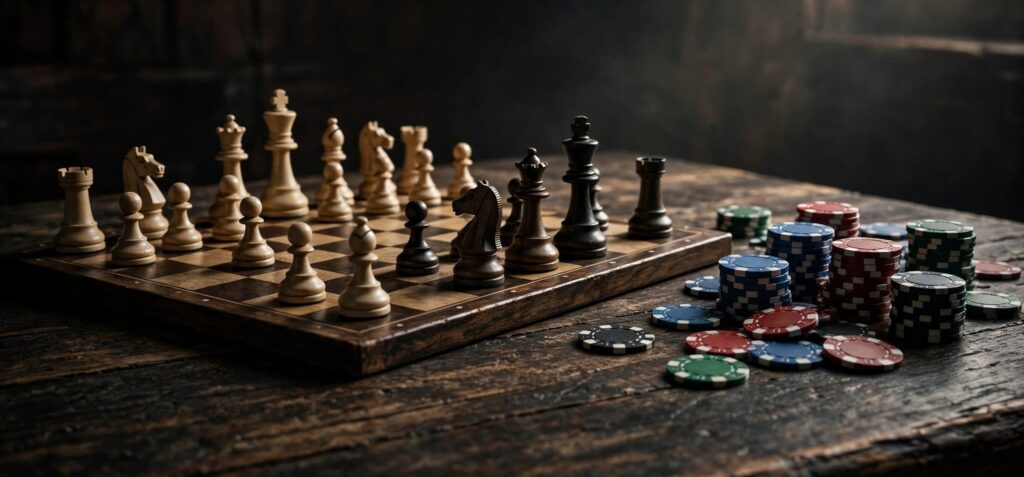
Human behavior becomes easier to read when the pressure is clear. Put someone in front of a chessboard, a poker table, or a hard personal decision, and familiar patterns appear fast: the need for control, the discomfort of uncertainty, and the habit of judging choices by results alone. These settings expose how people think when information is complete, when part of the picture is missing, and when emotion enters the process.
Seen together, poker, chess, and ordinary choices offer a practical model of how people reason under different forms of pressure.
How predictability and hidden information shape judgment
Chess and poker illustrate how people handle predictability, uncertainty, hidden information, and the emotional pressure of making decisions. Chess operates with complete information. Every piece is visible, and outcomes depend on the players' decisions rather than chance. Poker works differently, as hidden cards, changing probabilities, and unpredictable outcomes mean that even a well-considered decision can lead to a loss.
In poker, players must assess incomplete information, interpret opponents' behavior, and make decisions without knowing the final outcome. This requires managing uncertainty rather than trying to eliminate it. The emotional challenge comes from accepting that good decisions do not always produce immediate rewards. John von Neumann, one of the founders of game theory, argued that real-life decisions resemble poker more closely than chess because people rarely have access to all the information they need.
This relationship between information, uncertainty, and decision-making has become more noticeable as poker has moved onto online platforms. Traditional poker requires players to interpret physical behavior and control the pace of their decisions, while online formats place greater emphasis on betting patterns, timing, and available game information.
Mobile applications have extended this change by making games accessible outside traditional playing environments. On Unibet Apps, this development is reflected in the availability of poker and other gaming formats on mobile devices, where decisions are made through digital interfaces rather than across a physical table. The underlying uncertainty remains the same, but the way players receive information and respond to it has changed.
Why outcome bias distorts everyday thinking
Many poor judgments begin after the decision is already over. People tend to rate a choice by what happened next, even when the original reasoning was solid. Annie Duke, in Thinking, describes this habit as “resulting.” It is the tendency to treat a good outcome as proof of a good decision and a bad outcome as proof of a bad one. That shortcut feels natural because the mind prefers neat cause and effect, yet it often produces false lessons.
Everyday life is full of this error. A person may take a reckless action and face no immediate cost, then assume the choice was sound. Someone else may build a careful business plan, test assumptions, and act with discipline, only to be derailed by a supply shock outside their control. Public reaction usually follows the result, not the quality of thought behind it. That response rewards luck and punishes process.
Poker offers a cleaner way to think. A strong decision should be judged by the information available at the time, the logic behind the move, and the probability it carried over many repetitions. People who adopt that view become less impulsive after setbacks and less overconfident after short-term success. The result is better judgment across work, money, and relationships.
What pressure reveals about emotion and self-control
Pressure exposes habits that remain hidden in calm moments. Chess pressure often builds slowly. A player can see the threats, calculate responses, and still make an error because time, fatigue, or ego narrows attention. Poker pressure is more uneven. It forces decisions before certainty arrives, then asks the player to live with outcomes that may look unfair in the short run. Both settings show that emotion does not replace logic; it disturbs access to it.
This matters because most everyday choices carry the same tension. People know the sensible action but delay it after a loss, a rejection, or a surprise. Others become rigid after one bad outcome and start protecting themselves from uncertainty at any cost. Behavior under stress often comes down to tolerance for ambiguity. Some people stay steady when the evidence is incomplete. Others rush to close the gap, even if the answer they choose is weak.
Emotional control, then, is less about suppressing feeling and more about keeping decision quality intact while feeling it. That skill can be trained. Reviewing choices after the fact, separating process from result, and noticing recurring triggers all help. The person who can stay clear under pressure gains an advantage in any uncertain environment.
How risk changes the way people assign meaning
Risk changes behavior because it changes the story people tell themselves. In chess, mistakes often feel personal because the board is visible and the error can be traced. In poker, the same human need for meaning has less stable ground. A strong move may fail, a weak one may succeed, and the mind quickly starts inventing explanations. That search for certainty is deeply human. People want events to feel deserved, ordered, and interpretable.
Outside games, the same pattern shapes careers, investing, and personal plans. When outcomes are noisy, people often overrate confidence, charisma, or short-term wins. They may follow someone who sounds sure rather than someone who thinks in probabilities. They may also abandon a sound strategy too early because a few early results look disappointing.
In uncertain systems, patience becomes a cognitive skill, not a passive trait. The person who understands risk is less likely to panic during setbacks and less likely to build false certainty from temporary gains.
What better decisions look like in real life
Better decisions rarely come from perfect prediction. They come from clear framing, honest assessment, and repeated adjustment. Chess teaches the value of structure, planning, and direct accountability. Poker teaches the value of flexibility when part of the picture is hidden. Everyday life asks for both. People need rules for stable situations and probability-based thinking for uncertain ones.
A practical decision-maker asks a few grounded questions. What do I know for sure? What remains hidden? Which part of the outcome is under my control, and which part depends on chance? That approach reduces emotional noise and improves consistency. It also makes failure easier to study because the person is no longer treating every setback as proof of personal error.
Human behavior becomes more understandable when seen through these three settings. People want fairness, predictability, and control, yet much of life refuses to offer all three at once. The strongest response is neither rigid certainty nor passive acceptance. It is the ability to think well with limited information and keep doing so when the result is still unknown.
Previously in Technology: How AI Is Helping Teachers Catch Learning Gaps Before the Next Lesson