
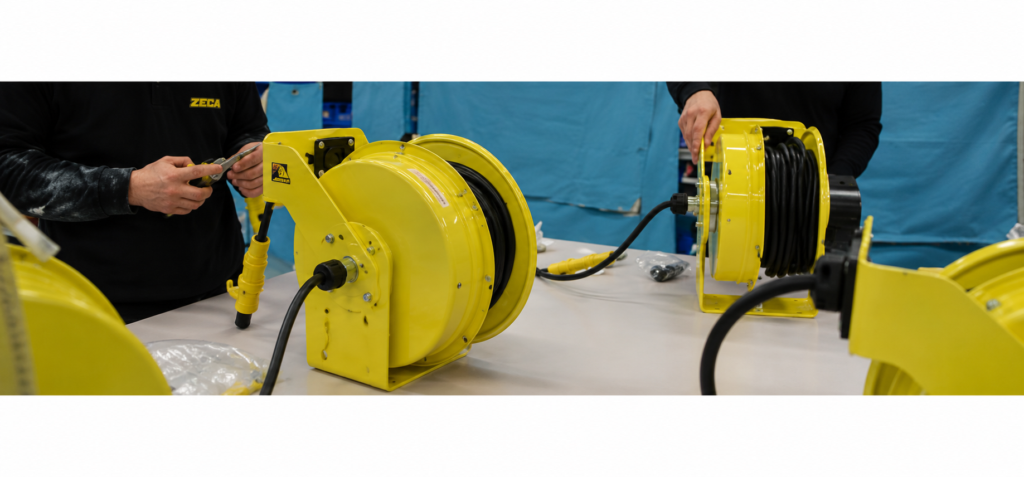
If you enter a serious industrial sourcing discussion, certification will be one of the first topics raised. In manufacturing, aviation, oil and gas, and construction, a heavy-duty extension cord reel without proper documentation can create challenges during equipment reviews, facility audits, and procurement verification processes. Cord reel manufacturer certifications help buyers separate documented industrial equipment from generic claims
The term ‘heavy duty’ is commonly used across the industry, but certifications and documented specifications provide a more objective basis for evaluating equipment. A reel may seem sturdy, have an attractive amp rating on its label, and at the same time, be incapable of meeting the independent safety standards that regulated industries require. Here is what a complete documentation set looks like, and why each layer earns its place.
NEMA Ratings: The Environmental Baseline
One of the first specifications to review for industrial cord reel compliance is the enclosure’s NEMA rating. The rating informs you precisely which environmental risks the cover has been experimentally verified to withstand, including moisture, dust, and corrosive agents.
The three ratings you will most often encounter in industrial purchasing are:
- NEMA 2: Indoor locations with light dripping water or condensation. Practical for controlled warehouse and manufacturing environments where moisture exposure is minimal.
- NEMA 4: Indoor and outdoor use with protection against windblown dust, rain, and hose-directed water. The standard for most outdoor job sites, construction environments, and utility operations.
- NEMA 4X: Everything NEMA 4 covers, plus corrosion resistance. Commonly specified for offshore oil and gas platforms, chemical processing facilities, naval shipyards, and anywhere salt air or aggressive cleaning chemicals are routine.
One thing worth knowing: A reputable cord reel manufacturer subjects their products to independent testing against these standards and can produce the documentation on request. Reputable manufacturers should be able to provide supporting documentation for the ratings they reference.
UL and ETL Certifications
Procurement departments requesting UL Certified cord reels are after one specific thing: evidence that the product has undergone independent testing against established safety standards. Safety is not just based on the manufacturer’s claims.
- Underwriters Laboratories (UL) evaluates cord reels for non-hazardous locations against UL 355, a standard tied to the National Electrical Code. Cord reels designed for hazardous locations fall under separate UL standards specific to those environments.
- This listing is not a one-time approval. UL carries out several factory inspections to consistently make sure the product meets the standards. In that way, a product with UL Listing remains accountable in a way that self-certification does not.
- ETL, administered by Intertek, is an equally valid alternative.
Both UL and ETL are Nationally Recognized Testing Laboratories (NRTLs) under OSHA’s designation program, and both test to identical standards.
For a cord reel manufacturer operating in North America, the practical question is not whether they chose UL or ETL. It is whether they chose either, and whether they can provide the specific listing documentation for the exact model you are purchasing.
CSA Certification: When Operations Cross the Border
For facilities or projects with any Canadian component, CSA-certified cord reels are the relevant standard. The Canadian Standards Association tests to Canadian Electrical Code requirements, which differ slightly from U.S. NEC requirements, particularly around flame performance.
Many manufacturers serving both markets pursue dual certification, reflected in markings like cULus (UL-certified for both U.S. and Canadian markets) or cCSAus (CSA-certified for both). If your supply chain spans the border, or might in the future, confirming dual certification upfront helps simplify future purchasing and deployment across both markets.
Class, Division, and Zone Ratings
Standard retractable cord reel safety standards do not apply in classified hazardous locations. In environments where flammable gases, combustible dust, or ignitable vapors may be present, such as petrochemical facilities, grain handling operations, paint booths, and pharmaceutical manufacturing, a standard cord reel may not be suitable for classified hazardous locations that require specialized equipment ratings.
Understanding the Classification System
The classification system works in layers:
- The Class identifies the nature of the hazard, gases and vapors, combustible dust, or ignitable fibers.
- The Division or Zone defines how frequently that hazard is present in the specific area.
- The Group specifies the exact substances involved within that class.
Explosion-proof cord reels designed for these environments contain any internal spark or fault within sealed enclosures, preventing ignition of the surrounding atmosphere.
Before a classified-location reel ships to your site, verify that the certification explicitly matches the Class, Division, and Group conditions at your specific installation point. A reel certified for Class I, Division 2 (flammable vapors present only under abnormal conditions) is not appropriate for a Class I, Division 1 area (flammable vapors present under normal operating conditions). Selecting the correct classification is an important part of matching equipment to the intended environment.
OSHA Compliance: Meeting Workplace Safety Guidelines
Among compliance and certification frameworks relevant to cord reel selection, OSHA functions differently from the rest. UL, CSA, and NEMA test or rate the equipment itself. OSHA regulates the workplace in which the equipment is used, including how flexible cords are deployed, inspected, and kept clear of walkways. Understanding this distinction helps buyers evaluate both the equipment itself and how it will be used within the workplace.
A UL-listed cord reel supports electrical safety documentation, while OSHA standards govern how flexible cords and related equipment are installed, used, and maintained. In practice, buyers should verify both the listing and the facility’s compliance requirements.
Beyond the Labels: Specifications That Confirm the Engineering
Certifications validate electrical safety, enclosure protection, and hazardous location rating, among other things. They do not tell the full engineering story. These additional specifications separate a product that was genuinely designed for industrial use from one that was assembled to a price point:
- Amperage rating: The reel must meet or exceed the peak draw of the connected load. Industrial configurations range from 15A for lighter tools through 20-25A ranges, up to 65A or more for heavy equipment. An undersized amperage rating can contribute to excess heat generation and reduced equipment lifespan over time.
- Cable gauge (AWG): The American Wire Gauge of the conductor determines safe current-carrying capacity across the full cord length. A manufacturer who documents specific AWG ratings for specific cord lengths has engineered the product. Clear documentation helps buyers evaluate whether the product is appropriate for the intended application.
- Enclosure material: Powder-coated steel enclosures outlast plastic alternatives in environments involving mechanical impact, chemical exposure, or heavy-use cycles. Ask specifically about construction material, not just the NEMA rating.
- GFCI protection: In wet environments, outdoor installations, or any location where shock risk is elevated, ground fault circuit interrupter protection is the first line of defense. It should appear as a documented specification, not an afterthought.
A manufacturer who documents all of these alongside their certification paperwork is demonstrating an engineering culture, not just a compliance posture. That distinction matters when a product is operating in a demanding environment two years after the purchase order closed.
A Practical Checklist Before You Approve a Supplier
Before finalizing any heavy-duty extension cord reel purchase for an industrial or commercial facility, these cord reel safety standards documents should be readily available from the supplier as part of the normal product evaluation process.
- NEMA rating documents for the specific enclosure rating claimed (NEMA 4 or 4X for demanding environments).
- UL or ETL listing documentation tied to the specific model number, not the product line.
- CSA certification if Canadian operations are part of the picture.
- Class, Division, and Group hazardous location certifications if your installation environment is classified.
- Complete product specification sheets, including amperage rating, AWG, cord length, and enclosure material.
- Documented warranty terms and replacement process.
A supplier who responds with organized, product-specific documentation shows you how they operate. Documentation transparency is often a useful indicator of a supplier’s overall approach to quality and product support.
The industrial cord reel market is not short of products. It is short of suppliers who treat documentation as seriously as they treat the product itself. A certified cord reel manufacturer shows its approach through organized documentation, clear support, and product-specific verification.
Frequently Asked Questions
-
Do all cord reels need a NEMA rating for industrial use?
For industrial and commercial applications, yes. NEMA ratings help define enclosure performance expectations for specific operating environments. Without it, you are relying on the manufacturer’s own word that the product will perform in your environment. In OSHA-regulated facilities, NRTL documentation supports the equipment side of a facility’s compliance posture. How the reel is installed and used remains governed separately by OSHA workplace standards.
-
What is the practical difference between NEMA 4 and NEMA 4X?
NEMA 4 guards against rain, water from a hose, and dust carried by the wind, and is a good match for the majority of outdoor and wet indoor environments. NEMA 4X adds corrosion resistance. It is therefore the right option for environments that have saltwater, harsh chemicals, or aggressive washdown procedures. If you are not sure about the corrosive exposure in your environment, specify 4X. The price difference between the two ratings is small compared to replacing a reel that fails early in a corrosive environment.
-
Is UL certification the same as ETL certification for cord reels?
Functionally, yes. Both UL and ETL are OSHA-recognized Nationally Recognized Testing Laboratories and test to identical safety standards. An electrical inspector treating ETL-listed equipment as inferior to UL-listed equipment would be applying the wrong standard. What matters is that the listing exists, that it is from an NRTL, and that it covers the specific model configuration you are purchasing.
-
Can a standard retractable cord reel be used in a classified hazardous location?
No. Standard retractable cord reels are not engineered or certified for classified hazardous environments. Using non-certified equipment in a Class/Division/Zone location creates an ignition risk and will not pass a compliance inspection. The reel must carry specific Class, Division, and Group certification matching the exact conditions at your installation point.