

By Joe Azoulay
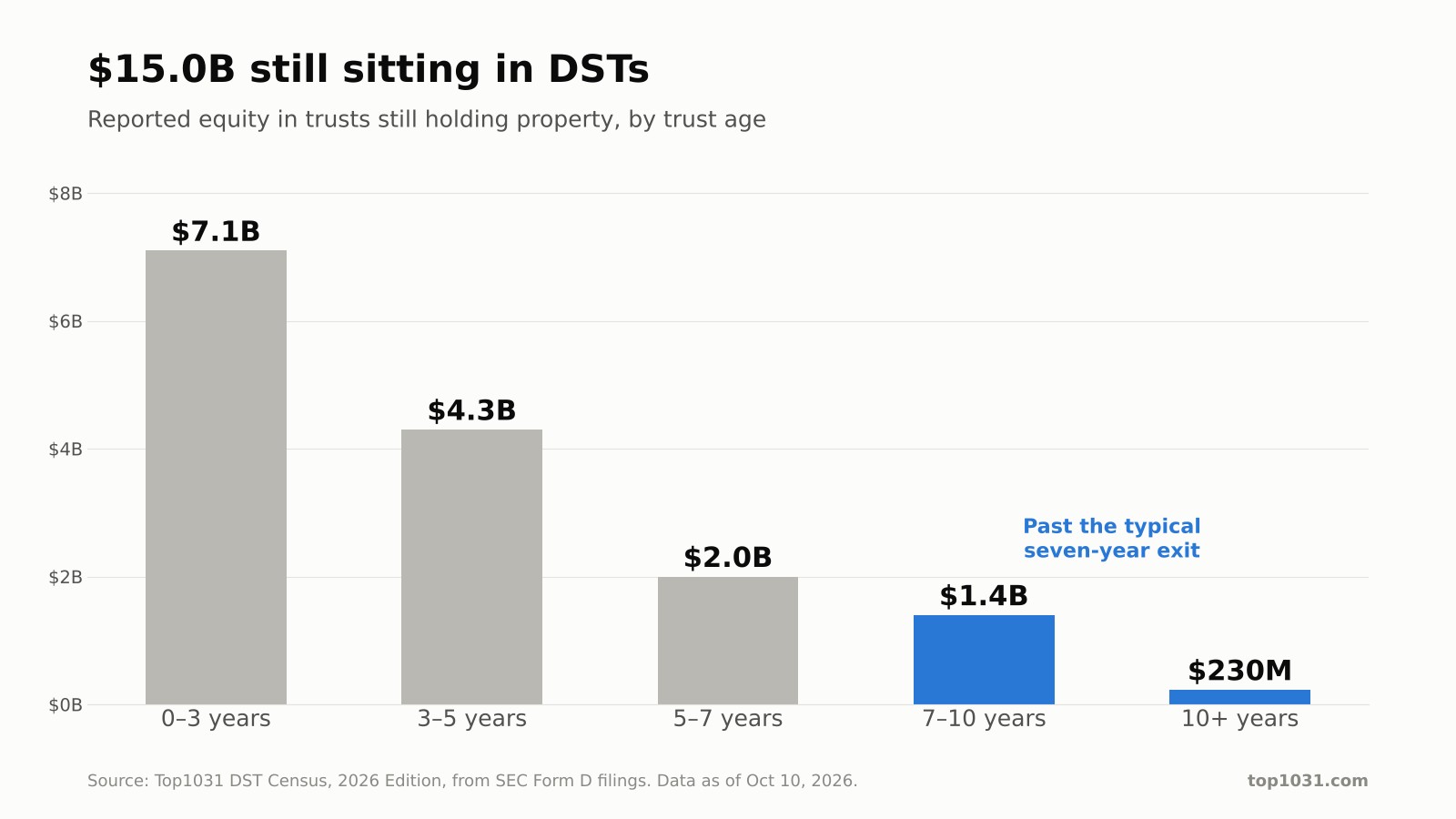
Reported equity in DSTs still holding property, by trust age. Source: Top1031 DST Census, 2026 Edition.
Delaware Statutory Trusts are one of the less visible parts of the real estate market. They are private placements, sold mostly to 1031 exchange investors, and the industry's best-known numbers have long come from surveys and sponsor reports. But every DST offering leaves a public trail: the Form D it files with the SEC. Count those filings carefully and you get a different, more granular picture.
That is what we set out to do. The result covers 1,749 securitized 1031 DST offerings since January 2009, drawn from 21,925 filings in the Form D record. Together they state $68.0 billion in offering amounts and report $39.7 billion sold across 75,361 investor commitments.
Public data is messy in specific ways
Form D was not designed as a market data feed, and building a census from it means handling its quirks explicitly.
First, Form D totals are a floor. Issuers are not required to amend a filing to report more sales, or to file at all after an offering ends. Any sum built from Form D undercounts.
Second, amendments can move numbers backward. When a later filing reports less sold than an earlier one, the census clamps that negative restatement to zero rather than letting it erase earlier fundraising.
Third, timing needs a rule. Equity is assigned to a trust's first-filed year for vintage analysis, while fundraising flows are assigned to each filing's date. Mixing the two produces numbers that look precise and are wrong.
Fourth, the universe is not obvious. Identifying DSTs meant screening 15,567 entities before arriving at the 1,749 offerings that qualify.
What the filings show
Fundraising: Filings reported $6.39 billion raised in 2025. An independent industry estimate puts the year closer to $8.4 billion, a gap that is consistent with
Dead launches: Of 1,482 trusts first filed at least 18 months ago, 28.3% never reported a dollar raised, and 41.1% sold less than a quarter of their target. The headline totals hide a long tail of offerings that barely got started.
Lifespans: Linking filings to outcome records lets you measure how long trusts really last. Among 164 mature trusts with a dated exit, the median was 6.2 years, against stated holds of up to ten.
The aging book: 599 trusts still operating or partly sold hold $15.0 billion of reported equity. Most of it is young: $7.1 billion in trusts under three years old. But $1.4 billion sits in trusts aged seven to ten years and about $230 million in trusts older than ten, the part of the market most exposed to refinancing pressure.
Why it matters
Private markets are often described as opaque. In this case, much of the data has been public all along. It just was not organized. Treating SEC filings as a dataset, with documented rules for the gaps, turns a market known mainly through marketing into one that can be measured, tracked edition to edition and checked by anyone.
The same approach extends further: geography from property records (Texas leads, and Sun Belt states hold 56% of located records), sponsor concentration over time, and how exits are shifting between property sales, REIT conversions and distress.
The full dataset, charts and methodology notes are published in the Top1031 DST Census, 2026 Edition, which is updated as new filings arrive.
Joe Azoulay is the CEO of Top1031.com, a free data and education site covering the 1031 DST market, built from SEC EDGAR filings.
Previously in Finance News: Forecasting IT Costs for 2027: A Finance Leader’s Guide to the Technology Budget